
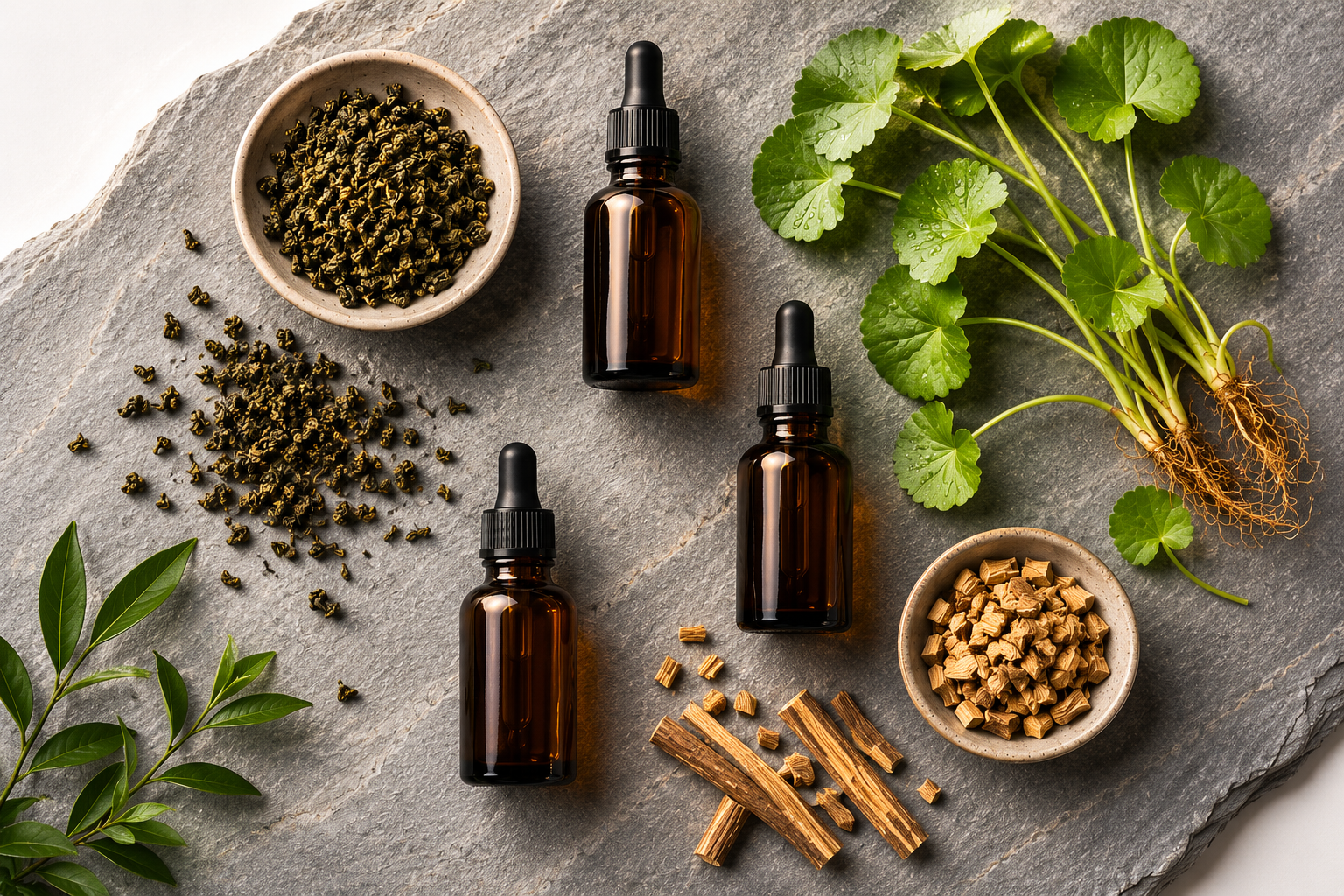
Botanical extracts in skincare appear on almost every product label sold today. Most brands list them prominently, but rarely explain what they are actually doing inside the formula. Understanding their functional role changes how you read an ingredient list — and whether a product is genuinely formulated or just well-marketed.
The Problem With How Botanical Extracts Are Marketed
When consumers see ingredients like green tea extract, centella asiatica, or licorice root on a label, they usually assume one of two things. Either the extract is the reason the product works — the hero ingredient. Or it is present to signal naturalness and justify a premium price.
Both assumptions are incomplete.
Common experiences that follow from this confusion:
- A product with an impressive botanical list performs no differently than a basic moisturiser
- Two products claim the same extract but produce completely different results on the skin
- Marketing leads with the botanical name without disclosing concentration, source, or standardisation
- The same extract appears in products targeting entirely different skin concerns
This is not the consumer’s fault. It is the result of marketing that leads with botanical identity rather than formulation logic. The truth about botanical extracts in skincare is more specific — and more useful — than most brands communicate.
The Science Behind Botanical Extracts in Skincare
Botanical extracts are concentrated preparations derived from plant material — roots, leaves, flowers, seeds, or bark. They are obtained through processes such as water extraction, solvent extraction, or supercritical CO2 extraction. The extraction method determines which bioactive compounds are captured and how stable they remain inside a finished formula.
What Plant Extracts Actually Contain
Botanical extracts are not single-molecule ingredients. They contain a complex mixture of bioactive compounds:
- Polyphenols — antioxidant compounds that help neutralise free radicals at the skin surface
- Flavonoids — plant pigments with anti-inflammatory and antioxidant properties
- Phenolic acids — smaller antioxidant molecules that support surface defence
- Terpenoids — aromatic compounds with anti-inflammatory or antimicrobial potential
This chemical complexity is both the strength and the formulation challenge of plant extracts. No two extraction batches are identical unless the extract is standardised to a defined active compound percentage.
How They Interact With Skin
Botanical extracts do not penetrate into deeper skin layers the way small actives like niacinamide or retinol do. Their primary functions occur at the skin surface or within the upper stratum corneum. Their roles include scavenging free radicals before they damage skin cells, modulating surface inflammatory signalling, and supporting the skin’s own antioxidant pathways. The mechanism is environmental defence and surface support — not direct cellular repair.
Formulation Logic — How Botanical Extracts Function Inside a Formula
Understanding what an extract does in isolation is not enough. The relevant question is what it does inside a complete formulation system.
Botanical extracts are not standalone actives. They function as part of a broader ingredient architecture. In well-designed formulas, they serve three primary roles.
Antioxidant protection within the formula itself. Many plant polyphenols help stabilise other unstable formula components — particularly unsaturated plant oils — by slowing oxidation during shelf life. This is a formulation stability function, not only a skin benefit function. A formula with well-chosen botanical extracts can maintain ingredient integrity longer than one without.
Calming and barrier tolerance support. Extracts such as centella asiatica and licorice root contain compounds that interact with inflammatory pathways at the skin surface. At appropriate concentrations, they help reduce sensitivity during and after cleansing or active ingredient use. This is particularly valuable in daily-use formulas designed for skin under environmental stress.
Sensory and stability integrity. A well-chosen extract blend contributes to overall skin feel, mild natural scent character, and colour stability — all of which affect how a product performs over its shelf life.
The point most blogs miss: concentration determines everything. An extract present at 0.01% performs a completely different function than the same extract at 1.5% or 3%. Marketing lists both identically. Formulation science does not. Extracts also require the right solvent environment — a water-soluble polyphenol behaves differently in a high-alcohol base than in a glycol-water system. The base architecture directly affects whether the extract can perform at all.
Practical Advice — Reading Botanical Extracts More Accurately
1. Check position in the INCI list. Ingredients are listed in descending concentration order. An extract appearing after the preservative system is present at a very low level and is unlikely to deliver meaningful functional benefit. Look for extracts positioned in the upper half of the list.
2. Prioritise standardised extracts. An extract labelled as “centella asiatica extract, 10% asiaticosides” is more likely to deliver consistent results than an unstandardised version. Standardisation means each batch delivers a defined concentration of the active compound.
3. Do not evaluate extracts in isolation. An antioxidant extract inside a poorly emulsified base will not perform well. The complete formulation system determines what the extract can do — not the extract name alone.
4. Morning routine. Antioxidant botanical extracts — green tea, turmeric-derived compounds — are most relevant in morning formulas. Their surface defence function is most valuable during daytime environmental exposure.
6. Treat botanical claims as a starting question, not a final answer. The presence of an extract on a label tells you what brand wants you to associate with the product. The concentration, standardisation, and formulation context tell you whether that association is earned.
Botanical Extracts in Skincare and Indian Climate Conditions
The Indian climate places specific demands on how botanical extracts perform and what functional role they need to serve.
Heat and UV exposure. In high-temperature environments, skin accumulates oxidative stress from UV radiation throughout the day. Antioxidant botanical extracts with polyphenol content — green tea, pomegranate, turmeric extract — provide surface defence support. The sweating that accompanies heat also increases cleansing frequency, which reduces the duration of leave-on extract contact with skin, making concentration and delivery system more critical.
Urban pollution. In cities with high PM2.5 loads — which includes most major Indian metros — airborne particulates settle on the skin surface and trigger oxidative stress. Botanical extracts with strong antioxidant profiles are particularly relevant here because they intercept surface-level free radical activity before it reaches deeper skin structures. Pollution exposure is daily and cumulative, which means morning antioxidant support is not optional for urban skin.
AC environments and dehydration. Air-conditioned spaces significantly reduce ambient humidity and accelerate transepidermal water loss. Botanical extracts with complementary surface-soothing properties — aloe vera, centella asiatica — support skin comfort in these environments. Their primary function is not hydration directly; that comes from humectant systems. But they reduce the surface irritation that follows barrier cycling between humid outdoor air and dry indoor air.
Monsoon humidity transitions. Moving repeatedly between high outdoor humidity and low indoor humidity stresses the skin barrier in a particular way. Calming botanical extracts help moderate the low-grade inflammatory response that accumulates over time from this repeated barrier cycling — reducing background redness and sensitivity even when no single event triggered it.
Hard water. Many Indian cities have high mineral content in tap water. Mineral residue left on the skin surface after washing can compound surface dryness and sensitivity. Botanical extracts with antioxidant and calming profiles help offset some of these surface effects when incorporated into daily leave-on formulas applied after cleansing.
At Nature Theory, botanical extracts are selected based on their functional role within the complete formula — antioxidant defence, barrier calming, or tone stabilisation — rather than for label positioning. Each extract is standardised to a defined active marker where possible and integrated into a formulation architecture designed for daily use in Indian climate conditions. The extract selection aligns with the lipid and humectant system of each product rather than being added independently. This integration is what allows botanical extracts in skincare to perform their intended function rather than serve as decorative listings.
Summary
Botanical extracts in skincare are functional tools — antioxidant, calming, and stabilising — that work at specific concentrations within a complete formulation system. Their performance depends on standardisation, concentration, solvent environment, and the quality of complementary ingredients around them. The position of an extract on a label tells you very little without knowing why it is there and at what level. The core principle applies to every extract in every product: if it cannot be explained, it probably has not earned its place.
Frequently Asked Questions
Do botanical extracts in skincare actually work or are they just marketing? They work when present at functional concentrations inside well-designed formulations. The problem is that many products include extracts at very low levels where their contribution is primarily about label positioning rather than skin performance. Standardised extracts at defined concentrations — particularly antioxidant and calming botanicals — have a real and measurable functional role in surface defence and skin comfort.
Are botanical extracts safe for sensitive skin? Most standardised botanical extracts used in modern skincare are well-tolerated at appropriate concentrations. The risk with sensitive skin is not the extract category itself but unstandardised preparations, high-alcohol delivery systems, or formulas combining multiple reactive botanicals without stability testing. Calming extracts like centella asiatica and licorice root, when used in mild base systems at functional concentrations, are frequently appropriate for sensitive skin.
Does a longer botanical extract list mean a product works better? No. A long botanical list is not evidence of better formulation. More extracts increase formulation complexity, the potential for ingredient interaction, and stability risk. A product with three well-chosen, standardised botanical extracts at functional concentrations will consistently outperform one with twelve extracts present at trace levels.
Which botanical extracts are most relevant for Indian skin and climate specifically? For urban Indian conditions, green tea extract provides antioxidant and pollution defence support. Centella asiatica supports barrier calming, particularly relevant in AC environments and humid-to-dry transitions. Licorice root extract contributes tone stabilisation and anti-inflammatory support across climate conditions. All three address challenges that are daily realities rather than occasional concerns for most Indian consumers.
How do I know if a botanical extract is at a useful concentration in a product? Position in the INCI list is the most reliable public indicator — higher on the list means higher concentration. Formulas that disclose extract percentages or specify standardisation levels (for example, “centella extract standardised to 10% asiaticosides”) are providing verifiable formulation transparency. An extract positioned after the preservative system is almost certainly present at below 0.1% and is functionally marginal.
Can botanical extracts replace synthetic actives in a skincare routine? They serve different functions and are not substitutes for each other. Synthetic actives like niacinamide or retinol work through defined biological pathways at measurable concentrations. Botanical extracts typically provide broader antioxidant, calming, or surface-stabilising support rather than targeted pathway activity. The two categories complement each other in well-balanced formulations. Neither replaces the other without leaving a functional gap.
Latest Posts
Continue learning how skincare works.
We explain ingredients, formulation systems, and climate-based skincare in a structured way.