
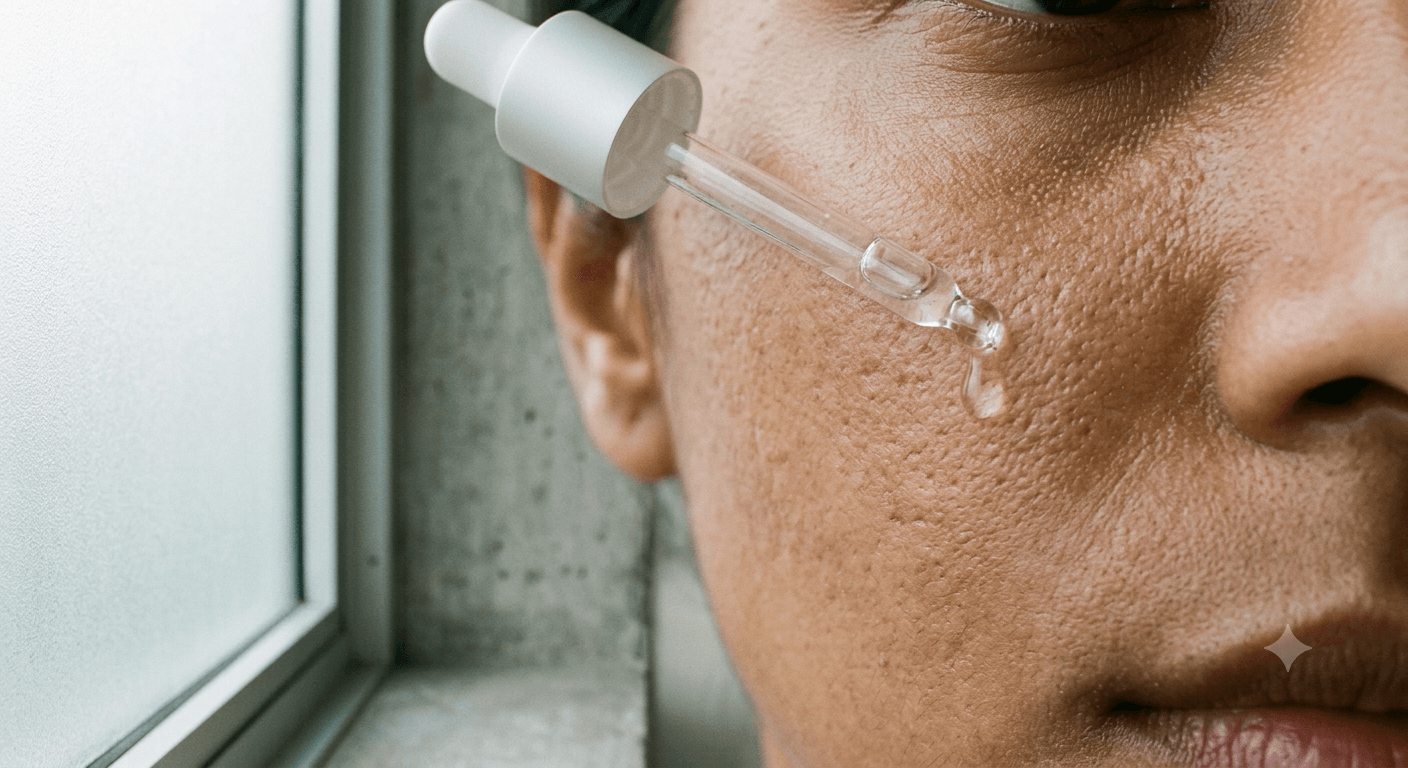
Hyaluronic acid drying out skin sounds contradictory, since the ingredient is marketed as a hydration hero, but in air-conditioned rooms it does exactly that. In low humidity, a humectant with nothing to draw water from pulls moisture from the skin’s own deeper layers instead of the atmosphere, leaving skin drier than before application.
The Problem: Hyaluronic Acid Drying Out Skin in AC Rooms
Plenty of people apply a hyaluronic acid serum expecting all-day plumpness, then notice the opposite happening under air conditioning.
Signs this is happening:
- Skin feels tighter an hour after applying a humectant-only serum
- Hydration seems to fade faster indoors than outdoors
- Serum sits on skin without absorbing properly in cold, dry air
- Fine lines look more pronounced by afternoon, not less
- Skin feels worse after layering more hydrating product, not better
This is a formulation gap, not a personal skin issue. Hyaluronic acid drying out skin under AC exposure happens because of where the water is pulled from, not because of a flaw in the ingredient itself.
The Science Behind Reverse Humectant Action
Humectants work by osmosis. They bind to water molecules and pull them toward the skin’s surface, from whichever source has the highest available moisture.
In humid air, that source is the atmosphere. Water vapour is abundant, and humectants draw it into the stratum corneum, the skin’s outer layer, increasing surface hydration.
In an air-conditioned room, humidity often drops below 40 percent. There is little water vapour available for a humectant to draw from. The humectant does not stop working. It continues seeking water, and instead pulls it from the skin’s own deeper epidermal layers.
This is why hyaluronic acid drying out skin specifically occurs indoors and not outdoors during humid months. The same molecule, in a different humidity context, behaves in the opposite direction. Cosmetic science documents this as reverse humectant action, and it is most pronounced with high-molecular-weight hyaluronic acid used alone, without any lipid layer to seal the surface.
Formulation Logic
A humectant is not a complete hydration system on its own. It is one half of a two-part mechanism that requires a lipid layer to function correctly in low-humidity conditions.
Without an occlusive or emollient layer, water pulled by a humectant, whether from the air or from the skin itself, evaporates straight back out. In humid climates, this loss is slow enough that humectant-only products still perform reasonably well. In AC environments, the loss is fast enough that the humectant works against the skin rather than for it.
This is a formulation oversight most single-ingredient serums do not address. A humectant needs a sealing layer applied over or alongside it, particularly for anyone spending more than four to five hours a day in air-conditioned rooms, which describes most urban office workers in India.
Practical Advice
- Apply a lipid-based moisturiser over any hyaluronic acid or humectant serum, since this seals in the water the humectant has pulled and prevents it evaporating into dry AC air.
- Avoid layering multiple humectant-only products before entering an AC room, since stacking humectants without a seal increases how much water is drawn from deeper skin layers.
- Apply humectant serums to slightly damp skin, not dry skin, so there is external water available to draw from before the humectant turns to the skin’s own reserves.
- Choose a moisturiser that pairs humectants with lipids in one formulation, rather than using a standalone humectant serum in AC-heavy routines.
Climate Relevance
AC exposure is the direct trigger for this mechanism. Indian offices frequently run air conditioning at settings that push indoor humidity below 40 percent, outside the range in which a humectant-only serum performs safely.
Monsoon and humidity shifts complicate this further. A humectant serum that performs well outdoors during monsoon season can behave differently the moment someone enters an air-conditioned car, mall, or office, since the humidity swing can happen within minutes.
Heat and sweat cycles add a secondary layer. Skin that sweats outdoors loses surface hydration through evaporation regardless of humectant use, so by the time someone reaches an air-conditioned space, the skin’s own moisture reserves are already reduced.
How Nature Theory formulates
Nature Theory formulates hydration products around a paired humectant-lipid architecture specifically to prevent reverse humectant action in AC-heavy routines. Rather than relying on a standalone humectant, the system combines water-binding actives with a structured lipid phase in one formula, so hydration is drawn in and sealed in the same step. This is designed for daily use in Indian offices and homes where air-conditioned exposure is the norm.
Summary: Hyaluronic Acid Drying Out Skin Is a Formulation Problem
Hyaluronic acid drying out skin in AC rooms is a real, documented mechanism, not a myth or an isolated bad reaction. Humectants pull water from whatever source is available, and in low-humidity indoor air, that source becomes the skin itself. Pairing humectants with a lipid layer is not optional in AC-heavy routines, it is the mechanism that prevents reversal. The ingredient is not the problem. The formulation is.
FAQ
Does hyaluronic acid always dry out skin, or only in certain conditions? Only in low-humidity conditions, such as air-conditioned rooms. In humid outdoor air, hyaluronic acid draws moisture in normally and does not pull from the skin’s own layers.
Is this why my skin feels worse in a Bengaluru or Gurgaon office than at home? Central air conditioning in large offices tends to run at lower humidity settings than home units, and longer daily exposure gives the reverse humectant effect more time to occur.
Can I stop using hyaluronic acid serum altogether to avoid this? Not necessary. The fix is sealing it with a lipid-based moisturiser, not removing the humectant, since hyaluronic acid still performs a valid function when paired correctly.
Does this happen with all humectants or just hyaluronic acid? It applies to all humectants, including glycerin and sodium PCA, though high-molecular-weight hyaluronic acid shows the effect most visibly due to how much water it attempts to draw.
Latest Posts
Continue learning how skincare works.
We explain ingredients, formulation systems, and climate-based skincare in a structured way.