
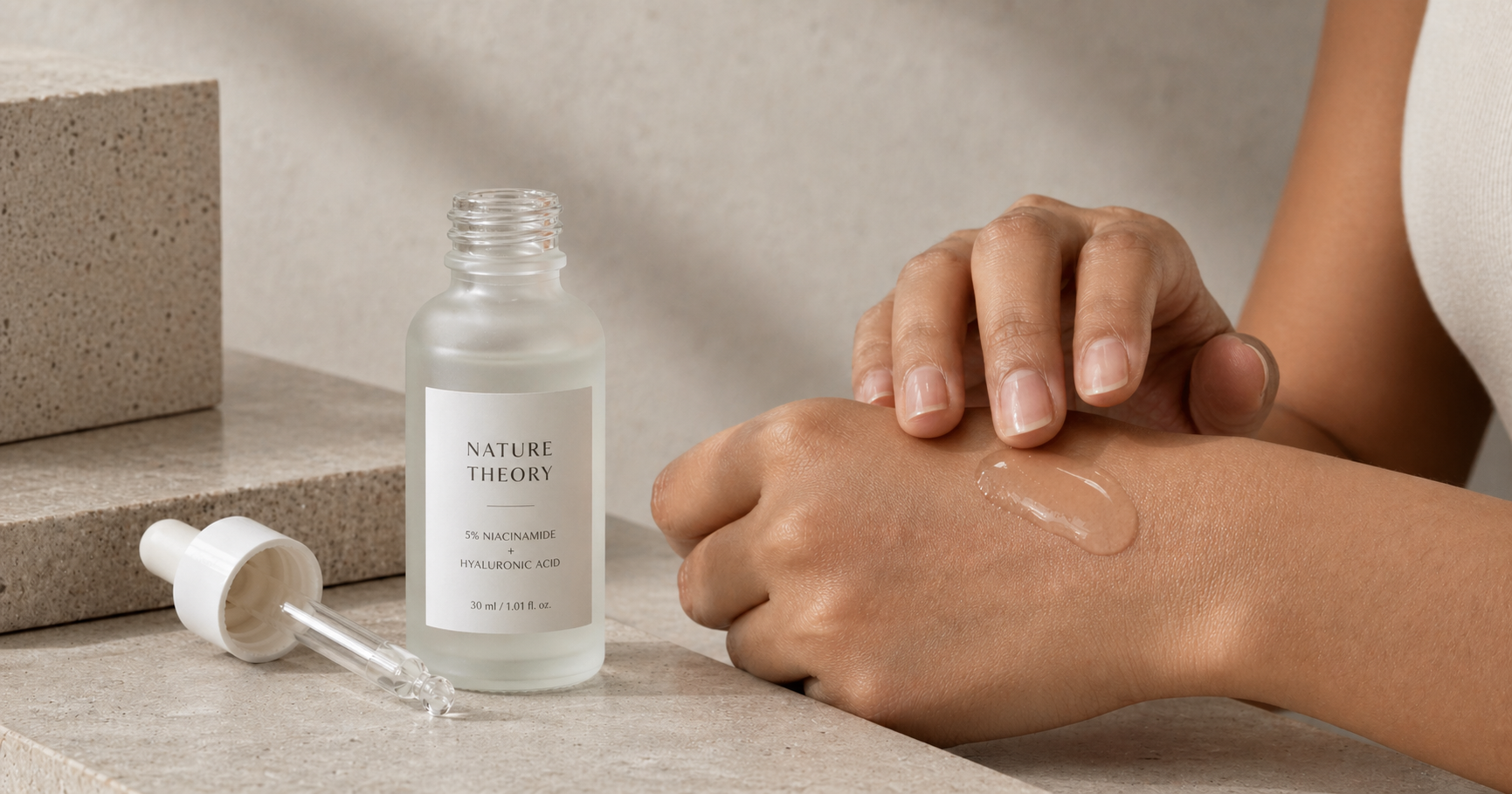
Many people use hydrating serums but still experience dryness or tightness after a few hours. This often leads to confusion around Sodium Hyaluronate vs Hyaluronic Acid Explained and why one seems more effective than the other. The difference is not just naming — it is about molecular structure, formulation systems, and how skin actually retains water.
The Problem: Hydration That Feels Temporary
You apply a hydrating product, but the effect does not last.
Common experiences include:
- Skin feels soft immediately but dry later
- Tightness returns in air-conditioned spaces
- Hydrating serums feel ineffective over time
- Moisturisers sit on top without improving comfort
- Skin appears dull despite consistent use
This is not simply a lack of hydration.
It reflects how water is managed inside the skin — and how formulations support or fail that process.
The Science: What Is Happening Inside the Skin
The Skin Barrier and Water Balance
The outermost layer of skin is the stratum corneum.
It functions as a controlled system:
- Corneocytes = cells that hold water
- Lipid matrix = fats that seal moisture
Together, they regulate hydration and prevent excessive water loss.
What Is TEWL?
Transepidermal Water Loss (TEWL) is the passive escape of water from the skin into the environment.
- Higher TEWL = faster dehydration
- Lower TEWL = better moisture retention
If hydration is not supported structurally, water leaves quickly.
Hyaluronic Acid: Surface-Level Hydration
Hyaluronic Acid is a large molecule.
- Typical molecular weight: ~1000–1800 kDa
- Remains mostly on the skin surface
- Forms a temporary hydrating film
This improves immediate softness.
But:
- Penetration into the stratum corneum is limited
- Hydration effect is often short-lived without support
Sodium Hyaluronate: Functional Hydration Support
Sodium Hyaluronate is the sodium salt form of hyaluronic acid.
- Lower molecular weight variants (≈10–1000 kDa)
- Better interaction within the stratum corneum
- More stable in water-based formulations
This allows it to support hydration more effectively within the outer skin layers.
The Role of Natural Moisturizing Factor (NMF)
The Natural Moisturizing Factor (NMF) is the skin’s internal hydration system.
It includes:
- Amino acids
- Sodium PCA
- Urea
- Lactates
These molecules hold water inside skin cells.
When NMF is reduced:
- Skin cannot retain water efficiently
- Dehydration occurs even after applying products
Sodium Hyaluronate supports this system by contributing to the water-binding network within the stratum corneum.
Key Insight
Both ingredients attract water.
But hydration depends on:
- where they act
- how they are formulated
- how well water is retained
Formulation Logic: How Sodium Hyaluronate vs Hyaluronic Acid Works in Skincare
Hydration is not delivered by a single ingredient.
It is delivered by a system.
Humectant Network
Humectants attract water into the skin.
Examples:
- Glycerin
- Sodium PCA
- Propanediol
- Sodium Hyaluronate
A well-designed formula uses multiple humectants because:
- Each behaves differently
- Together they create layered hydration
A single humectant at low concentration provides only limited support.
Multi-Molecular Weight Strategy
Advanced formulations often use:
- High molecular weight HA → surface hydration
- Low molecular weight Sodium Hyaluronate → deeper interaction
This combination provides:
- Immediate comfort
- Sustained hydration support
They are not competing ingredients.
They are complementary.
Lipid Support System
Humectants bring water into the skin.
Lipids keep it there.
Examples:
- Squalane
- Plant oils
- Fatty alcohols
Lipids:
- Reduce TEWL
- Support barrier structure
- Extend hydration duration
Without lipids, hydration remains temporary.
Occlusive Balance
Light occlusive layers:
- Slow water evaporation
- Improve hydration retention
Balance is important:
- Too much → heavy feel
- Too little → rapid water loss
A Nuanced Point
Even effective humectants like Sodium Hyaluronate depend on the surrounding system.
In low humidity:
- Water can evaporate faster
- Hydration feels short-lived
Formulation design determines outcome — not the ingredient name alone.
Practical Advice: What to Do
- Look for Sodium Hyaluronate within a humectant system
→ Multiple humectants improve hydration stability. - Do not rely on “hyaluronic acid” as a label signal
→ Performance depends on formulation, not naming. - Always pair hydrating products with a moisturiser
→ Lipids reduce TEWL and retain water. - Apply on slightly damp skin
→ Provides water for humectants to bind. - Adjust texture based on environment
→ Use lighter layers in humidity, richer ones in AC conditions. - Focus on consistency, not quantity
→ Hydration improves with regular use, not multiple products.
Simple Routine
Morning:
- Gentle cleanser
- Hydrating serum (with Sodium Hyaluronate)
- Lightweight moisturiser
- Sunscreen
Night:
- Cleanser
- Hydrating layer
- Barrier-support cream
Climate Relevance: Why This Matters in Indian Conditions
Air Conditioning and Low Humidity
AC reduces environmental moisture.
- Humectants have less water to draw from
- Without lipids, water evaporates faster
This increases TEWL and skin tightness.
Heat and Sweat Cycles
High temperatures increase sweat and evaporation.
- Surface hydration is repeatedly lost
- Frequent cleansing removes lipids
Hydration needs to be replenished and retained.
Monsoon and Humidity
High humidity changes hydration dynamics.
- Skin absorbs environmental moisture
- Heavy occlusives may feel uncomfortable
Balanced, breathable hydration systems perform better.
Urban Pollution
Pollution affects the skin barrier.
- Weakens lipid structure
- Increases TEWL
Hydration alone cannot compensate without barrier support.
Hard Water Exposure
Hard water leaves mineral residue.
- Affects surface hydration behavior
- Can disrupt NMF balance
This makes post-cleansing hydration more important.
The Nature Theory Approach
At Nature Theory, hydration is addressed through a structured humectant network that combines sodium hyaluronate with complementary water-binding molecules such as glycerin and sodium PCA. This system is designed to support the Natural Moisturizing Factor within the stratum corneum rather than relying on a single ingredient. The humectant network is paired with a lipid architecture that reduces transepidermal water loss and supports barrier stability across changing Indian climate conditions. The goal is consistent hydration that holds through daily environmental stress, not short-term surface softness.
Summary
Sodium Hyaluronate and Hyaluronic Acid are structurally related but behave differently due to molecular size and formulation context. Sodium Hyaluronate interacts more effectively within the outer skin layers, while Hyaluronic Acid mainly supports surface hydration. Neither works in isolation — hydration depends on a system that includes humectants, lipids, and environmental adaptation. Consistent, formulation-supported care is what improves long-term skin comfort.
FAQ
Why does my hyaluronic acid serum stop working after a few hours?
Because surface hydration fades quickly if not supported by lipids. Water evaporates, increasing TEWL.
Is Sodium Hyaluronate better than Hyaluronic Acid?
It is often more functionally effective due to its size and stability, but performance depends on the full formulation.
Can hydrating products make skin feel drier in AC environments?
Yes, if humectants are not supported by lipids, water can evaporate faster in low humidity conditions.
Why does my skin feel tight even after using a moisturiser?
Because hydration is not being retained. Barrier support may be insufficient.
Should I use both Sodium Hyaluronate and Hyaluronic Acid?
Yes. They can work together as part of a multi-layer hydration system.
Does Indian climate affect how these ingredients work?
Yes. Heat, humidity, AC exposure, and pollution all influence hydration performance and retention.
Latest Posts
Continue learning how skincare works.
We explain ingredients, formulation systems, and climate-based skincare in a structured way.
1 thought on “Why Your Hydrating Serum Stops Working — Sodium Hyaluronate vs Hyaluronic Acid Explained”
Comments are closed.