
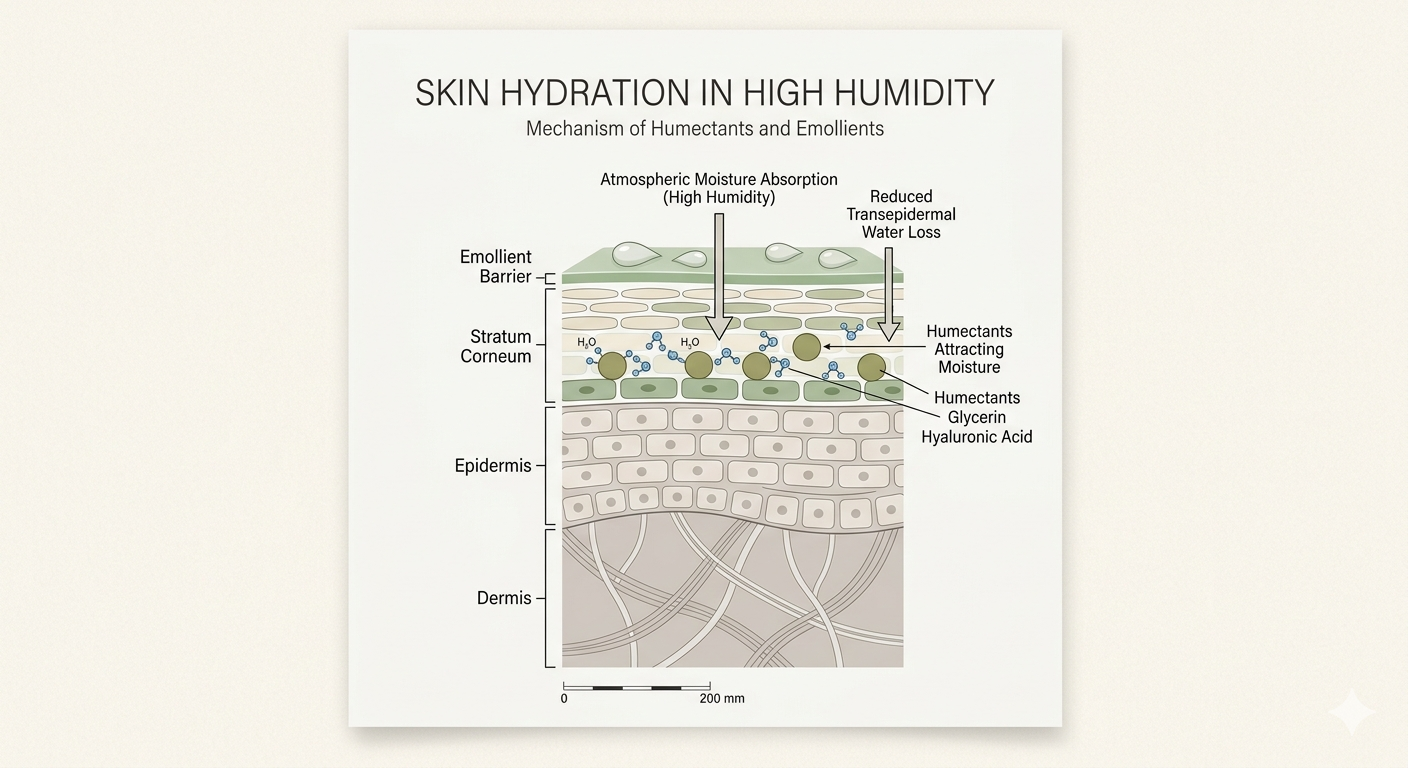
Skincare in High Humidity
Skincare in high humidity often feels counterintuitive.
The air is saturated with moisture, yet the skin can feel:
- oily on the surface
- dehydrated underneath
- unstable throughout the day
This leads many people to stop moisturizing altogether or switch to heavier creams to “lock in” hydration.
Neither approach works consistently.
Because humidity does not hydrate the skin directly — it only changes how hydration behaves.
Why Skin Feels Oily but Dehydrated in Humidity
To understand this, we need to separate three things:
- water content inside the skin
- oil (sebum) on the surface
- barrier function that controls both
Humidity increases the availability of water in the environment.
This allows humectants — ingredients like glycerin — to attract water more efficiently.
Glycerin, for example, is hygroscopic. In high relative humidity, it pulls water from the environment into the upper layers of the skin, increasing hydration quickly.
But this is only one part of the system.
At the same time:
- sweat production increases
- sebum production rises
- the skin surface becomes more active
If the barrier is not stable, this added water does not stay. It evaporates or becomes unevenly distributed.
This creates the common summer condition:
👉 hydrated at the surface, but not structurally stable
Why Heavy Moisturizers Feel Worse in Summer
Traditional moisturizers are built to reduce transepidermal water loss (TEWL).
They use:
- emollients to smooth the surface
- occlusives to slow water evaporation
In dry climates, this is necessary.
In humid conditions, it can become excessive.
When heavy occlusion is combined with:
- sweat
- sebum
- environmental humidity
it creates a dense surface layer.
This can:
- feel greasy
- interfere with heat regulation
- increase surface congestion in acne-prone skin
This is why heavier creams often feel uncomfortable in Indian summers — not because they are incorrect, but because they are mismatched to the environment.
The Logic of Lightweight Hydration
In high humidity, hydration is not about sealing water in.
It is about managing how water is introduced, distributed, and retained without overwhelming the skin surface.
This shifts the formulation logic toward:
Best Moisturizer Texture for Humid Indian Summers
This is why gel and gel-cream textures perform better.
They allow:
- fast water absorption
- minimal surface residue
- compatibility with sweat and sebum
Instead of forcing hydration into the skin, they support its natural balance.
Building a Lightweight Hydration Routine
A functional routine in Indian summer conditions is not complex, but it is structured.
Step 1: Gentle Cleansing Without Over-Stripping
In humid weather, it is common to cleanse more frequently to remove sweat and oil.
But over-cleansing — especially with strong surfactants — disrupts lipids and increases the oily–dehydrated cycle.
A mild, low-foam cleanser helps:
- remove sweat and pollution
- maintain lipid balance
- prevent rebound oiliness
Step 2: Hydration Through Humectants
This is where humidity becomes useful.
Humectants like glycerin and sodium PCA attract water into the skin more efficiently in humid air.
But this hydration needs structure.
Without support, the water they attract can evaporate quickly — especially when moving into air-conditioned environments.
Step 3: Light Emollient Support
Even in humidity, the skin needs lipid support.
Light emollients like squalane help:
- improve surface smoothness
- support barrier flexibility
- reduce uneven water loss
For acne-prone skin, lighter emollients are particularly important to avoid excessive surface buildup.
Step 4: Minimal, Context-Based Occlusion
Occlusion is not removed — it is reduced and used strategically.
For example:
- minimal during the day in humid conditions
- slightly higher at night if sleeping in air-conditioning
This allows hydration to remain without trapping excess oil and sweat.
Step 5: Lightweight Sun Protection
Humidity does not reduce UV exposure.
In fact, sweat can make sunscreen wear off faster.
Lightweight, fluid or gel-based sunscreens help maintain protection without adding heaviness.
A Practical Example Routine
For many people, this structure looks like:
- a gentle gel cleanser
- a hydrating serum with humectants
- a gel-cream moisturizer with light emollients
- a lightweight sunscreen during the day
This is not minimal for the sake of fewer steps.
It is minimal because each step has a defined role.
The Indoor–Outdoor Shift (India-Specific Insight)
One of the most important factors in Indian summers is environmental fluctuation.
During the day, skin moves between:
- humid outdoor air (high water availability)
- air-conditioned indoor spaces (low humidity, higher TEWL)
This shift is where most routines fail.
A lightweight but structured hydration system allows the skin to adapt without needing constant adjustment.
Practical Understanding
A well-balanced summer routine should feel:
- light immediately after application
- stable through the day
- neither greasy nor tight
If skin feels oily but still uncomfortable, hydration is not structured correctly.
If it feels tight after cleansing, lipids are being removed too aggressively.
Conclusion
Humidity does not eliminate the need for skincare.
It changes the rules.
Water is more available, but not automatically retained.
Oil is more present, but not always balanced.
The solution is not more product — and not less.
It is structure.
At Nature Theory, hydration is approached as a system:
- water needs to be introduced
- the barrier needs to be supported
- loss needs to be controlled without excess
Because in real conditions — heat, humidity, pollution, and air-conditioning — skin does not respond to trends.
It responds to how well the system is built.
Frequently Asked Questions
If the air is full of moisture in Indian summers, why is your skin still dehydrated? Because humidity in the air and hydration inside your skin are two completely different things. Humidity changes how your skin’s surface behaves — it increases sweat, raises sebum production, and makes the skin feel more active. But unless your skin barrier is stable enough to actually hold onto water, that surface moisture doesn’t translate into real skin hydration. The skin can feel oily and wet on the outside while still being dehydrated underneath. Humidity changes the environment your skin is in — it doesn’t automatically fix what’s happening inside it.
Should you stop moisturising in summer because the weather is already humid? No — and this is one of the most common summer skincare mistakes in India. Skipping moisturiser doesn’t reduce oiliness. What it does is remove the layer of support that helps your skin manage hydration properly. Without it, your barrier weakens, water loss increases, and your skin compensates by producing even more oil. The answer is not to stop moisturising — it’s to switch to a lighter, better-matched formula that gives your skin the hydration support it needs without the heaviness that feels wrong in hot weather.
Why does your regular moisturiser feel so heavy and uncomfortable in Indian summers — even though it worked fine in winter? Because the same formula behaves differently in different environments. In winter, heavier occlusives that slow water evaporation are necessary and comfortable because the air is drier. In summer humidity, your skin is already dealing with sweat, heat, and excess sebum on the surface. Adding a heavy occlusive layer on top of all that creates a dense, suffocating film that traps heat, adds to the congestion, and feels unbearable. The formula didn’t get worse — your environment changed and the formula is no longer matched to it.
What kind of moisturiser actually works for oily, humid Indian summers? Gel and gel-cream textures are the best match. They absorb quickly, leave minimal surface residue, and work with sweat and sebum instead of adding to the surface load. What you want inside that formula is a humectant-led approach — ingredients like glycerin and sodium PCA that pull water into the skin efficiently, especially in humid air where they can draw from the environment itself. Light emollient support — like squalane — smooths the surface without heaviness. Minimal occlusion during the day keeps things balanced without trapping sweat and oil.
What is a humectant and why does it matter more in summer than in winter? A humectant is an ingredient that draws water — from the environment and from deeper skin layers — into the outer surface of the skin. Glycerin, hyaluronic acid, and sodium PCA are common examples. In summer, they matter more because humid air gives them more to work with. In high humidity, glycerin can pull atmospheric moisture directly into your skin, which means hydration can happen more efficiently with lighter products. In dry winter air, there’s less environmental moisture available, so heavier formulas with more occlusion become necessary to compensate. Summer actually works in your favour if you use the right ingredients.
Why does skin feel fine outside in summer but tight and dry the moment you go indoors into AC? This is the most common and most underaddressed skin problem in Indian cities. Outdoors, humidity is high — humectants work well, your skin feels hydrated, and everything is relatively balanced. The moment you step into air conditioning, the humidity drops dramatically. Air conditioning actively removes moisture from the air, which increases transepidermal water loss — the rate at which water escapes from your skin. If your routine isn’t structured to handle both environments, your skin will feel comfortable outside and dehydrated indoors every single day. A well-structured lightweight routine with both humectants and light occlusion handles this shift better than a routine built for only one condition.
Is skipping sunscreen in summer okay because the skin already feels heavy? No — and humidity actually makes sunscreen wear-off faster, not slower. Sweat breaks down sunscreen on the skin surface, which means UV protection reduces more quickly on hot, sweaty days. If your sunscreen feels too heavy in summer, the answer is to switch to a lighter, fluid or gel-based sunscreen — not to skip it. UV damage from unprotected summer exposure builds up cumulatively and affects skin texture, pigmentation, and barrier health over time. Lightweight SPF products exist specifically for humid, hot climates and they don’t have to feel heavy.
Can over-cleansing in summer actually make oily skin worse? Yes, and it’s one of the most common ways oily Indian skin gets more problematic in summer. Because sweat and pollution build up faster outdoors, many people respond by washing their face more frequently or using stronger face washes. But each wash with an aggressive cleanser strips essential oils from the skin. The skin responds by ramping up sebum production to reprotect the barrier — making oiliness worse. Washing more with a harsh cleanser is the exact opposite of what oily summer skin needs. A mild, low-foam cleanser used twice a day does a better job of keeping the skin balanced than a strong one used more frequently.
What’s the right order of products in a summer skincare routine for Indian conditions? Keep it structured and light. Start with a gentle, low-foam gel cleanser to remove sweat, oil, and pollution without stripping. Follow with a hydrating serum or lightweight product with humectants like glycerin — this is your hydration step. Then apply a gel-cream moisturiser with light emollient support to smooth the surface and provide minimal occlusion. Finish with a lightweight fluid or gel-based sunscreen during the day. Each step has a specific job — cleanse, hydrate, support, protect. No step is redundant and none should feel heavy if the products are correctly matched to humid conditions.
Does the same routine work through Indian monsoon season too — or does it need to change? The core structure works, but the balance shifts. In monsoon, outdoor humidity is even higher — sometimes 80 to 90 percent or more in coastal cities. In these conditions, humectants become even more effective outdoors, but occlusion needs to be minimal during daytime. The bigger challenge in monsoon is the indoor shift — heavy monsoon rain often means more time in air conditioning, which pulls moisture out rapidly. You may need slightly more emollient support at night to compensate for what the AC is doing indoors. The principle stays the same: match the weight of your products to the environment you’re actually spending time in, not the season on the calendar.
Latest Posts
Continue learning how skincare works.
We explain ingredients, formulation systems, and climate-based skincare in a structured way.
4 thoughts on “Why Your Skin Still Feels Dehydrated in Humidity: A Lightweight Hydration Routine for Indian Summers”
Comments are closed.