
What Does Niacinamide Do in Skincare
Many people use niacinamide expecting clearer, smoother, or more balanced skin.
Sometimes it works well. Other times, it feels like nothing is happening.
This creates a common question:
what does niacinamide actually do in skincare?
The answer is less dramatic than most marketing suggests — but more important.
Niacinamide is not designed to create instant visible change.
It works by stabilizing how the skin functions over time.
What Does Niacinamide Actually Do in Skin?
Niacinamide, or vitamin B3, is a water-soluble ingredient that interacts with multiple processes inside the skin.
Instead of targeting one outcome, it supports the systems that keep skin stable.
Barrier Support and Lipid Production
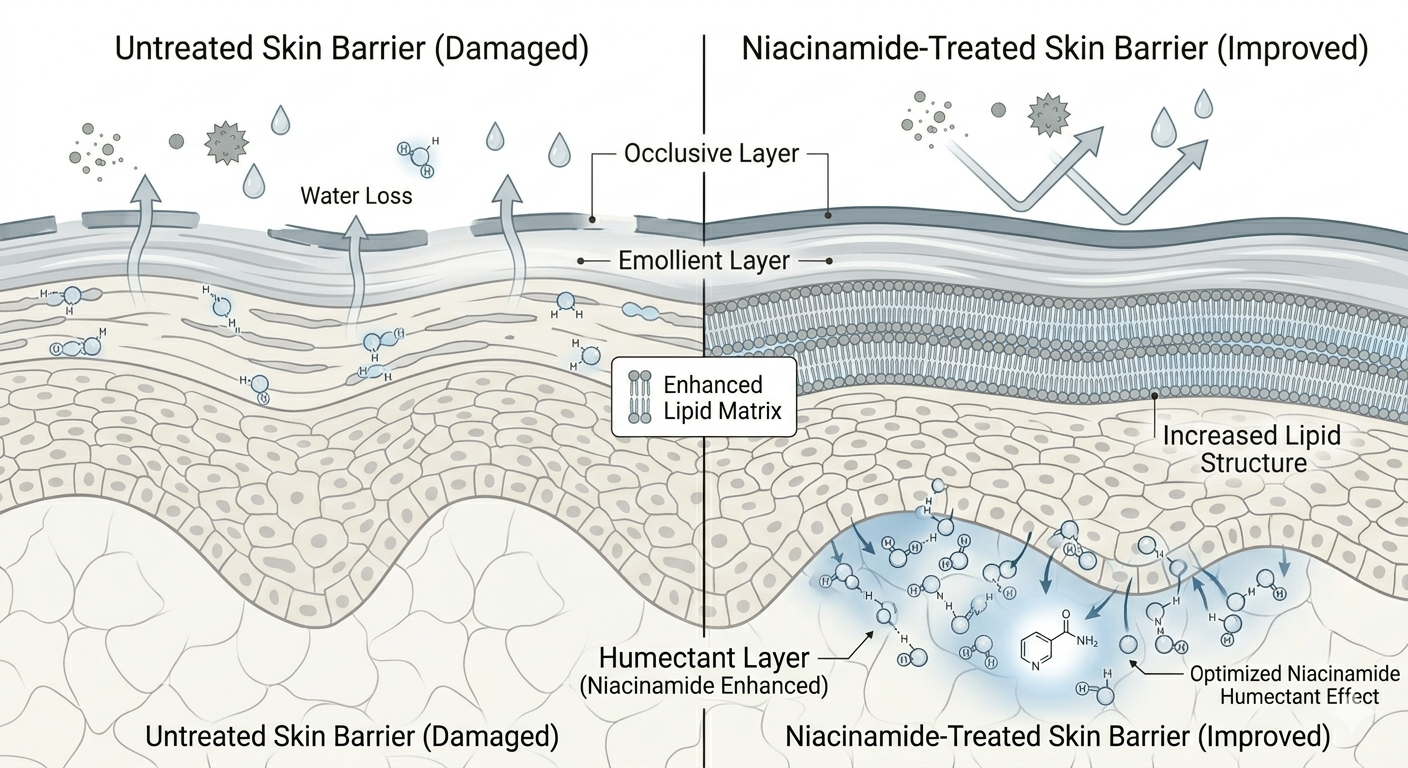
The skin barrier depends on lipids like ceramides, fatty acids, and cholesterol.
These lipids help hold skin cells together and reduce water loss.
Niacinamide supports the production of these lipids.
Over time, this leads to:
- improved barrier strength
- better moisture retention
- more resilient skin
Reducing Water Loss (TEWL)
Water naturally evaporates from the skin surface.
When the barrier is weak, this process accelerates.
Niacinamide helps reduce transepidermal water loss (TEWL) by improving lipid structure.
This helps skin:
- stay hydrated longer
- feel less tight
- maintain balance throughout the day
Oil Regulation (Not Oil Removal)
Sebum is part of the skin’s natural protection system.
But excess oil can create imbalance.
Niacinamide helps regulate oil production rather than suppressing it.
This leads to:
- reduced visible oiliness
- more even skin texture
- better surface balance
Skin Response and Environmental Stress
Skin is constantly exposed to:
- pollution
- heat
- UV exposure
Niacinamide supports how skin responds to these stressors.
It helps calm visible irritation and supports overall stability.
A Note on Skin Tone
Niacinamide has also been shown to influence how pigment is distributed in the skin.
Over time, this can contribute to a more even-looking tone.
This is a gradual effect — not a rapid brightening or peeling mechanism.
Why Niacinamide Sometimes “Doesn’t Work”
This is where most confusion comes from.
Niacinamide is often used incorrectly.
For example:
A high-strength niacinamide serum used on a dry, compromised barrier — especially alongside multiple active ingredients — may lead to irritation without improving results.
In contrast:
A balanced formulation with moderate niacinamide (around 2–5%), combined with hydration and lipid support, is more likely to improve skin comfort and stability over time.
The difference is not the ingredient.
It is the formulation context.
Ingredient and Formulation Logic
Niacinamide works best as part of a system.
Works with Hydration Systems
Niacinamide does not directly hydrate the skin.
It works best when combined with humectants like:
- glycerin
- sodium PCA
- hyaluronic acid
These provide water, while niacinamide helps the skin retain it.
Works with Lipid Systems
Since niacinamide supports lipid production, it performs better in formulations that also include:
- emollients (like squalane or plant oils)
- structured lipid systems
This combination improves both hydration and barrier stability.
Concentration Matters
Niacinamide is typically effective in the 2–5% range.
Higher concentrations are often marketed as stronger, but they are not always more effective.
For many people, especially in daily-use products, moderate levels:
- provide consistent results
- reduce irritation risk
- support long-term use
If skin is sensitive or already using exfoliants or retinoids, starting lower is often more comfortable.
Climate Relevance (Indian Conditions)
Niacinamide performs particularly well in Indian environments because it addresses multiple stress factors at once.
Heat and Humidity
Helps regulate excess oil without stripping the skin.
Air-Conditioned Environments
Supports barrier function and reduces dehydration indoors.
Pollution Exposure
Improves skin resilience against environmental stress.
Hard Water Exposure
Helps reinforce barrier stability when skin balance is disrupted by alkaline water conditions.
In many Indian cities, skin moves between these conditions daily.
Niacinamide supports stability across all of them.
Practical Understanding
Niacinamide is not a quick-result ingredient.
Its value comes from consistency.
What to Look For
- Moderate concentration (2–5%)
- Balanced formulations with hydration and lipids
- Products designed for daily use
What to Avoid
- Very high concentrations without need
- Combining too many active ingredients
- Expecting immediate visible change
Where It Fits in a Routine
Niacinamide can be used:
- in serums
- in moisturizers
- in both morning and evening routines
It works best as a consistent, supportive layer in a routine — not as a standalone solution.
System-Level Understanding
Niacinamide does not force the skin to change.
It supports the processes that keep the skin stable.
When used within a well-structured formulation, it helps:
- improve barrier strength
- maintain hydration
- regulate oil balance
- support long-term skin comfort
At Nature Theory, niacinamide is used as part of a broader hydration and barrier system — not as a standalone “hero ingredient,” but as a stabilizing component within a complete formulation structure.
Conclusion
Niacinamide works quietly.
It does not deliver dramatic overnight results.
It improves how the skin functions over time.
By supporting lipid production, reducing water loss, and regulating oil balance, it helps maintain stability in changing environments.
In real conditions — heat, humidity, pollution, hard water, and indoor dryness — this kind of stability matters more than intensity.
Skin does not need constant correction.
It needs consistent support.
Frequently Asked Questions
Niacinamide is in almost every product right now — but what does it actually do to your skin? Less dramatically than most brands make it sound — but more importantly. Niacinamide is vitamin B3, and it works by supporting the processes that keep your skin stable over time. It helps your skin produce the lipids that make up your barrier, reduces how fast water escapes from the surface, regulates oil production, and helps your skin handle environmental stress better. It doesn’t force a visible change — it improves how your skin functions. The results are real, but they’re gradual and structural, not overnight.
Why did niacinamide work brilliantly for someone else but do nothing for your skin? Almost always a formulation problem, not an ingredient problem. Niacinamide doesn’t work the same way in every product. A high-concentration niacinamide serum in a thin, poorly structured base applied to a compromised or dry barrier will either cause irritation or feel like it’s doing nothing. The same ingredient in a balanced formula — moderate concentration, combined with humectants and lipid support — will gradually improve barrier strength and skin comfort over weeks. Same ingredient name on the label, completely different result based on how it’s put together.
What percentage of niacinamide is actually effective — and is higher always better? The 2 to 5 percent range is where niacinamide consistently performs well for most people in daily use. This is backed by research and is enough to support barrier function, regulate oil, and improve skin tone over time. Higher concentrations — 10 percent and above — are heavily marketed but not necessarily more effective. For many people, especially those with sensitive skin or those already using exfoliants or retinoids, higher concentrations increase the risk of irritation without adding meaningful benefit. More is not better here — consistency at the right level is what delivers results.
Can niacinamide reduce oiliness — or is that just a claim? It genuinely can, but it works differently than people expect. Niacinamide doesn’t strip oil or block sebum production the way harsh cleansers or certain actives do. Instead it helps regulate how much sebum is produced in the first place. Over consistent use — typically four to eight weeks — many people notice less visible shine, more even surface texture, and skin that feels less reactive. It brings oil production closer to balance rather than suppressing it completely, which means the results last and the skin doesn’t compensate by producing even more oil afterward.
Does niacinamide help with dark spots and uneven skin tone — or is that exaggerated? It does have a real but gradual effect on pigmentation. Niacinamide influences how melanin — the pigment that causes dark spots — is distributed in the skin. With consistent use over several weeks, it can contribute to a more even-looking tone and reduced appearance of post-inflammatory pigmentation. But this is not the same as a fast brightening or peeling effect. It’s a slow, structural improvement. If you’re expecting visible results in a week, you’ll be disappointed. If you use it consistently for two to three months, the improvement is often genuinely noticeable.
Is niacinamide good for Indian skin specifically — or is it just a global trend ingredient? It’s actually particularly well-suited to Indian skin and Indian conditions. Indian skin typically deals with a combination of challenges simultaneously — heat, high humidity outdoors, dry air-conditioned interiors, pollution, hard water, and UV exposure. Niacinamide addresses almost all of these at once: it regulates oil in humidity, supports barrier function in dry AC air, helps with pollution-related skin stress, reinforces barrier stability against hard water disruption, and protects against some UV-related pigmentation changes. It’s one of the few ingredients that works across multiple Indian environmental stressors at the same time.
Can you use niacinamide with vitamin C — is the “they cancel each other out” claim true? This concern is mostly outdated. The older theory was that niacinamide and vitamin C combined to form a compound that caused flushing or redness. More recent research suggests this reaction is minimal at the concentrations used in skincare products and at normal skin temperatures. Using both in the same routine is generally fine for most people. If you want to be cautious, use them at different times — vitamin C in the morning, niacinamide in the evening — but there’s no strong evidence that this precaution is necessary for the majority of users.
Why does niacinamide sometimes cause flushing or redness — especially in the beginning? This occasionally happens when niacinamide is used at high concentrations or when the skin is already sensitised or compromised. The flushing is a temporary vascular response and usually subsides as the skin adjusts. To minimise this, start with a product that has niacinamide in the 2 to 4 percent range, especially if your barrier is already under stress. Avoid layering it with multiple other actives when starting out. If flushing persists beyond a couple of weeks, the concentration may be too high for your skin’s current condition — drop down to a lower level or switch to a product where niacinamide is part of a more balanced formulation rather than the star ingredient at a very high percentage.
Does niacinamide need to be in a serum — or does it work in a moisturiser too? It works well in both. A serum delivers niacinamide in a lightweight base that absorbs quickly, which is useful if you want a dedicated hydration or barrier step before your moisturiser. A moisturiser with niacinamide built in delivers it alongside emollients and occlusive support, which helps the skin retain the benefits throughout the day. Neither is inherently better — what matters is that the product it’s in has a well-balanced formulation. Many people get consistent results from niacinamide in a moisturiser alone, especially if their routine is already simple and barrier-focused.
How long does niacinamide take to actually work — when should you expect to see a difference? Set realistic expectations: four to eight weeks of consistent, daily use is the minimum before you can fairly assess whether niacinamide is working for you. The first signs are usually functional — your skin feels less tight, less reactive, more comfortable through the day. Surface oil feels more balanced. Visible improvements in skin tone, texture, and pore appearance tend to show up in the six to twelve week range. The reason people think niacinamide doesn’t work is almost always that they stopped using it before it had enough time to actually do anything. It’s a long-game ingredient, not a weekend fix.
Latest Posts
Continue learning how skincare works.
We explain ingredients, formulation systems, and climate-based skincare in a structured way.
2 thoughts on “What Does Niacinamide Do in Skincare Formulations”
Comments are closed.