
1. The Problem
Many people experience skin that feels:
• tight after washing
• dry even after moisturizing
• uncomfortable in air-conditioned rooms
• dehydrated during hot weather
A common assumption is:
“Skin just needs more moisturizer.”
But the underlying issue is often not a lack of products.
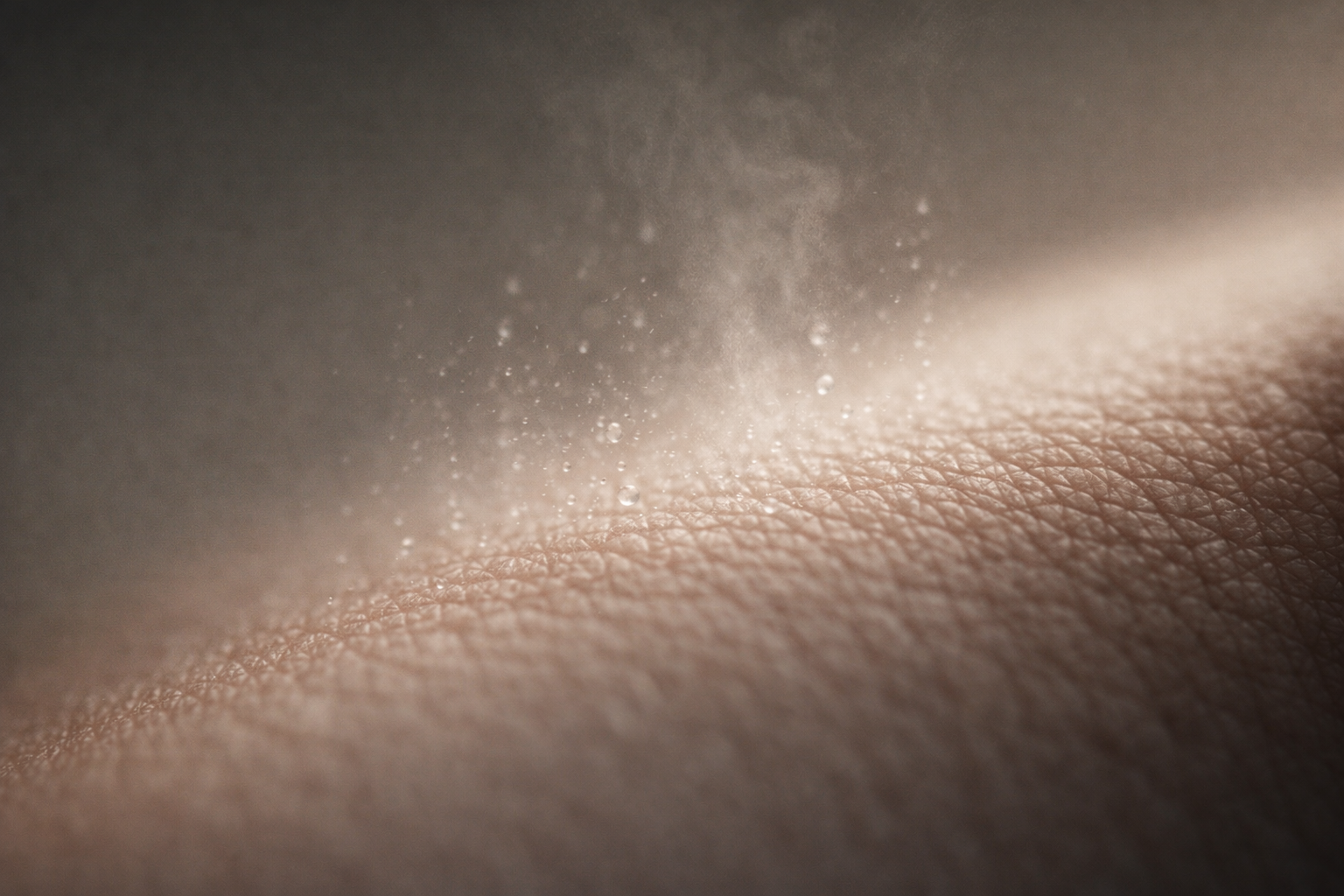
It is excess water loss from the skin.
This process is called transepidermal water loss (TEWL).
2. The Science
Your skin is not a solid surface.
It is a layered biological barrier designed to regulate water movement.
The outermost layer, known as the stratum corneum, functions like a protective structure:
• skin cells act as “bricks”
• lipids act as the “mortar”
This structure helps retain water inside the skin.
However, water is constantly moving.
Even in healthy skin, a small amount of water naturally evaporates from the surface.
This is normal TEWL.
When TEWL Increases
Problems begin when this water loss becomes excessive.
This can happen when:
• the lipid barrier is disrupted
• cleansing is too aggressive
• environmental conditions are harsh
When the barrier weakens:
→ water escapes faster
→ hydration levels drop
→ skin feels dry and tight
This is why TEWL is directly linked to skin dehydration and barrier health.
3. Ingredient and Formulation Logic
Reducing TEWL is not about adding more water to the skin.
It is about slowing down water loss.
This requires a structured formulation approach.
1️⃣ Humectant Systems (Water Retention)
Ingredients like:
• Glycerin
• Sodium PCA
• Sodium Hyaluronate
These help:
→ attract water into the skin
→ maintain hydration within the upper layers
But humectants alone are not enough.
2️⃣ Lipid Systems (Barrier Support)
Ingredients like:
• Squalane
• Jojoba oil
• Shea butter
These help:
→ reinforce the lipid matrix
→ reduce the rate of water evaporation
→ improve skin comfort
This is where TEWL reduction actually happens.
3️⃣ Barrier-Support Actives
Ingredients like:
• Niacinamide
• Panthenol
These help:
→ improve barrier function over time
→ reduce sensitivity
→ support long-term hydration stability
Why Systems Matter
Individual ingredients do not work in isolation.
Effective formulations combine:
→ humectants (water binding)
→ lipids (water sealing)
→ actives (barrier repair)
This creates a complete hydration system.
4. Climate Relevance
TEWL is strongly influenced by environmental conditions, especially in India.
Heat
High temperatures increase water evaporation from the skin.
Result:
→ faster dehydration
→ increased TEWL
Humidity
Humidity can reduce water loss temporarily.
But:
→ sweat and cleansing cycles can still disrupt the barrier
Air Conditioning
Air-conditioned environments are low in humidity.
This creates:
→ continuous water loss
→ persistent dryness
Hard Water
Mineral-heavy water can:
→ disrupt skin balance
→ increase barrier stress
TEWL is not just a biological process.
It is climate-dependent.
5. Practical Advice
To manage TEWL effectively, focus on formulation characteristics.
Choose Gentle Cleansers
Avoid systems that leave skin feeling tight.
Look for:
• mild surfactants
• added humectants
• barrier-support ingredients
Use Layered Hydration
A complete routine should include:
• water-binding ingredients
• lipid-based moisturizers
Do Not Over-Cleanse
Frequent washing can:
→ remove protective lipids
→ increase TEWL
Support the Barrier Daily
Consistency matters more than intensity.
Skin responds better to:
→ regular, balanced care
→ not aggressive routines
At Nature Theory, formulations are designed to address TEWL through structured systems.
This includes:
• humectant networks for hydration retention
• lipid architectures to reduce water loss
• barrier-support actives for long-term stability
The focus is not on single ingredients.
It is on how the system performs during daily use in real climate conditions.
6. Summary
Transepidermal water loss (TEWL) is a natural process.
But when it increases:
→ skin loses water faster
→ hydration drops
→ barrier function weakens
Managing TEWL requires:
• retaining water (humectants)
• reducing evaporation (lipids)
• strengthening the barrier (actives)
Skin comfort is not just about adding moisture.
It is about controlling how water moves through the skin.
❓ FAQ
1. Is TEWL bad for the skin?
TEWL is a normal process. It becomes a problem only when water loss is excessive.
2. Why does my skin feel dry after washing?
Cleansing can remove protective lipids, increasing TEWL and causing temporary dryness.
3. Can moisturizers stop TEWL completely?
No. They reduce water loss but do not completely stop it.
4. Is oily skin affected by TEWL?
Yes. Even oily skin can experience dehydration due to water loss.
5. Does humidity prevent TEWL?
It can slow it down, but barrier condition still plays a major role.
Latest Posts
Continue learning how skincare works.
We explain ingredients, formulation systems, and climate-based skincare in a structured way.
21 thoughts on “What Is TEWL and How Does It Affect Your Skin”
Comments are closed.