
The Problem
You use a moisturizer.
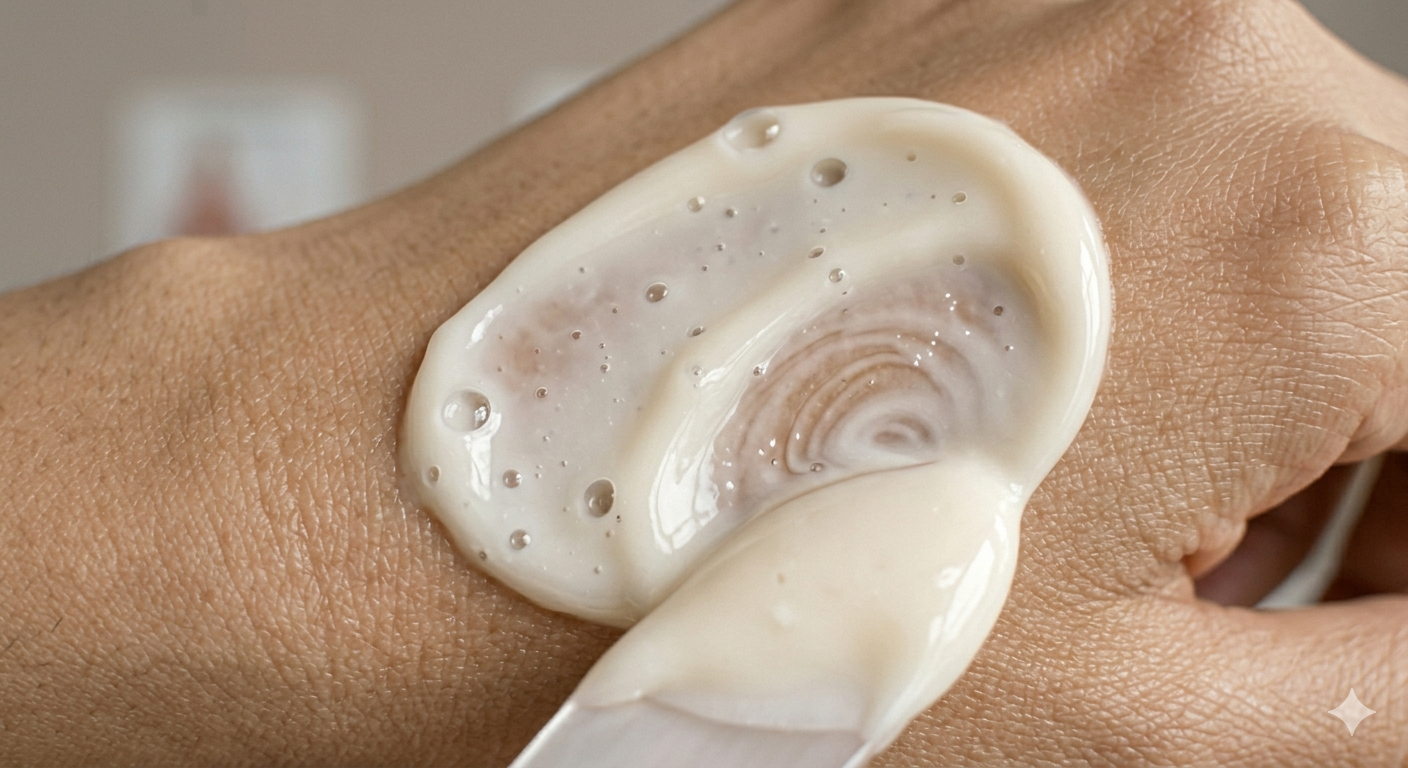
It feels smooth. Light. Easy to spread.
It doesn’t feel oily. It doesn’t feel watery.
Just balanced.
But when you try another product, it feels completely different.
Too heavy. Too greasy. Or too thin.
Both are called moisturizers.
But they behave very differently.
What an Emulsion Actually Is
An emulsion is a way of combining two things that do not naturally mix.
Water and oil.
In skincare, most creams and lotions are emulsions.
They are structured systems where water and oil are blended together in a stable form.
This structure determines how the product feels, spreads, and behaves on your skin.
Why Water and Oil Need Structure
Water and oil separate naturally.
If you mix them without structure, they will split again.
So a formulation needs a system that holds them together.
This is done using components that stabilise the mixture and keep it uniform.
This is what allows a product to remain smooth and consistent instead of separating over time.
How Skin Responds to an Emulsion
Your skin needs both water and oil.
Water supports hydration.
Oil helps reduce water loss and supports the skin barrier.
An emulsion delivers both together in a balanced way.
Instead of layering separate products, the system combines them into one stable structure.
This is why emulsions are the foundation of most daily skincare products.
Why Different Emulsions Feel Different
Not all emulsions are built the same.
Some are designed to feel light and fast-absorbing.
Others are designed to feel richer and more protective.
This depends on how water and oil are arranged within the formulation.
In some systems, water forms the outer phase, making the product feel lighter.
In others, oil plays a more dominant role, making the product feel richer.
These are known as oil-in-water and water-in-oil emulsions.
This distinction is what creates the difference between a light lotion and a richer cream, and it becomes even more important when choosing products for different skin types and climates.
Why Formulation Matters More Than Texture
Two products may feel similar at first.
But how they behave over time can be very different.
A well-designed emulsion spreads evenly, stays stable, and supports hydration over time.
A poorly structured one may feel good initially but lose effectiveness quickly.
The difference is not just in how the product feels when applied.
It is in how the system holds together and performs on the skin.
How Environment Affects Emulsions
Your skin moves through changing conditions.
Outdoor heat, humidity, indoor air-conditioning, and pollution all affect how a product performs.
In humid environments, lighter emulsions may feel sufficient.
In dry indoor conditions, the skin may need more support to reduce water loss.
A well-formulated emulsion is designed to remain stable and effective across these shifts.
A More Useful Way to Understand Moisturizers
Instead of thinking of moisturizers as creams or lotions,
It is more useful to think of them as emulsions.
Systems designed to deliver water and oil in balance.
If your skin stays comfortable for longer, the system is working.
If the effect fades quickly, the structure may not be balanced.
Conclusion
An emulsion is the foundation of most skincare products.
It is how water and oil are combined into a stable, usable system.
But the way this system is built determines how the product performs.
At Nature Theory, emulsions are designed as structured systems that support hydration, barrier function, and consistency across real-world conditions.
Frequently Asked Questions
What exactly is an emulsion in skincare — and why should you care? An emulsion is simply water and oil mixed together in a stable form. On their own, water and oil don’t mix — they separate. In skincare, emulsions solve this problem by holding both together in one product. This matters because your skin needs both water for hydration and oil to lock that hydration in. An emulsion delivers both at the same time, which is why most moisturisers, lotions, and creams are emulsions.
Is every moisturiser an emulsion? Most are, yes. If your moisturiser has a smooth, blended texture that doesn’t feel purely oily or purely watery — it’s almost certainly an emulsion. Creams, lotions, and day fluids are all emulsions. The difference between them is just how they’re structured inside — which is what changes the texture, weight, and how long they last on your skin.
Why do two moisturisers feel so different even when they claim to do the same thing? Because the structure inside the bottle is different. Two products can both be emulsions but behave very differently depending on whether water or oil forms the outer phase of the system, and how well the whole formula is balanced. One might absorb in 30 seconds and feel invisible. Another might sit on the skin for hours. That difference comes entirely from how the emulsion was built — not just what ingredients are in it.
Why can’t skincare brands just use water and oil separately — why do they need to mix them? Because skin doesn’t work well with just one or the other. A purely water-based product hydrates but evaporates quickly and doesn’t protect the barrier. A purely oil-based product seals but doesn’t add moisture. An emulsion combines both functions in one stable system — so your skin gets hydration and protection together, without you having to layer multiple products.
What does “stable emulsion” mean and why does it matter? A stable emulsion is one that doesn’t separate over time. If you’ve ever seen a product go watery or oily at the edges of the jar — that’s an unstable emulsion breaking down. Stability matters because an unstable product doesn’t deliver ingredients consistently. The first few uses might feel different from the last few. A well-formulated emulsion stays uniform from the first use to the last.
Does the emulsion type affect how well a product works for oily skin? Yes. Oily skin generally does better with oil-in-water emulsions — where water is on the outside and oil is dispersed inside in small droplets. These feel lighter, absorb faster, and don’t add to the oiliness. Water-in-oil emulsions — where oil is on the outside — feel heavier and can feel too much for skin that already produces excess oil.
Why does my moisturiser feel great in winter but too heavy in summer? Because emulsions respond to the environment around them, and so does your skin. In humid Indian summers, your skin already has surface moisture and doesn’t need as much from the product. A richer, oil-heavy emulsion can feel suffocating in that heat. In cooler, drier months, that same product feels comfortable because your skin actually needs the extra support. The emulsion didn’t change — the conditions did.
Is a face serum also an emulsion? Some serums are lightweight emulsions, but many are water-based solutions without oil at all. If a serum feels slightly milky or creamy, it’s likely an emulsion. If it’s completely clear and watery, it’s probably not. Emulsions always have that blended, neither-fully-watery-nor-fully-oily quality to them.
Can a bad emulsion actually damage your skin? Not damage in a dramatic way, but a poorly built emulsion can cause consistent mild problems. If it breaks down on your skin instead of absorbing properly, it can leave residue that clogs pores. If it’s unstable, the ingredients won’t reach your skin consistently. Over time, using a poorly structured emulsion means your skin never fully gets what the product is supposed to deliver.
How do I know if the emulsion I’m using is actually working? Simple check — notice how your skin feels 2 to 3 hours after applying your moisturiser. If it still feels comfortable, balanced, and not tight or greasy, the emulsion is doing its job. If the effect fades within an hour, or your skin feels either too dry or too heavy, the structure of the emulsion may not be right for your skin type or environment.
Latest Posts
Continue learning how skincare works.
We explain ingredients, formulation systems, and climate-based skincare in a structured way.
5 thoughts on “What Is an Emulsion in Skincare Formulation”
Comments are closed.