
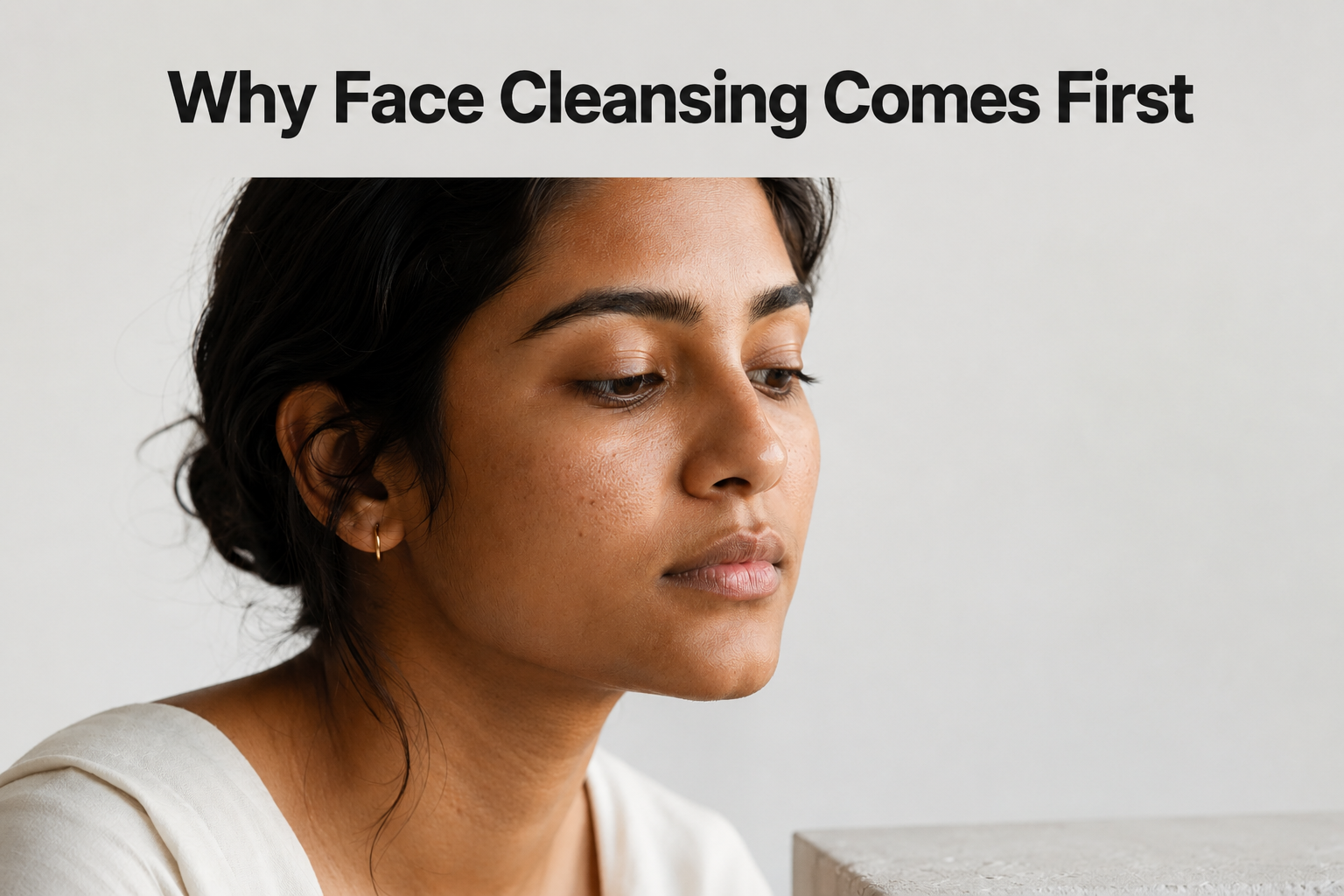
Face cleansing is the first step in every skincare routine, but the reason is not what most people assume. It is not simply about removing visible dirt or excess oil. Cleansing determines whether every product applied afterward — moisturiser, serum, SPF — can function at all. What happens at this step shapes the skin environment for the entire day.
When Face Cleansing Goes Wrong
Most people treat their cleanser as a preparation step — something quick and functional before the real skincare begins.
This is where the routine loses its foundation.
When cleansing disrupts rather than prepares the skin, every product applied afterward works against a compromised surface. A cleanser that is too strong does not just remove impurities — it strips the lipids and hydration factors the outer skin layer depends on to stay stable.
Signs that cleansing is creating disruption:
- Skin feels tight or dry immediately after rinsing
- Moisturiser absorbs unevenly or sits on the surface
- Serums sting mildly after cleansing
- Breakouts persist despite consistent washing
These are not product failures. They are signals that the first step is undermining everything that follows.
How Cleansing Changes the Skin Environment
The outer layer of the skin — the stratum corneum — is not just a surface. It is a structured system of skin cells and lipids that controls two critical functions: keeping moisture inside the skin and keeping environmental stressors out.
Cleansers work through surfactants — molecules with a water-attracting end and an oil-attracting end. This structure allows them to surround and lift oil, pollution particles, and dead cell debris so they rinse away with water.
The problem is selectivity. Surfactants cannot distinguish between pollution-bound lipids and the skin’s own protective lipids. A cleanser that is too aggressive will remove both. When the protective lipid layer is disrupted, the skin loses moisture faster — a process called transepidermal water loss, or TEWL. The skin becomes more permeable, more reactive, and less able to benefit from products applied afterward.
This is why face cleansing is not just a hygiene step. It directly controls the permeability of the skin barrier that every other product depends on.
What a Well-Formulated Cleanser Actually Does
A cleanser that respects the skin barrier is built around three functional systems working together.
The surfactant system does the cleansing work. Modern mild cleansers use blended surfactant systems — typically a combination of glucosides and betaines — rather than a single strong surfactant. This reduces the interaction any one molecule has with the skin’s lipid layer.
The hydration retention system maintains moisture balance during the wash step. Ingredients like glycerin, panthenol, and sodium PCA do not fully rinse away. They form a temporary film that reduces the moisture loss cleansing would otherwise cause.
The pH system matters in a way most blogs ignore. Skin maintains a naturally acidic surface — approximately pH 4.5 to 5.5. A cleanser with an inconsistent or elevated pH disrupts this environment, making the skin temporarily more permeable even when the surfactant system is mild.
Four Steps That Make Cleansing Work Properly
- Wet the face with lukewarm water before applying cleanser — hot water softens the protective lipid layer before surfactants even contact it.
- Apply cleanser for 30 to 45 seconds using light circular motion — this gives the surfactant system enough contact time to lift debris without extended barrier exposure.
- Rinse thoroughly and completely — residual surfactant film raises surface pH and continues to interact with lipids after washing ends.
- Apply moisturiser while skin is slightly damp — the barrier is temporarily more permeable immediately after cleansing, making this the most efficient window for hydration absorption.
How Indian Climate Conditions Change What Face Cleansing Demands
Heat and Sweat Cycles
In cities like Delhi, Chennai, and Mumbai, temperatures exceed 38°C for months. Sweat increases sebum mixing and draws pollution particles to the skin surface. This demands more frequent cleansing — and each wash with a strong surfactant system compounds barrier disruption faster than in temperate climates.
Hard Water
Hard water contains elevated calcium and magnesium that react with surfactants to form insoluble films on the skin after rinsing. These films trap residue and interfere with the skin’s natural pH recovery. In Hyderabad and Bengaluru, where water hardness is consistent, this effect accumulates with every wash.
Air Conditioning
AC environments reduce ambient humidity, which accelerates moisture loss from the skin immediately after cleansing. In low-humidity indoor conditions, the barrier recovers more slowly. Morning cleansing followed by hours of AC exposure compounds barrier stress — a daily pattern for most urban Indians.
How Nature Theory Approaches Cleansing
Face cleansing formulations at Nature Theory are built around a three-system approach — mild blended surfactants, hydration-retention ingredients, and pH-aligned preservation — so that cleansing prepares the skin rather than disrupts it. The goal is for the skin barrier to be in the same condition after washing as before, minus accumulated impurities. This gives every product applied afterward an intact, stable surface to work on.
The Foundation Every Skincare Routine Builds On
Face cleansing is not preparation for a routine — it is the first active decision the routine makes. A cleanser that disrupts the barrier before serums and moisturisers arrive makes every subsequent step less effective. A cleanser that respects the barrier delivers an intact surface for everything that follows. Every product in a skincare routine performs better when the first step is done well.
Frequently Asked Questions
Why does my skin feel tight after cleansing?
Tightness usually indicates a pH mismatch, hard water interaction, or surfactant residue not fully rinsed away. In cities like Delhi and Mumbai, hard water reacts with cleanser molecules to leave an invisible film that slows barrier recovery. Thorough rinsing significantly reduces this effect.
Should I cleanse my face in the morning if I cleansed at night?
Yes, but with different intent. The skin produces sebum and sheds surface cells overnight, and in AC environments this output accumulates faster and creates an uneven surface. Morning cleansing removes it so subsequent products absorb into a clean, stable base.
Does the order of skincare products matter if the cleanser is good?
Cleansing determines the condition of the surface that serums and moisturisers contact. Even a well-formulated serum absorbs inconsistently on a surface carrying pollution residue, excess oil, or surfactant film from an incomplete rinse.
Why does face cleansing cause breakouts in Indian summers?
High temperatures increase sebum production and sweating. A cleanser that leaves residue — through poor rinsing or hard water interaction — combines with elevated sebum to create conditions for congestion. The problem is usually incomplete rinsing, not the formulation itself.
Latest Posts
Continue learning how skincare works.
We explain ingredients, formulation systems, and climate-based skincare in a structured way.