
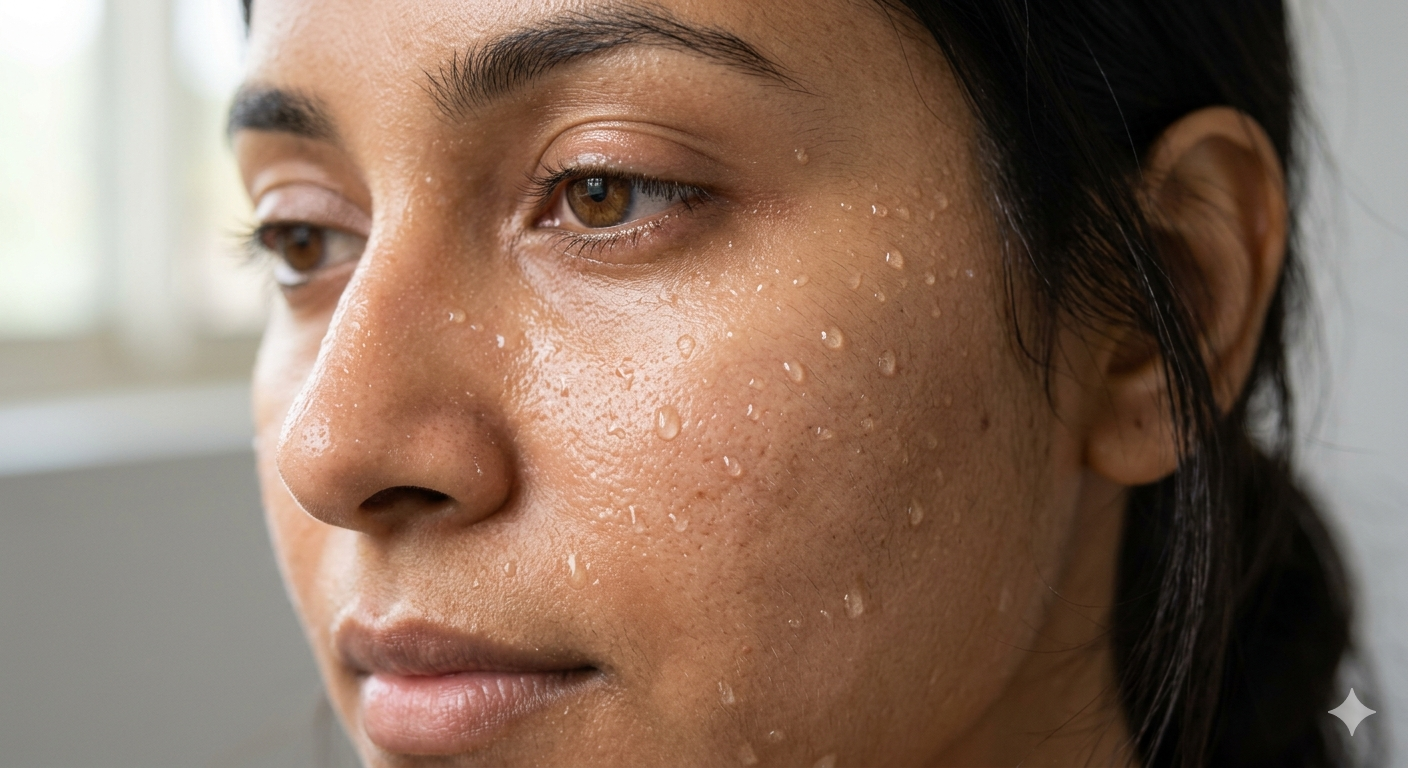
The Problem
Your skin feels tight after washing.
Sometimes dry. Sometimes slightly irritated.
Even when you use a good cleanser.
This is often blamed on the product.
But in many cases, the issue is not just what you use.
It is the water you use it with.
What Hard Water Actually Is
Hard water contains dissolved minerals, mainly calcium and magnesium.
These minerals are naturally present in groundwater.
They are not harmful to drink.
But they change how water behaves on your skin.
In many regions, including parts of India, water hardness is relatively high.
This means your skin is regularly exposed to these minerals during washing.
What Happens When Hard Water Meets Cleansers
When hard water interacts with cleansers or soaps, it does not rinse cleanly.
Instead, the minerals react with cleansing agents and form a residue.
This residue stays on the skin.
It is often invisible, but it changes how your skin feels after washing.
Research shows that this interaction increases residue on the skin surface and affects how the skin barrier functions .
How This Affects Your Skin Barrier
Your skin has a natural protective layer that helps maintain hydration and protect against external stress.
Hard water disrupts this in two ways.
First, the residue left behind interferes with the skin surface.
Second, it raises the skin’s pH.
Healthy skin is slightly acidic.
When pH shifts upward, barrier function weakens.
This leads to increased transepidermal water loss (TEWL), which means your skin loses moisture more easily .
Why Skin Feels Dry or Tight After Washing
The dryness you feel is not just from cleansing.
It is from what happens after.
When water loss increases and residue remains on the skin, the surface becomes less comfortable.
This can feel like tightness, roughness, or mild irritation.
Over time, repeated exposure can make skin more reactive.
This is especially noticeable in people with sensitive or already compromised skin.
How Hard Water Can Affect Skin Conditions
Hard water does not directly cause skin conditions.
But it can make them worse.
Research shows higher rates of eczema in regions with harder water .
This is likely due to repeated barrier disruption and increased irritation.
Similarly, residue and imbalance on the skin surface can affect how pores behave, which may contribute to breakouts in some individuals.
The effect builds gradually with repeated exposure.
Why Environment Makes This More Noticeable
In Indian conditions, your skin moves between outdoor heat and humidity and dry air-conditioned interiors throughout the day.
Hard water exposure combined with dry indoor air increases water loss from the skin.
This makes post-wash dryness more noticeable.
So the same routine may feel different depending on where you are.
Why Formulation Still Matters
Hard water does not act alone.
It interacts with the products you use.
Some formulations are more resilient.
Others leave more residue or do not support the barrier effectively after washing.
This is why two cleansers can feel different even in the same water.
A well-designed formulation helps reduce stress on the skin and supports recovery after cleansing.
A More Useful Way to Think About the Problem
Instead of asking:
“Is my cleanser too harsh?”
It is more useful to ask:
“How does my skin feel after washing, and does it recover?”
If your skin consistently feels tight or dry, water quality may be part of the reason.
Understanding this changes how you approach your routine.
Observations That Help Improve Skin Comfort
Gentle, low-residue cleansers reduce buildup, lower water temperatures help protect the barrier, and applying moisturizer immediately after washing supports hydration recovery — patterns that become more important in harder water conditions.
Conclusion
Hard water contains minerals that change how water interacts with your skin.
When combined with cleansers, it can leave residue, shift pH, and weaken the skin barrier.
This leads to increased water loss and reduced skin comfort over time.
The effect is gradual but consistent.
At Nature Theory, formulations are designed with this in mind — because how a product performs depends not just on its ingredients, but on the environment it is used in.
Frequently Asked Questions
Is hard water actually ruining your skin — or is that just a myth?
It’s not a myth. Hard water has minerals like calcium and magnesium in it. When you wash your face with hard water, these minerals mix with your cleanser and leave a thin residue on your skin. You can’t see it, but over time it weakens your skin’s protective layer and dries it out. Most people blame their products — but it’s often the water.
Why does my skin feel tight and dry after washing even when I use a good cleanser?
This is the most common hard water complaint. The minerals in the water react with your cleanser and don’t rinse off completely. That leftover residue sits on your skin and pulls moisture out. So that tight, squeaky-clean feeling after washing? It’s not clean — it’s your skin being stressed.
Can hard water cause acne or breakouts?
Not directly, but it can make things worse. The residue hard water leaves behind can clog pores and throw off your skin’s pH. If you’re already prone to breakouts, washing with hard water regularly can make them more frequent or harder to control.
Can hard water make eczema worse?
Yes. Studies have found higher eczema rates in areas with harder water. When your skin barrier is already sensitive or compromised, the constant mineral exposure from hard water keeps irritating it. Even if you’re using the right products, hard water can quietly undo the progress.
Is this a bigger problem for people living in India?
It can be. Many Indian cities — including Delhi, Bengaluru, Chennai, and Hyderabad — have hard water. Add to that the heat, pollution, and constant switching between outdoor humidity and dry AC air, and your skin is already under a lot of stress. Hard water is just one more thing it has to deal with every day.
Does water temperature matter when washing your face?
Yes, more than most people think. Hot water makes it easier for mineral residue to affect the skin and increases moisture loss. Lukewarm or cool water reduces that. In a hard water area, this one small switch can make your skin feel noticeably better after washing.
Can moisturiser fix the damage hard water causes?
It helps, but it’s not the full solution. Applying moisturiser right after washing — while your skin is still a little damp — does reduce moisture loss. But it doesn’t remove the mineral residue or fix the pH disruption. What your cleanser does matters more here.
How do I even know if hard water is affecting my skin?
A few signs: your skin always feels tight or dry after washing, it feels rough even though you moisturise regularly, or your routine worked fine in another city but feels off here. If your skin noticeably feels better when you travel somewhere else, hard water at home is probably part of the problem.
Does double cleansing or micellar water help?
Adding more cleansing steps isn’t really the fix. Over-cleansing can actually strip your skin more. The better approach is using a cleanser that doesn’t leave much residue to begin with — one that’s built to work well even in harder water conditions.
Do I need to install a water filter or softener?
It helps, and many people do notice a difference. But it’s not the only option. If your cleanser and moisturiser are well-suited to your environment, your skin can manage. A good formulation designed for Indian conditions already accounts for factors like this. The filter is a bonus, not a requirement.
Latest Posts
Continue learning how skincare works.
We explain ingredients, formulation systems, and climate-based skincare in a structured way.
7 thoughts on “Hard Water and Skin Health: Why Minerals Affect Skin Comfort”
Comments are closed.