
The Problem
Shea butter in skin barrier repair skincare is one of the most discussed ingredient topics — and one of the least precisely understood.
It is often associated with softness and richness. It appears in multiple products and is widely used across formulations.
But the reason shea butter belongs in a barrier repair system is not based on how it feels.
It depends on what it is made of, how it behaves on the skin surface, and how it functions within a formulation.
What Shea Butter Actually Is
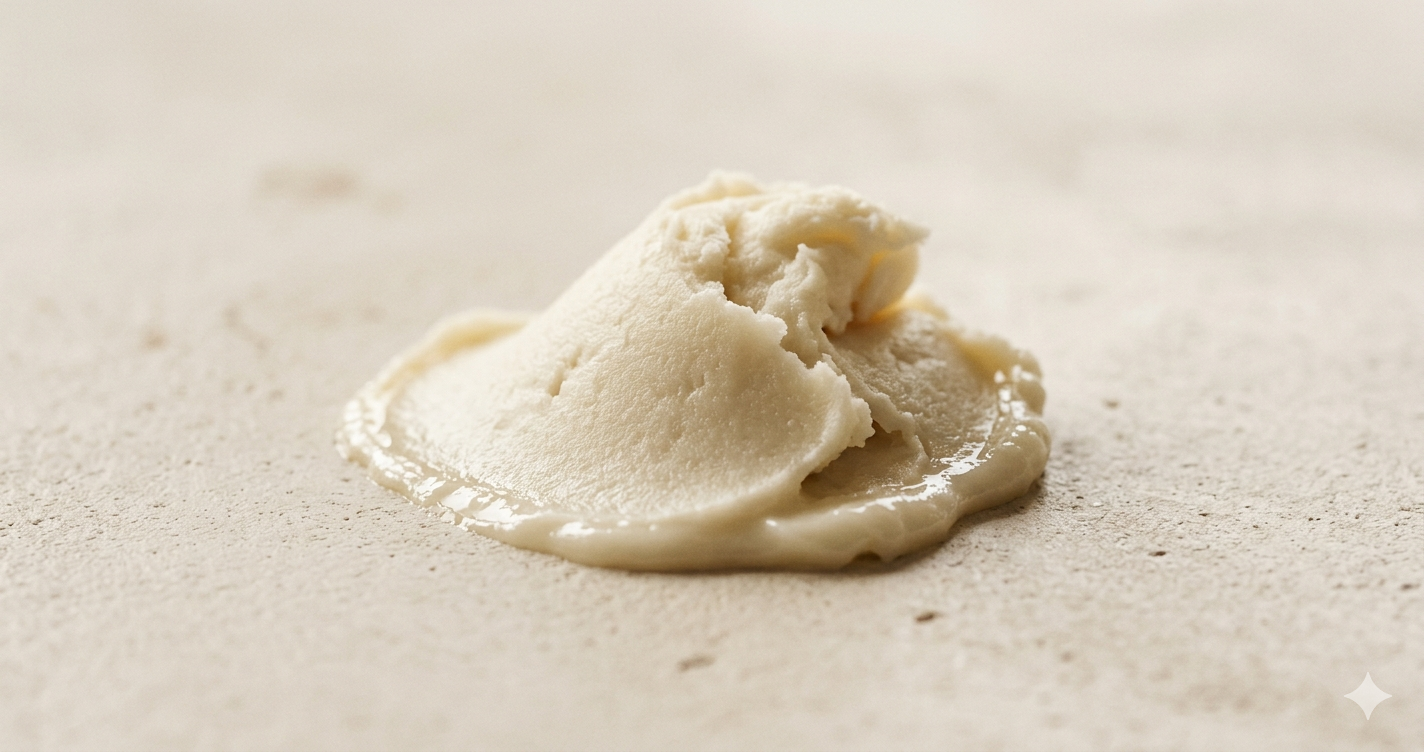
Shea butter is the fat extracted from the seeds of Vitellaria paradoxa.
At room temperature, it exists as a solid. This indicates a higher proportion of saturated fatty acids, which provide structural stability.
The dominant fatty acids in shea butter are stearic acid and oleic acid, together making up a large portion of its composition.
Stearic acid is a long-chain saturated fatty acid also present in the skin’s lipid system.
Oleic acid is a monounsaturated fatty acid commonly found in sebum and plant oils.
This composition is structurally compatible with the skin’s lipid architecture.
In addition, shea butter contains an unsaponifiable fraction that includes triterpenes, tocopherols, and phytosterols.
These components contribute to its functional role in barrier repair.
Why Shea Butter in Skin Barrier Repair Works — The Structural Reason
The skin barrier is a structured lipid system composed of corneocytes and intercellular lipids.
This lipid matrix regulates water loss and maintains hydration balance.
When this system is disrupted, transepidermal water loss increases and the skin loses its ability to retain moisture effectively.
Shea butter contributes to barrier repair through two mechanisms.
First, its fatty acids are compatible with the lipid matrix of the skin and can support lipid replenishment.
Second, its triterpene components support the repair environment by reducing low-grade inflammation associated with barrier disruption.
This allows the skin’s natural repair processes to function more effectively.
The Distinction Between an Occlusive and a Barrier Repair Ingredient
Many occlusive ingredients reduce water loss by forming a film on the skin surface.
This slows evaporation but does not contribute structural lipids.
Shea butter provides both an occlusive effect and lipid compatibility.
It helps reduce water loss while also contributing components that align with the skin’s lipid structure.
This dual role is what differentiates it from simple occlusives.
Why Concentration and Formulation System Determine Efficacy
Shea butter does not provide barrier repair benefits at very low concentrations.
For functional impact, it must be present at a level where its fatty acids can contribute meaningfully to the skin surface.
In leave-on products, this typically requires moderate concentration within the formulation.
The surrounding formulation system is equally important.
Shea butter works best when combined with humectants that support hydration and with a stable emulsion system that ensures consistent contact with the skin.
This combination determines how effectively the ingredient performs over time.
Shea Butter in Indian Climate Conditions
Indian climate conditions present a unique challenge for barrier repair formulations.
Heat, humidity, pollution, and frequent cleansing all contribute to barrier disruption.
At the same time, heavy formulations may feel uncomfortable in high temperatures.
This creates a balance requirement.
Shea butter needs to be used at functional levels while maintaining a texture suitable for daily use.
This is achieved by combining it with lighter lipids such as squalane or jojoba oil.
This approach allows the formulation to remain effective while improving usability across different climate conditions.
Reading Shea Butter on a Label
When evaluating a product, the position of shea butter in the ingredient list provides useful information.
Ingredients are listed in descending order of concentration.
If shea butter appears lower in the list, its contribution may be limited.
If it appears higher and is supported by other lipid components, it is more likely to be functionally relevant.
The surrounding formulation determines whether the ingredient contributes to barrier repair or is present in minimal amounts.
Nature Theory Formulation Approach
At Nature Theory, shea butter is used as part of a structured lipid system.
It is combined with other lipids and supportive ingredients to create a balanced formulation.
The focus is not on individual ingredients in isolation, but on how the system functions as a whole.
This approach ensures that barrier support is achieved through consistent use in real environmental conditions.
Conclusion
Shea butter functions in barrier repair through lipid compatibility and supportive bioactive components.
Its effectiveness depends on concentration, formulation structure, and consistency of use.
Understanding this allows for better evaluation of products and formulation systems.
At Nature Theory, formulations are designed with this structure in mind — because barrier repair depends on how ingredients work together, not just which ingredients are included.
Frequently Asked Questions
Does shea butter repair the skin barrier on its own?
Shea butter contributes to barrier repair through its fatty acid composition and bioactive components. However, effective barrier repair depends on the full formulation system, including other lipids, humectants, and the overall structure of the product.
What concentration of shea butter is effective in skincare?
Shea butter needs to be present at a functional concentration to contribute meaningfully to barrier repair. In most leave-on formulations, moderate concentrations are required for its lipid contribution to have a measurable effect.
Why do some shea butter products feel heavy on the skin?
Texture depends on formulation, not just the ingredient itself. Shea butter can feel heavy if used in high concentrations without balancing lipids. Well-designed formulations combine it with lighter lipids to improve usability in different climate conditions.
Latest Posts
Continue learning how skincare works.
We explain ingredients, formulation systems, and climate-based skincare in a structured way.
1 thought on “Shea Butter in Skin Barrier Repair: How It Works, Why Concentration Matters, and What Indian Skin Actually Needs”
Comments are closed.