
How to Choose a Cleanser for Your Skin Type
Choosing a cleanser based on skin type seems straightforward.
Oily skin gets stronger cleansers.
Dry skin gets gentler ones.
But this approach often leads to the same problems:
- tightness after washing
- oil returning quickly
- skin feeling both dry and oily
Because skin does not respond to labels.
It responds to how cleansing interacts with its structure.
What Actually Happens When You Cleanse
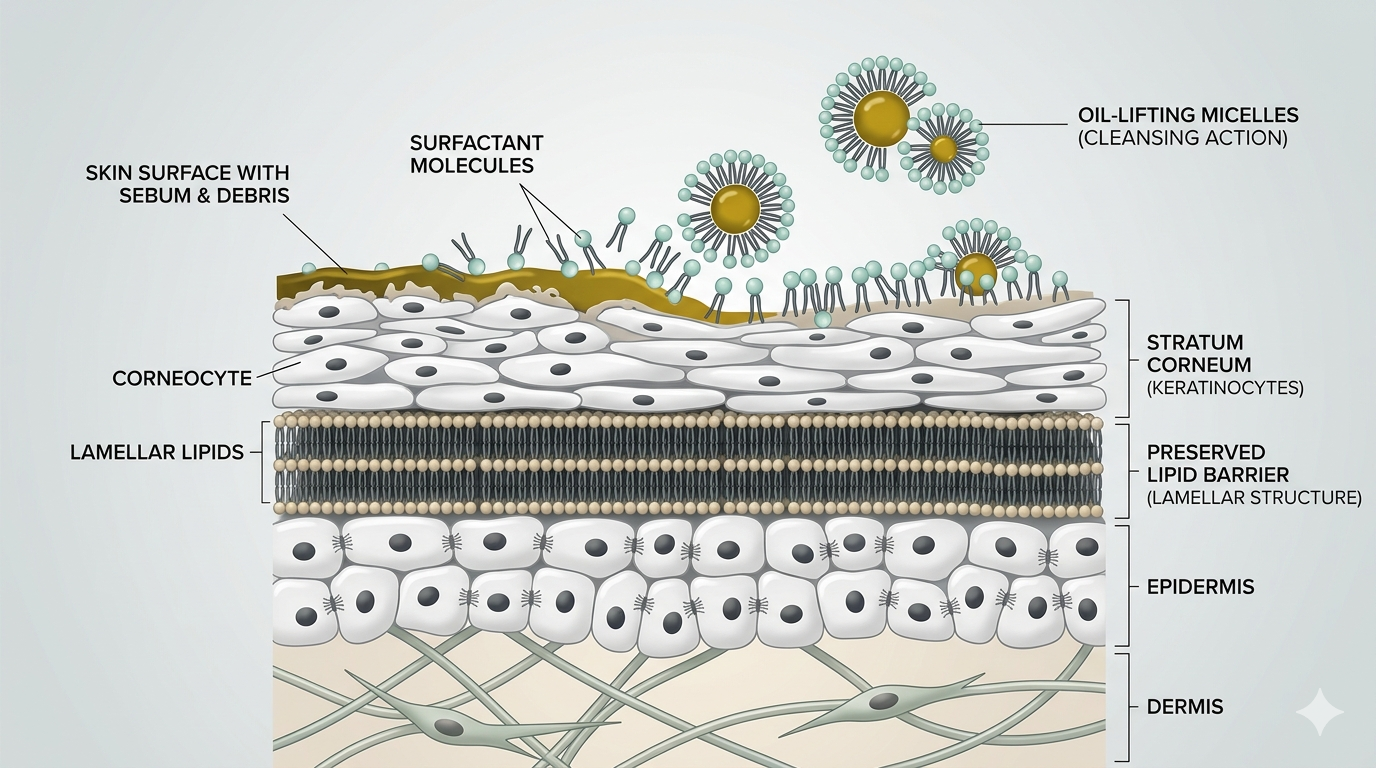
The skin surface is not just oil and dirt.
It is a structured system made of:
- lipids that hold cells together
- natural moisturizing factors that retain water
- a controlled balance of water and oil
When you cleanse, surfactants lift oil and impurities so they can be rinsed away.
But they do not distinguish between:
- excess oil
- essential lipids
If too much is removed, the barrier becomes temporarily unstable.
Water escapes more easily.
Skin feels tight.
Oil production often increases to compensate.
This is why “squeaky clean” is often a sign of disruption, not effectiveness.
The Role of Surfactants (Where Cleansers Actually Differ)
The real difference between cleansers lies in their surfactant systems.
Surfactants have two ends:
- one that binds to oil
- one that binds to water
This allows oil to be lifted and washed away.
But the type and structure of surfactants determine how aggressively this happens.
Strong Surfactant Systems
Common examples include:
- sodium lauryl sulfate (SLS)
- sodium laureth sulfate (SLES)
These create:
- high foam
- strong cleansing action
But they can also:
- remove lipids excessively
- increase transepidermal water loss
- leave the skin feeling tight
Mild Surfactant Systems
These often include:
- glucosides (like decyl glucoside)
- amino acid–based surfactants
They are typically combined with:
- humectants
- polymer systems that reduce irritation
This creates a more controlled cleansing process that:
- removes impurities
- preserves more of the barrier
This is what “gentle cleansing” actually means at a formulation level.
Why Skin Type Alone Is Not Enough
Two people with “oily skin” can respond very differently to the same cleanser.
Because what matters is:
- how often they cleanse
- the condition of their barrier
- their environment (humidity, AC, pollution)
For example:
Oily skin in humid weather often gets over-cleansed.
This increases dehydration and triggers more oil production.
Dry skin in air-conditioned environments may lose water faster, even with mild cleansing.
So the better question is not:
“What is my skin type?”
But:
“How does my skin behave after cleansing?”
How to Choose a Cleanser Based on Skin Behavior
If your skin feels tight after washing
This usually means too many lipids are being removed.
Instead of switching to a heavier moisturizer, it is more effective to reduce cleansing disruption.
A low-foam cleanser with a mild surfactant system helps maintain balance without stripping.
If your skin becomes oily again very quickly
This is often a response to over-cleansing.
When too much oil is removed, the skin compensates.
A more balanced cleanser can stabilize oil production over time.
If your skin feels both oily and dry
This is common in Indian climates.
Surface oil increases, but internal hydration is unstable.
Using stronger cleansers worsens this imbalance.
A mild cleanser combined with proper hydration is more effective.
If your skin is sensitive or easily irritated
This usually reflects barrier instability.
Cleansing should reduce stress, not add to it.
Simpler formulations with mild surfactants and fewer irritants help improve tolerance over time.
Texture Does Not Tell You How a Cleanser Performs
Gel, foam, cream — these are formats, not performance indicators.
A gel cleanser can be harsh if it uses strong surfactants.
A foam can be mild if it uses buffered systems.
For example:
A low-foam gel cleanser with glucosides may be gentler than a rich foam built on sulfates, even if both are labeled for oily skin.
So instead of relying on texture, look for:
- how your skin feels after washing
- whether tightness or rebound oil occurs
That feedback is more reliable than labels.
Climate Changes How Cleansers Behave
In Indian conditions, this becomes even more important.
High humidity increases sweat and oil, leading people to cleanse more frequently.
Air-conditioning reduces humidity, increasing water loss.
Pollution requires effective cleansing, but repeated stripping worsens barrier damage.
Most people do well with cleansing once or twice daily.
If additional cleansing is needed, the cleanser must be mild enough to avoid cumulative disruption.
Practical Understanding
A well-chosen cleanser does not draw attention to itself.
It:
- removes what needs to be removed
- leaves the skin comfortable
- allows the rest of the routine to work effectively
If cleansing creates a problem that your moisturizer has to fix, the system is not balanced.
Conclusion
Choosing a cleanser is not about matching a product to a skin type.
It is about understanding how cleansing interacts with the skin barrier.
At Nature Theory, cleansing is approached as a structural step:
remove excess without removing stability.
Because clean skin is not skin that feels stripped.
It is skin that remains balanced after washing.
And that balance determines how everything else in your routine performs.
Frequently Asked Questions
Is choosing a cleanser based on your skin type actually the wrong approach? For most people, yes. Skin type labels — oily, dry, combination, sensitive — are too broad to tell you how a cleanser will actually behave on your skin. Two people with oily skin can respond completely differently to the same face wash depending on how healthy their barrier is, how often they cleanse, and what environment they’re in. The more reliable way to choose a cleanser is to observe how your skin behaves after washing — not to match a label to a category.
Why does your oily skin get even oilier after using a face wash made for oily skin? Because most face washes made for oily skin use strong surfactants that strip oil very aggressively. When your skin loses too much of its natural oil, it responds by producing more to compensate and re-protect the barrier. So the more you use that strong cleanser, the more oil your skin produces, and the more you feel you need to cleanse — it becomes a self-reinforcing cycle. The fix is usually a milder cleanser, not a stronger one. Once your skin stops being over-stripped, oil production tends to settle down on its own.
What are surfactants and why do they matter more than everything else in a cleanser? Surfactants are the actual cleansing ingredients in your face wash — they’re what lifts oil and dirt off your skin so water can wash them away. Everything else in a cleanser — fragrance, texture, colour — is largely cosmetic. The type of surfactant used, and how the surfactant system is structured, determines whether the cleanser gently removes impurities or aggressively strips everything including what your skin needs to stay healthy. Knowing whether a cleanser uses strong sulfate surfactants or milder glucoside and amino acid surfactants tells you more about how it will treat your skin than any skin-type claim on the front of the packaging.
Is SLS actually bad — and should you avoid it in face washes? Sodium lauryl sulfate is a strong, effective surfactant that creates rich foam and removes oil very thoroughly. For occasional use that’s mostly fine. The problem is daily face washing — twice a day, every day. At that frequency, a strong surfactant like SLS removes not just excess oil and impurities but also the essential lipids your barrier needs to function. Over weeks and months this accumulates as barrier disruption — increasing sensitivity, rebound oiliness, and dehydration. For daily cleansers used twice a day, milder alternatives are better suited to long-term barrier health.
Does it matter whether a cleanser is a gel, foam, or cream — which texture is best? Texture is one of the most misleading things about cleansers. A gel can be harsh or gentle depending entirely on which surfactants it uses. A foam can be mild or stripping for exactly the same reason. A cream cleanser isn’t automatically gentler just because it looks creamier. The format tells you almost nothing about how the cleanser will actually treat your skin. What matters is the surfactant system inside — and the only reliable way to assess that is to observe how your skin feels after using it consistently for a week or two.
What does it mean when a cleanser says “for sensitive skin” — is it actually safer? It usually means the brand has made an effort to reduce obvious irritants — harsh surfactants, strong fragrance, certain preservatives. That’s a reasonable starting point. But “for sensitive skin” is a marketing claim, not a regulated standard. A cleanser labelled for sensitive skin can still be poorly formulated and disruptive if the surfactant system isn’t actually mild. Judge by results, not labels. If your skin feels comfortable and balanced after washing, the cleanser is working. If it feels tight, irritated, or quickly oily, it isn’t — regardless of what the label says.
How many times a day should you wash your face — and does it depend on your skin type? Twice a day — morning and evening — works for most people when the cleanser is gentle enough. But skin type and environment do affect this. In humid Indian summers, where sweating and outdoor pollution build up quickly, twice daily cleansing makes sense. In cooler or drier conditions, some people with dry or sensitive skin may find once daily is enough, using only water in the morning. The key variable is not just frequency but the cumulative impact of your cleanser on your barrier. A gentle cleanser used twice daily causes less total damage than a harsh one used once.
Why does the same face wash feel fine in monsoon but harsh and drying in winter? Because your skin’s condition changes with the environment, and that changes how the same formula affects it. In humid monsoon conditions, there’s more moisture available and your skin barrier is under less water-loss stress — so even a moderately strong cleanser feels manageable. In drier winter air, your skin is already losing moisture faster, the barrier is more fragile, and the same cleanser pushes it further out of balance. This seasonal difference is a useful signal: if your cleanser starts feeling harsh in certain conditions, it was always borderline — the environment just revealed it.
Can your cleanser be causing your breakouts — even if it’s specifically marketed for acne-prone skin? Yes, and this is surprisingly common. Many cleansers marketed for acne-prone skin use strong surfactants and additional drying agents designed to remove as much oil as possible. This disrupts the barrier significantly. A disrupted barrier is inflamed and reactive — conditions that can actually worsen breakouts even as the cleanser is aggressively trying to prevent them. Acne-prone skin still needs a gentle, barrier-respecting cleanser. The acne treatment — if needed — should come from targeted treatments applied after cleansing, not from making the cleanser more aggressive.
What should your skin feel like right after washing — if the cleanser is actually the right one? Comfortable. That’s the only word that matters. Not tight, not dry, not squeaky, not like it needs a moisturiser immediately to feel okay. But also not greasy or like the cleanser didn’t do anything. Just clean and comfortable — the same way your skin feels on a good day without any products. If you can wash your face, rinse, pat dry, and walk away without your skin feeling like it’s in distress or urgently needs something to fix it — that’s the sign that your cleanser is working with your skin rather than against it.
Latest Posts
Continue learning how skincare works.
We explain ingredients, formulation systems, and climate-based skincare in a structured way.