
The Problem
Humectants for skin hydration play a key role in maintaining water balance in the skin. Many people experience dryness, tightness, or dehydration even after using skincare products, and the issue often comes down to how water is managed within the skin.
Skin may feel:
- dry even after applying moisturizer
- tight within a few hours
- uncomfortable in air-conditioned environments
- dehydrated despite multiple skincare steps
This often leads to a common assumption:
👉 “I need a heavier moisturizer.”
But hydration is not just about adding thicker products. It depends on how effectively the skin can attract, hold, and retain water.
The Science of Skin Hydration
Skin is not a passive surface that simply absorbs moisture. It is a structured system designed to regulate water movement.
The outermost layer of the skin, the stratum corneum, acts as a barrier. It helps:
- retain water within the skin
- protect against external stress
- maintain overall skin comfort
However, water is constantly moving from deeper layers of the skin toward the surface. Some of this water evaporates into the environment. This process is known as:
👉 transepidermal water loss (TEWL)
To maintain proper hydration, the skin needs mechanisms that:
- increase water content in the outer layers
- slow down water loss
Humectants directly support the first part of this system.
What Are Humectants?
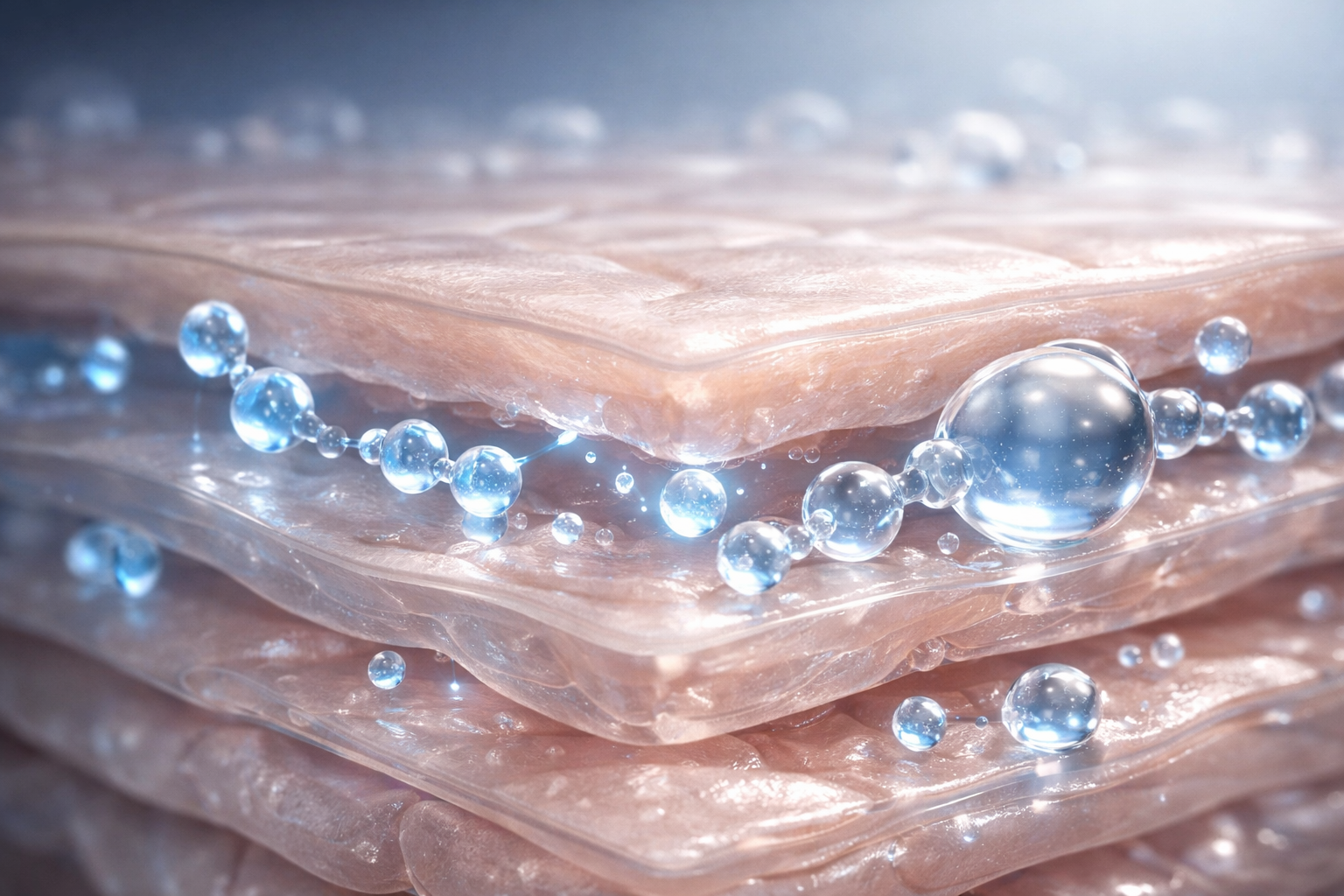
Humectants are ingredients that attract and bind water.
They work by drawing water from:
- deeper layers of the skin
- the surrounding environment (when humidity is present)
This increases the water content in the outer layer of the skin, improving hydration and flexibility.
Humectants for skin hydration are essential because they directly influence how much water the skin can hold at the surface level.
How Humectants Work
Humectants interact with water molecules and help retain them within the skin’s outer layers.
When applied:
- they bind water and increase hydration levels
- they improve skin softness and flexibility
- they reduce the feeling of tightness
This results in skin that feels:
- smoother
- more comfortable
- more balanced
However, humectants do not prevent water from escaping. Their function is to increase water availability, not to seal it in.
Common Humectants in Skincare
Several ingredients function as humectants. Each contributes differently depending on formulation.
Glycerin
- one of the most effective humectants
- improves hydration across environments
- widely used in formulations
Hyaluronic Acid
- binds large amounts of water
- improves surface hydration
- commonly used in serums
Sodium PCA
- naturally present in the skin
- supports moisture balance
Urea (low concentrations)
- acts as a humectant and mild exfoliant
- improves water retention
Aloe Vera
- provides light hydration
- often used in soothing products
These ingredients are effective, but their performance depends on how they are combined with other components.
Why Humectants Alone Are Not Enough
A common mistake is relying only on humectants for hydration.
While humectants increase water content, they do not:
👉 prevent water loss
If the skin barrier is weak:
- water drawn to the surface can evaporate quickly
- hydration becomes temporary
- skin may feel dry again within hours
This is why humectants for skin hydration must be used within a complete system.
The Role of Lipids and Occlusives
To maintain hydration, the skin needs additional support.
Lipids (Barrier Support)
Lipids help maintain the structure of the skin barrier.
Examples:
- ceramides
- fatty acids
- cholesterol
They reduce barrier disruption and improve water retention over time.
Occlusives (Water Retention)
Occlusives create a protective layer on the skin.
Examples:
- petrolatum
- silicones
- waxes
They slow down water evaporation and help retain hydration.
The Ideal Hydration System
Effective hydration depends on combining:
- Humectants → attract water
- Lipids → support barrier structure
- Occlusives → reduce water loss
Without this structure:
👉 hydration remains incomplete and inconsistent
Environmental Impact on Humectants
Humectants behave differently depending on environmental conditions.
High Humidity
- more water available in the air
- humectants perform effectively
Low Humidity (AC rooms, dry climates)
- limited external moisture
- humectants may pull water from deeper skin layers
Without occlusives:
👉 this can lead to increased dehydration over time
When to Use Humectants
Humectants are most effective when:
- applied to slightly damp skin
- followed by a moisturizer
- used consistently in a routine
They are commonly found in:
- serums
- toners
- lightweight moisturizers
Signs Your Skin Needs Humectants
You may benefit from humectants for skin hydration if your skin feels:
- tight after cleansing
- dehydrated during the day
- dull or lacking elasticity
These signs indicate low water content in the outer skin layer.
Signs of Improper Use
Humectants may not work effectively if:
- used alone without barrier support
- applied in very dry environments without occlusion
- overused without balancing ingredients
This can result in:
- temporary hydration
- recurring dryness
- inconsistent skin comfort
How to Use Humectants Correctly
To maximize effectiveness:
- Apply on slightly damp skin
- Layer with lipid-rich moisturizer
- Use consistently within a structured routine
This ensures water is:
- attracted
- retained
- protected
Hydration Is a System, Not a Product
One of the most common misconceptions is:
👉 “This product hydrates the skin.”
In reality, hydration depends on:
- ingredient function
- formulation structure
- environmental conditions
Humectants for skin hydration are only one part of a larger system.
Conclusion
Humectants for skin hydration play a critical role in increasing water content in the skin. They help improve softness, flexibility, and overall comfort.
However, they do not work alone.
Effective hydration requires:
- water attraction (humectants)
- barrier support (lipids)
- water retention (occlusives)
Understanding this structure leads to more consistent and predictable skincare results.
Latest Posts
Continue learning how skincare works.
We explain ingredients, formulation systems, and climate-based skincare in a structured way.
7 thoughts on “Humectants for Skin Hydration: How They Work and Why They Matter”
Comments are closed.