
Understanding the Real Problem
Skin concerns are often approached too simply.
When skin feels dry, the usual response is to:
- Apply a heavier moisturizer
- Add more hydrating products
- Layer multiple skincare steps
However, even after doing all this, skin may still:
- Feel dry within hours
- Remain tight despite moisturizing
- Show uneven texture
- React easily to environmental changes
This often leads to confusion:
- “Am I not hydrating enough?”
- “Do I need richer products?”
In reality, the issue is not about using more products—it’s about understanding what the skin truly needs.
Healthy skin depends on two essential components:
👉 water and lipids working together
The Science Behind Skin Balance
The outermost layer of the skin, called the stratum corneum, plays a vital role in maintaining balance.
It performs two key functions:
- Retains water within the skin
- Prevents excessive water loss
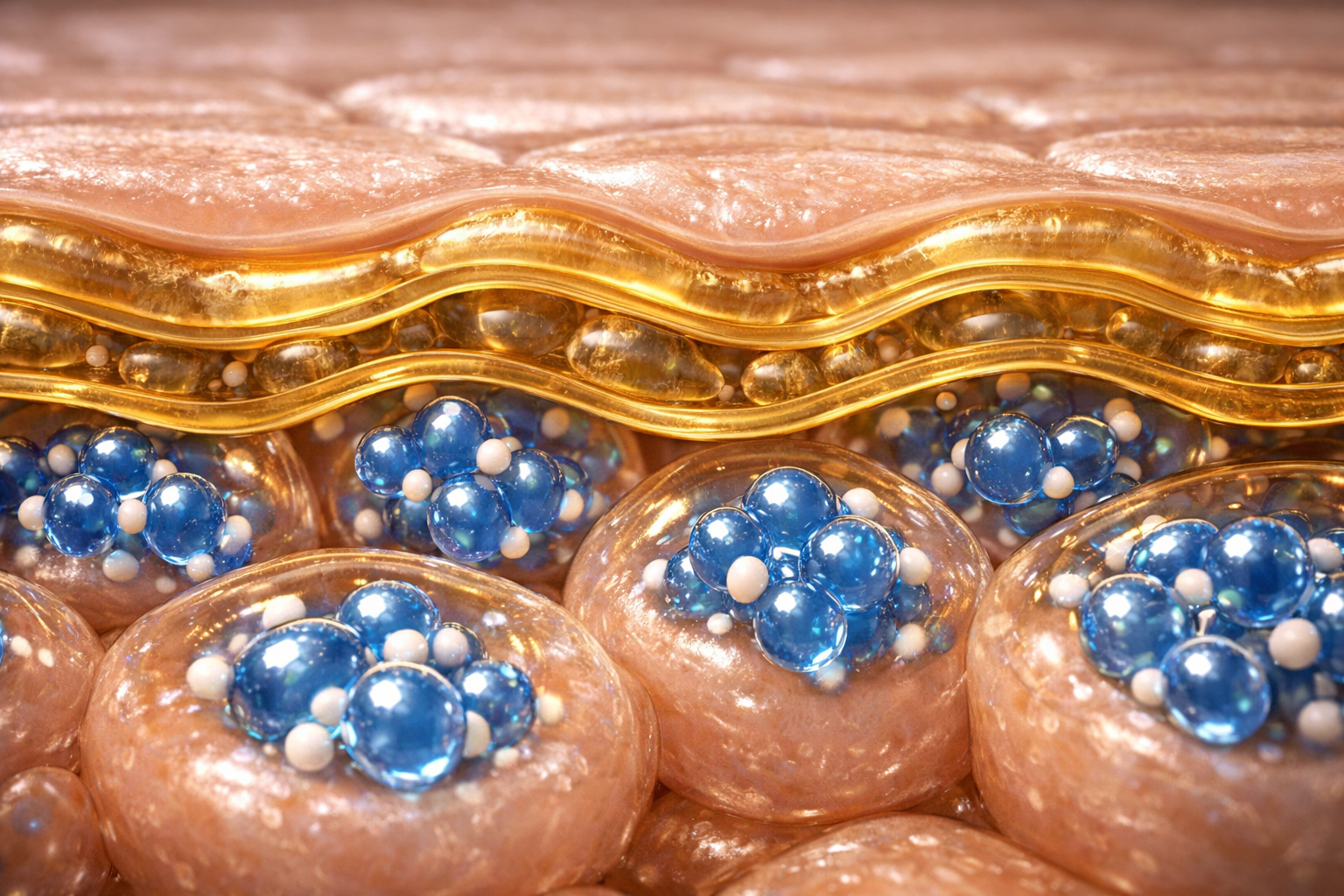
Its structure is often described as a “bricks and mortar” system:
- Bricks: skin cells (corneocytes) that hold water
- Mortar: lipids that bind everything together
The Role of Water in Skin Health
Water is crucial for:
- Skin flexibility
- Smooth texture
- Overall comfort
When skin has enough water:
- It feels soft
- It looks more even
- It functions properly
Water is maintained through:
- Natural moisturizing factors (NMF)
- Humectant ingredients in skincare
But there’s a catch—water alone isn’t stable in the skin.
Why Water Alone Isn’t Enough
Water continuously moves through the skin and naturally evaporates through a process called transepidermal water loss (TEWL).
If the skin barrier is weak:
- Water escapes quickly
- Hydration becomes short-lived
- Dryness returns soon
This explains why hydrating products alone may not deliver lasting results.
The Role of Lipids in Skin Health
Lipids act as the skin’s structural support system. Key lipids include:
- Ceramides
- Cholesterol
- Fatty acids
They:
- Fill gaps between skin cells
- Form a protective barrier
- Reduce water loss
Their job isn’t to add water—but to retain and protect it.
How Lipids Support Hydration
Lipids help by:
- Sealing structural gaps
- Slowing water evaporation
- Strengthening the skin barrier
When lipid levels are balanced:
- Water stays in the skin longer
- Hydration becomes stable
- Skin feels consistently comfortable
Why Skin Needs Both Water and Lipids
Water and lipids serve different but complementary roles:
Water provides:
- Hydration
- Flexibility
- Internal moisture
Lipids provide:
- Structure
- Protection
- Moisture retention
Without water → skin becomes dehydrated
Without lipids → hydration cannot be maintained
How Water and Lipids Work Together
Healthy skin depends on their balance.
When both are present:
- Water is retained effectively
- The barrier remains strong
- Skin functions smoothly
When the balance is disrupted:
- Water escapes quickly
- The barrier weakens
- Skin becomes sensitive
What Happens When Balance Is Lost
- Low water, normal lipids:
Skin feels tight, dull, and less flexible - Adequate water, low lipids:
Hydration fades quickly and sensitivity increases - Low water and low lipids:
Persistent dryness and barrier damage occur
Environmental Impact (Indian Conditions)
External conditions play a major role in this balance:
Heat & Humidity
- Increase sweating
- Lead to frequent cleansing
- Can disrupt lipids
Air Conditioning
- Reduces moisture in the air
- Increases water loss
Pollution
- Weakens the skin barrier
- Damages lipid integrity
Hard Water
- Leaves mineral residue
- Disrupts barrier balance
👉 In such environments, both hydration and lipid support are essential.
Understanding Ingredients and Formulations
Effective skincare uses a combination of ingredients:
Humectants (Water Support)
- Glycerin
- Sodium PCA
- Hyaluronic acid
✔ Attract and hold water
Lipids (Barrier Support)
- Ceramides
- Squalane
- Fatty acids
✔ Strengthen barrier and reduce water loss
Botanical Extracts
✔ Soothe irritation
✔ Support barrier repair
✔ Provide antioxidant protection
Practical Takeaway
Instead of focusing only on labels like “hydrating” or “moisturizing,” ask:
- Does the product include humectants?
- Does it contain barrier-supporting lipids?
- Is the formulation balanced?
Products that combine both typically offer:
- Longer-lasting hydration
- Better comfort
- Improved skin stability
A System-Level View of Skincare
Healthy skin works as a system:
- Water must be present
- Lipids must retain it
- The barrier must stay intact
Focusing on just one element leads to incomplete results.
Balanced skincare ensures that:
👉 hydration is not just achieved—but maintained
Conclusion
Skin health is about more than hydration alone.
Water delivers essential moisture, while lipids ensure that moisture stays protected.
When both are balanced:
- Skin remains stable
- Hydration lasts longer
- Overall comfort improves
Understanding this relationship helps you make smarter, more effective skincare choices.
Latest Posts
Continue learning how skincare works.
We explain ingredients, formulation systems, and climate-based skincare in a structured way.
4 thoughts on “Why Skin Needs Both Water and Lipids to Stay Healthy”
Comments are closed.