
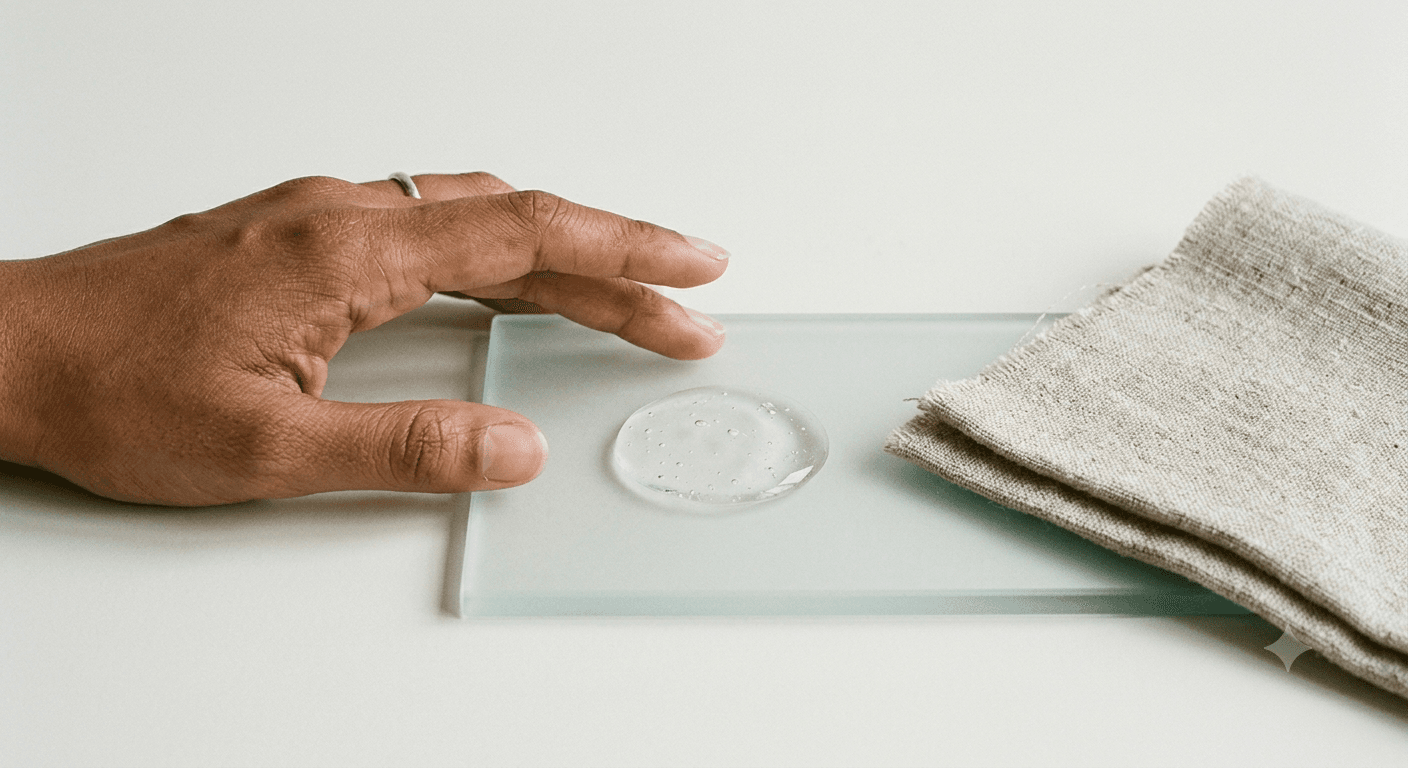
Propanediol has quietly become a common line item in skincare formulas, often standing in for glycerin. Many people assume this is a cost-cutting swap, but the substitution usually reflects a specific formulation goal: a lighter, faster-absorbing humectant with fewer sensorial trade-offs than glycerin at higher concentrations.
Why Some Moisturizers Feel Heavy or Sticky in Humid Weather
Many people notice that a moisturizer feels pleasant in air-conditioned rooms but turns tacky or heavy the moment they step outside into heat and humidity. This is often blamed on the product being “too rich,” but the real cause is usually the humectant system, not the oil content.
Common complaints include:
- A sticky or tacky film that lingers for several minutes after application
- Product that seems to “pill” under sunscreen or makeup
- A moisturizer that feels fine in winter but unusable in summer
- Slower absorption in high-humidity months
This is not just a texture preference. Humectant choice affects how a product performs across seasons, which changes whether people actually keep using it.
The Science of Propanediol as a Humectant
Propanediol is a 1,3-propanediol, a small diol molecule that can be produced through fermentation of corn glucose or, less commonly, through a petrochemical route. Diol refers to a molecule with two hydroxyl (OH) groups, which is what gives it humectant properties, meaning it can attract and hold water at the skin’s surface.
Glycerin is also a humectant, but it is a triol, meaning it carries three hydroxyl groups instead of two. This extra hydroxyl group makes glycerin more hygroscopic, or better at pulling in water, but also gives it a thicker, tackier feel, especially in humid air where it draws in ambient moisture rather than only skin-bound water.
Propanediol has a lower molecular weight and lower viscosity than glycerin. It still functions as a humectant, but with a lighter, faster-absorbing skin feel. It also acts as a solvent, helping dissolve other ingredients such as preservatives and plant extracts, and has some ability to enhance penetration of actives into the skin.
Formulation Logic: Where Propanediol Fits in a Humectant System
Propanediol is rarely used as a full replacement for glycerin. Most formulations use both, adjusting the ratio to control tackiness, since it sits in the humectant phase alongside glycerin, sodium PCA, and low molecular weight hyaluronic acid, each contributing a different water-holding mechanism rather than duplicating one function.
The nuanced point most explanations skip: this ingredient also acts as a preservation booster. At sufficient concentration, it lowers water activity in a formula, which supports preservative efficacy, particularly in systems built around Geogard ECT. This is a formulation reason for its use that has nothing to do with skin feel.
Ratio matters more than presence. A formula heavy in this humectant but light on glycerin can under-perform in very dry conditions, since glycerin’s stronger water pull matters when ambient humidity is low. The system, not the single ingredient, determines whether hydration holds up across a full day.
Practical Advice for Choosing the Right Humectant Blend
- Check ingredient order: propanediol should be listed within the first third of the ingredient list if it is meant to function as a primary humectant, not just a minor solvent.
- Pair with a barrier cream in dry winter months, since propanediol alone may not provide enough water-pull when ambient humidity drops sharply.
- Look for it alongside glycerin or sodium PCA on the label, since a blended humectant system typically performs more consistently than either ingredient alone.
- Apply on damp skin, since humectants including propanediol work by drawing in available water, and slightly damp skin gives them more water to draw from.
Climate Relevance for Indian Skin
Heat and sweat cycles across most of the year change how any humectant performs, since higher skin temperature increases water loss even when ambient humidity is high. A lighter humectant does not turn tacky as skin heats up through the day, unlike thicker options that feel heavier under sweat.
Monsoon humidity creates a paradox: air feels wet, but that does not mean skin is retaining water. Lighter humectants tend to feel more comfortable in these months since they do not add to the stickiness already present in humid air.
AC exposure, common in Indian offices and homes, lowers indoor humidity artificially, increasing skin’s reliance on humectants rather than ambient moisture. A well-chosen humectant blend matters more, not less, in air-conditioned environments where skin cannot rely on the air itself.
Where This Fits at Nature Theory
Nature Theory’s hydration formulations use a blended humectant system rather than relying on any single ingredient, including this one, in isolation. The logic follows the same principle described above: pairing fast-absorbing and stronger water-holding humectants so performance holds up across seasons rather than favoring one weather condition. This reflects a broader commitment to formulation systems over single-ingredient claims.
Summary
This is not a story about one ingredient outperforming another. Lighter humectants and heavier ones each hold water differently, and the right formula usually blends both rather than choosing sides. The shift many brands are making reflects skin feel and climate performance, not evidence that older humectants no longer work. A good formulation earns its result through the combination, not the label on a single ingredient.
FAQ
Is this humectant safe for sensitive skin? Yes, in most formulations. It is generally well tolerated, though as with any humectant, very high concentrations without a supporting barrier system can cause mild dryness in reactive skin.
Does this ingredient work as well as glycerin in dry climates like Delhi winters? Not on its own. Glycerin’s stronger water-pulling ability tends to matter more in low-humidity conditions, so most effective formulas pair the two rather than relying on one alone.
Why do more skincare brands use this ingredient instead of glycerin now? It offers a lighter, less tacky skin feel and doubles as a mild preservation booster, which is useful in humid Indian conditions such as Mumbai or Chennai where product stability is harder to maintain.
Can this humectant help with AC-related dryness? It can help, but it is rarely enough on its own. AC environments lower ambient humidity significantly, so a full humectant and lipid system generally performs better than any single ingredient.
Latest Posts
Continue learning how skincare works.
We explain ingredients, formulation systems, and climate-based skincare in a structured way.