
The Problem
You try a product that everyone recommends.
It has the right ingredients. The reviews are strong. It should work.
But on your skin, nothing really changes. Or worse, it feels uncomfortable after a few uses.
Then you try another product with almost the same ingredients—and it works better.
This is where most people get confused.
If the ingredients are the same, why does the result feel completely different?
What Most People Miss
When we look at skincare, we tend to focus on ingredient names.
Niacinamide. Hyaluronic acid. Vitamin C.
These become signals of performance.
But in reality, an ingredient name tells you very little about how a product will behave on your skin.
Because ingredients do not work alone.
They work inside a formulation.
And the formulation decides everything that happens after you apply the product.
What a Skincare Formulation Actually Is
A formulation is the complete structure of a product.
It defines how ingredients are combined, in what proportions, and in what environment they exist.
It controls:
- how the product spreads
- how quickly it absorbs
- whether it feels light or heavy
- whether it stays stable over time
- whether the active ingredients remain effective
Two products can have the same ingredient list and still behave differently because their internal structure is different.
Even small changes in concentration, pH, or texture system can change how the product interacts with your skin.
Why the Same Ingredient Can Behave Differently
Take a simple example.
You might use two products that both contain niacinamide.
One feels smooth, absorbs well, and improves skin balance over time.
The other feels sticky, sits on the surface, and causes mild irritation after repeated use.
The ingredient is the same. But the formulation is not.
What changes is:
- how much niacinamide is used
- what surrounds it in the formula
- how the product is structured
- how stable it remains during use
The skin is not reacting to the ingredient name. It is reacting to the entire system.
How Formulation Interacts With Skin
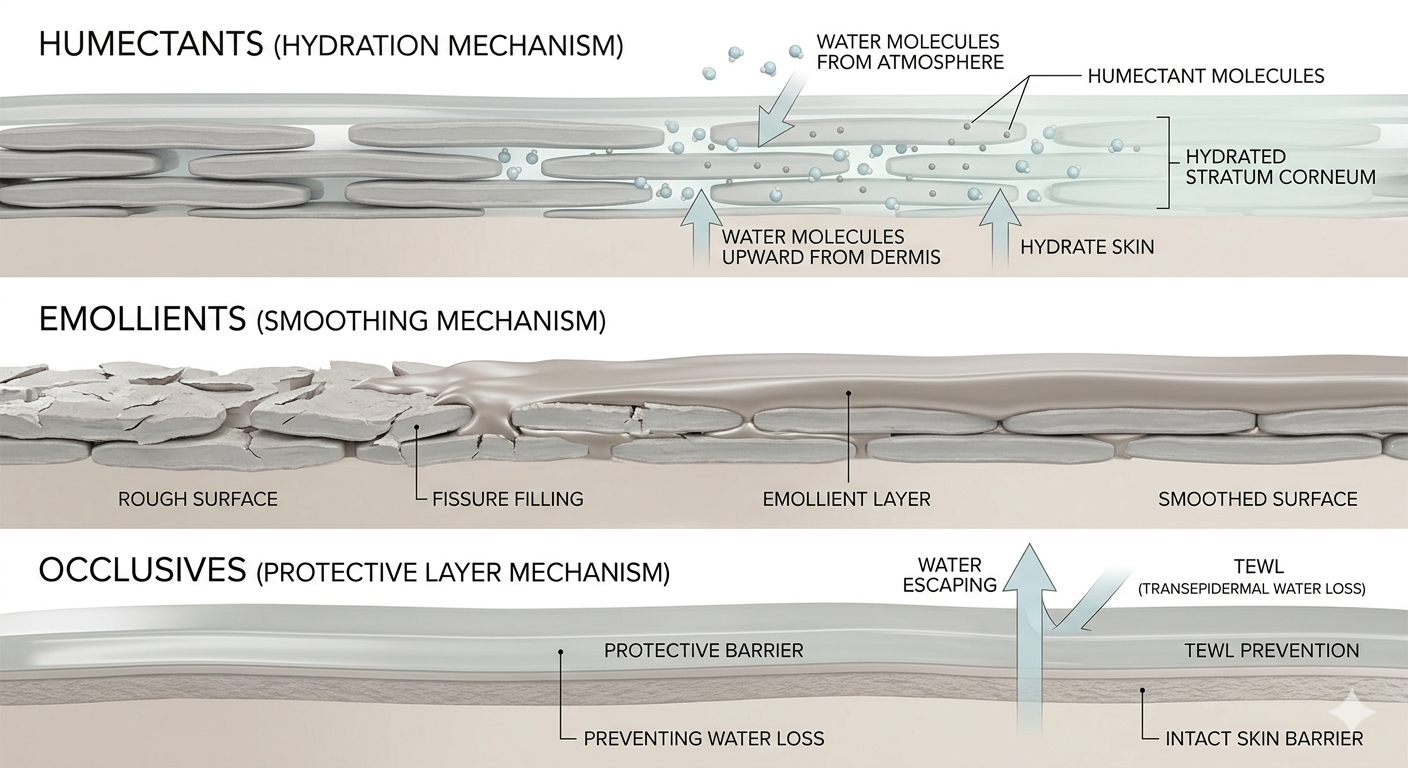
Your skin is constantly managing water, lipids, and external stress.
A product has to work within this system, not just sit on top of it.
If hydration is added without being supported, it disappears quickly.
If oils are added without balance, the product can feel heavy without improving comfort.
If active ingredients are included without a stable base, they may not perform consistently.
This is why formulation matters.
It determines whether a product supports the skin’s natural balance—or disrupts it.
Why Some Products Feel Good but Don’t Work Long-Term
A product can feel good immediately because of surface effects.
Slip, softness, or a temporary hydration boost can create the impression that it is working.
But if the formulation does not support water retention or barrier stability, that effect fades.
This is when you notice:
- dryness returning after a few hours
- inconsistent results over time
- skin feeling dependent on repeated application
Long-term performance depends on how well the formulation maintains balance, not just how it feels in the first few minutes.
Why Environment Changes Everything
A formulation does not exist in isolation. It interacts with your environment.
In India, this interaction becomes more noticeable.
You move between humid outdoor air and dry indoor environments throughout the day.
In humidity, products can feel heavier and slower to absorb.
In air-conditioned spaces, water leaves the skin faster, and lighter products may not be enough.
A well-designed formulation takes this into account.
It remains stable, comfortable, and effective across changing conditions—not just in one setting.
A More Useful Way to Think About Skincare
Instead of asking, “What ingredients does this product contain?” a better question is:
“How does this product behave on my skin over time?”
Does it stay comfortable after a few hours?
Does it feel balanced in both heat and indoor environments?
Does it remain consistent with regular use?
These are signs of a formulation that is working with your skin, not just reacting on the surface.
Conclusion
A skincare product is not defined by its ingredient list.
It is defined by how those ingredients are structured, balanced, and delivered to the skin.
This is why formulation matters.
It explains why two products with similar ingredients can perform very differently, and why real results depend on more than just what is written on the label.
At Nature Theory, this is the principle behind how products are designed.
Not by focusing on individual ingredients, but by building formulations where hydration, lipids, and active components work together in a stable, balanced system that supports the skin over time.
Frequently Asked Questions
Why did a product with amazing reviews do absolutely nothing for your skin? Because reviews tell you how a product worked on someone else’s skin — in their environment, with their routine, and their skin type. But more importantly, most people judge products by their ingredient lists, not by how those ingredients are put together. Two products can have the same star ingredients and behave completely differently because the internal structure — the formulation — is different. The ingredients are not the product. The formulation is.
What exactly is a skincare formulation — and why does it matter more than the ingredient list? A formulation is the complete structure of a product — how all the ingredients are combined, in what amounts, at what pH, and in what kind of base. It controls how the product spreads, how fast it absorbs, whether it stays stable, and whether the active ingredients actually reach your skin and do something. An ingredient list tells you what’s inside. The formulation determines what actually happens when it touches your skin. Two products can share almost identical ingredient lists and perform completely differently because their formulations are built differently.
Why do two products with the same key ingredient feel and work so differently? Because the ingredient doesn’t work in isolation — it works inside a system. Take niacinamide as an example. One product might use it at the right concentration, in a stable base, with supporting ingredients that help it absorb evenly. Another might use it at too high a concentration, in a formula with conflicting pH levels, surrounded by ingredients that cause irritation. Same ingredient name on both labels. Completely different experience on your skin. The ingredient is just one part. The system around it is everything.
Is a higher percentage of an active ingredient always better? No — and this is one of the most common misconceptions in skincare. A higher percentage sounds more effective on paper, but if the formulation isn’t built to support that concentration, it can actually cause irritation, sensitivity, or inconsistent results. A well-formulated product at a moderate concentration will outperform a poorly formulated one at double the percentage. More of an ingredient without the right structure around it is just more of a problem.
Why does a product feel great for the first few days and then stop working? This is a formulation problem, not a skin problem. Some products create strong immediate effects — a smooth slip, a temporary hydration boost, a fresh feeling — because of surface-acting ingredients. But if the formulation doesn’t actually support water retention or barrier stability, those effects fade quickly. Your skin hasn’t adapted or become immune to the product. The product was only working on the surface to begin with, and the surface effect has worn off. Real performance is measured at the two to three hour mark and over several weeks — not in the first few minutes.
Does pH actually matter in skincare — or is that just technical talk? It genuinely matters, and it affects you directly. Your skin’s natural surface is slightly acidic — around pH 4.5 to 5.5. Many active ingredients only work within a specific pH range. If a product’s pH is off, the actives in it may not function properly regardless of what the label says. A vitamin C product at the wrong pH won’t deliver the results it’s meant to. A niacinamide formula at too high a pH can cause irritation. pH is one of the hidden formulation factors that separates products that work from products that sound like they should.
Why does the same product feel different in summer versus winter, or indoors versus outdoors? Because a formulation doesn’t exist in a vacuum — it interacts with your environment. In humid conditions, products absorb more slowly and can feel heavier. In dry air-conditioned spaces, your skin loses water faster, so lighter products may not provide enough support. A product formulated only for one set of conditions will feel off in others. A well-designed formulation accounts for this variability and remains comfortable and effective across different environments — which is especially relevant in India where you shift between heat, humidity, and AC multiple times a day.
How do you know if a product is well-formulated without being a chemistry expert? You observe your skin’s behaviour, not just how the product feels at the moment of application. A well-formulated product keeps your skin comfortable two to three hours after applying — not just immediately after. Hydration doesn’t disappear within an hour. Your skin doesn’t feel tight, greasy, or irritated after consistent use. The effect feels stable and consistent from week one to week four. These real-world signals are more reliable than any ingredient list or marketing claim. Your skin tells you if the formulation is working — you just have to observe the right things.
Can two cheap products have better formulations than expensive luxury ones? Absolutely. Price reflects marketing, packaging, brand positioning, and distribution costs — not formulation quality. Some of the most thoughtfully formulated products in the market are mid-range. Some expensive luxury products rely heavily on fragrance, sensory textures, and branding while the core formulation is average. The formulation quality is about the decisions made in the lab — what concentrations are used, how the base is structured, how stable the actives are — and those decisions don’t automatically improve with price. Judge by how your skin behaves, not by what you paid.
Is “clean” or “natural” skincare automatically better formulated than regular skincare? No. Clean or natural labelling refers to ingredient sourcing and what’s excluded from the formula — not to how well the remaining ingredients are put together. A natural product can be poorly formulated and cause irritation or deliver no real benefit. A product with synthetic ingredients can be exceptionally well-formulated and highly effective. The formulation — how ingredients are combined, balanced, and stabilised — is what determines performance. Natural and synthetic are origin descriptors, not quality indicators. What matters is how the whole system works, not where individual ingredients came from.
Latest Posts
Continue learning how skincare works.
We explain ingredients, formulation systems, and climate-based skincare in a structured way.
3 thoughts on “What Is a Skincare Formulation and How Does It Work”
Comments are closed.