
Emollients vs Occlusives vs Humectants Explained
Many people use moisturizers daily but still experience dryness, tightness, or inconsistent skin comfort.
This often leads to confusion. If you are already using a moisturizer, why does your skin still feel dehydrated?
The answer lies in how moisturizers are built.
Not all moisturizers work in the same way. They are structured using three functional categories:
- humectants
- emollients
- occlusives
Understanding the difference between emollients vs occlusives vs humectants helps explain why some products feel hydrating but short-lived, while others feel heavy but protective.
How Skin Loses Moisture
The outermost layer of the skin — the stratum corneum — functions as a barrier system.
It is made of skin cells surrounded by lipids. This structure helps retain water and maintain stability.
At the same time, water continuously escapes through transepidermal water loss (TEWL).
When this balance is disrupted:
- skin loses water faster
- hydration drops
- skin feels tight or rough
Moisturizers work by controlling this balance — not just by adding moisture, but by managing how water is retained.
Emollients vs Occlusives vs Humectants: Key Differences
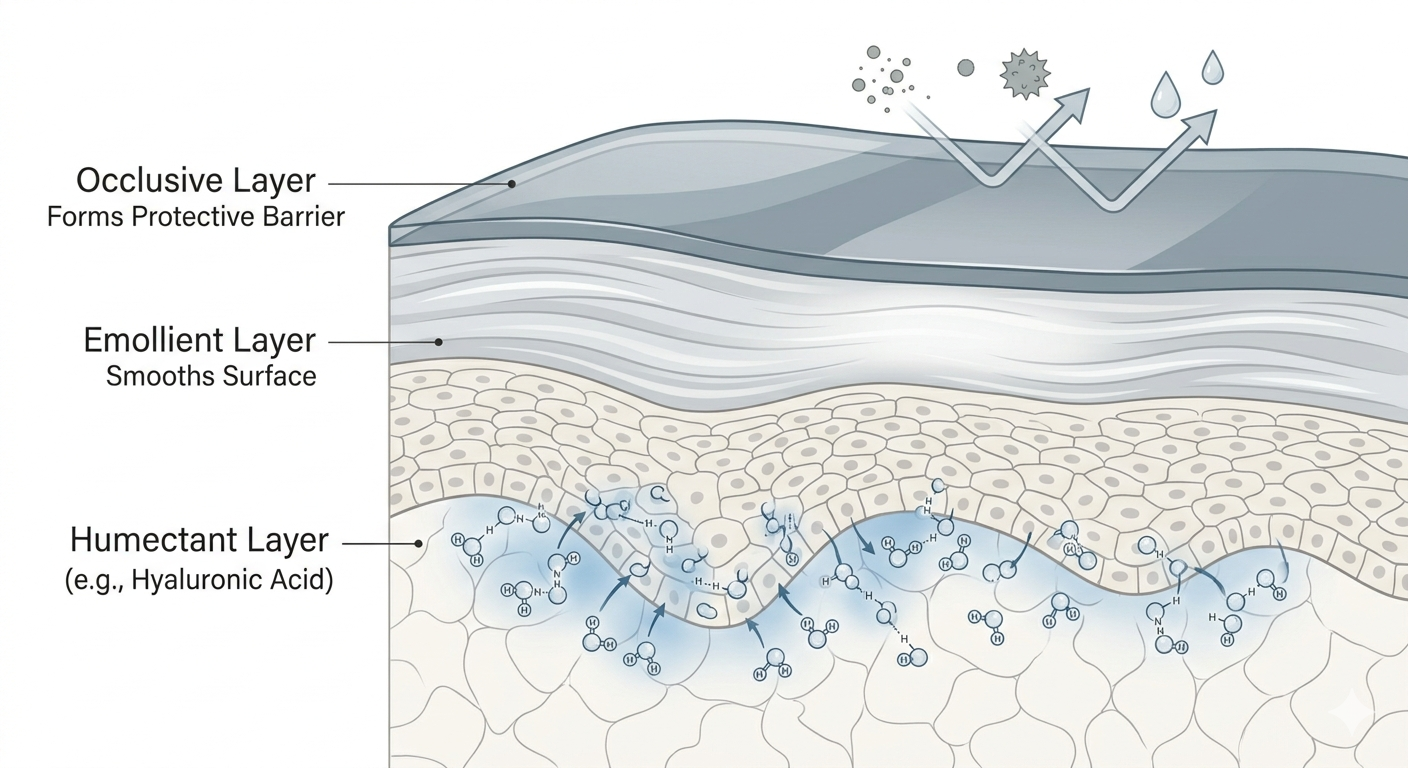
Humectants — Hydration Input
Humectants attract water into the skin.
Ingredients like glycerin, sodium PCA, and hyaluronic acid increase water content in the upper layers of the skin.
This improves flexibility and gives an immediate hydrated feel.
However, humectants do not prevent water loss. In dry or air-conditioned environments, hydration can evaporate quickly if not supported by other components.
Emollients — Surface Conditioning
Emollients improve skin texture and comfort.
They fill microscopic gaps between skin cells, making the surface smoother and more uniform.
Ingredients such as squalane and plant oils also support the lipid layer.
Emollients exist on a spectrum:
- lighter ones improve texture
- richer ones also reduce some water loss
They act as a bridge between hydration and barrier protection.
Occlusives — Water Retention
Occlusives reduce water loss by forming a protective layer on the skin.
Butters, waxes, and heavier oils slow down TEWL and help retain hydration.
They do not hydrate directly but preserve moisture already present in the skin.
Higher occlusion can feel heavier, especially in humid conditions.
Ingredient Overlap Matters
These categories are not rigid.
Many ingredients perform multiple roles. Some oils, for example, act as both emollients and mild occlusives.
What matters is how the formulation balances these roles.
How Moisturizers Work
Effective moisturizers combine all three systems:
- humectants bring water in
- emollients improve skin texture
- occlusives reduce water loss
This layered approach ensures hydration is both delivered and retained.
At Nature Theory, formulations are built around this structured system — focusing on balance rather than single-ingredient claims.
Best Moisturizer Approach for Indian Climate
Skin in Indian conditions experiences constant environmental shifts:
- heat and humidity outdoors
- pollution exposure
- hard water during cleansing
- dry air-conditioned indoor spaces
Heat and Humidity
Humectants perform well. Heavy occlusives may feel excessive.
Air-Conditioned Environments
Humidity drops. Skin needs emollients and occlusives to retain hydration.
Pollution
Barrier disruption increases water loss. Lipid support becomes important.
Hard Water
Alkaline minerals can disrupt the skin’s natural pH, weakening the barrier and increasing dryness.
How to Choose the Right Moisturizer
If hydration fades quickly:
The product likely lacks lipid support.
If skin feels coated but not hydrated:
The product may lack humectants.
Balanced formulations:
Provide hydration, comfort, and long-term stability.
Simple Guidance
- Oily, dehydrated skin → gel or gel-cream
- Dry skin in AC → cream with lipid support
- Sensitive skin → emollient + occlusive support
How to Layer Humectants, Emollients, and Occlusives
- Apply humectants on slightly damp skin
- Follow with emollient moisturizer
- Add occlusive layer if needed
This improves hydration retention, especially in changing climates.
Conclusion
The difference between emollients vs occlusives vs humectants is about function, not labels.
- Humectants manage water
- Emollients improve structure
- Occlusives reduce water loss
In real conditions — heat, humidity, pollution, and indoor dryness — skin responds to balance.
Skin does not respond to labels.
It responds to structure, consistency, and formulation logic.
FAQ
What is the difference between humectants and occlusives?
Humectants attract water into the skin. Occlusives prevent that water from escaping.
Which moisturizer is best for Indian climate?
A balanced formula with humectants, emollients, and light occlusives works best.
Should I use humectant or moisturizer first?
Humectants first, then moisturizer to seal hydration.
Is glycerin a humectant?
Yes. Glycerin is a humectant that helps retain water in the skin.
Latest Posts
Continue learning how skincare works.
We explain ingredients, formulation systems, and climate-based skincare in a structured way.
5 thoughts on “Emollients vs Occlusives vs Humectants Explained: How Moisturizers Actually Work”
Comments are closed.