
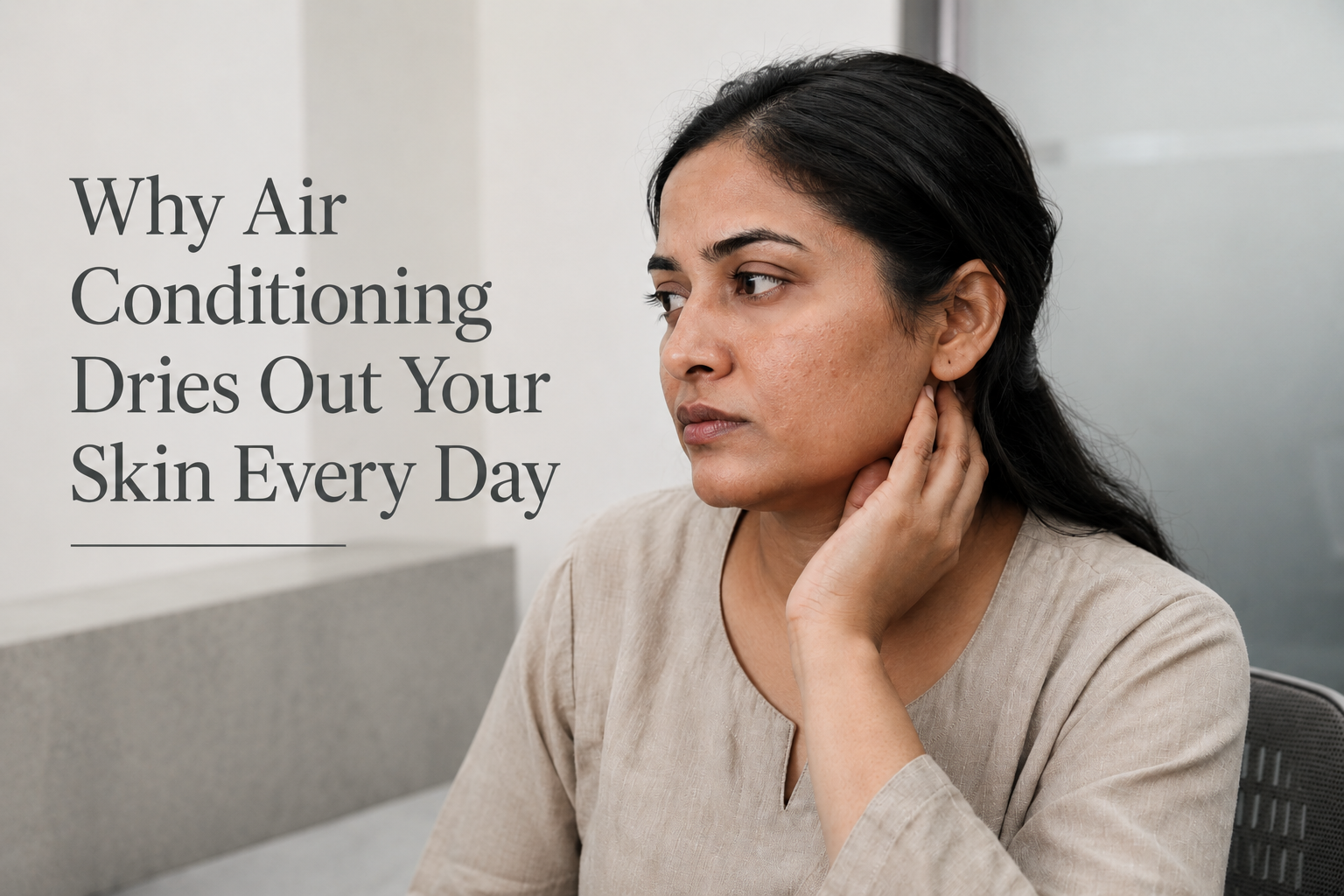
Air conditioning dries out skin by lowering indoor humidity to levels the skin was not designed for. When ambient humidity drops below 40 percent, the outer skin layer loses moisture faster than it can retain it. This is not a product failure. It is a physics problem.
Why Your Skin Feels Worse Indoors
Air conditioning dries out skin progressively through the workday, even when the morning skincare routine feels adequate. Skin that is comfortable at 9 a.m. becomes noticeably drier, tighter, and duller by midday — with no change in product or routine.
Common signs include:
- Skin that feels tight two to three hours after applying moisturiser
- A flat, dull appearance that does not respond to additional product
- Fine lines that appear more visible by the afternoon
- Roughness or discomfort around the eye area and cheeks
This is not the result of using the wrong product. It is the result of the environment actively working against the skin’s moisture retention mechanism.
How Air Conditioning Dries Out Skin at the Cellular Level
Air conditioning systems remove water vapour from indoor air as part of the cooling process. This reduces relative humidity, often to between 20 and 40 percent. The human skin barrier was adapted to function in environments with relative humidity above 50 percent.
The outer skin layer — called the stratum corneum — contains a group of water-binding molecules known as the Natural Moisturising Factor, or NMF. These include amino acids, sodium PCA, and lactic acid. NMF molecules hold water within the skin’s surface layer.
When indoor humidity drops sharply, these molecules lose capacity to retain water. A process called transepidermal water loss — the gradual evaporation of water through the skin’s outer surface — accelerates in response.
The skin compensates initially. After one to two hours in a low-humidity environment, the outer layer begins to dehydrate. Tightness, reduced flexibility, and surface roughness follow. Lipid channels within the stratum corneum also begin to contract, weakening the moisture barrier from within.
What Skincare Formulations Need to Do When Air Conditioning Dries Out Skin
Countering AC skin dehydration requires two ingredient categories working together. Neither is sufficient alone.
Humectants are water-binding molecules that attract moisture into the skin’s outer layer. Glycerin, sodium PCA, and sodium hyaluronate are examples. In low-humidity environments, their effectiveness is partially reduced because there is less atmospheric moisture available to draw from. This is the nuanced point most skincare content misses: humectants need the support of ingredients that slow water loss from below — not only pull moisture in from above.
Lipid-based ingredients form the second part of the system. Squalane, plant oils, and structured butters create a physical layer that slows transepidermal water loss. They do not add moisture. They reduce the rate at which the skin loses it.
Effective formulations combine both categories. The humectant attracts. The lipid retains.
Practical Steps for AC-Exposed Skin
- Apply moisturiser before entering air-conditioned spaces, not after skin becomes dry — because a hydrated skin surface retains humectants more effectively than a dehydrated one.
- Choose formulations that contain both humectants and lipid-based ingredients — because neither category compensates for the other under sustained low-humidity conditions.
- Consider a midday reapplication of a lightweight humectant layer if you spend more than six hours in cooled indoor environments — because transepidermal water loss accumulates progressively and a single morning application may not be sufficient.
- Apply moisturiser immediately after washing, while the skin surface is still slightly damp — because humectants can bind to available surface water in that window before it evaporates.
Indian Climate Factors That Intensify AC Skin Dehydration
Heat and sweat cycles. In Indian cities, the skin cycles between outdoor temperatures often exceeding 38 degrees Celsius and heavily cooled interiors. This repeated transition strips both surface moisture and protective lipids. Each cycle compounds the total moisture deficit accumulated through the day.
Urban pollution. Fine particulate matter from vehicle exhaust settles on the skin and generates oxidative stress in the outer layer. This reduces the skin’s tolerance for simultaneous moisture stress. Skin managing both pollution load and AC-driven dehydration has less capacity to recover from either.
Hard water. Tap water in cities like Delhi and Mumbai contains elevated mineral concentrations. These minerals leave a residue on skin after washing. In low-humidity air-conditioned spaces, this residue contracts and adds to surface dryness independently of the cooling effect.
Formulations Designed for AC Environments
Nature Theory formulations address air-conditioned skin dehydration through a combined humectant and structured lipid system, designed for the humidity conditions common to Indian offices and urban homes. The humectant layer retains available moisture while the lipid system reduces the rate of transepidermal water loss in sustained low-humidity air. Ingredient concentrations are calibrated for extended indoor exposure, not just the first hour after application.
Summary
Air conditioning dries out skin by reducing indoor humidity and accelerating moisture loss through the outer skin layer. The skin’s NMF system is calibrated for ambient humidity levels that most air-conditioned environments do not provide. Combining humectants with lipid-based ingredients in one formulation targets the mechanism, not just the symptom. Attract water and slow its loss simultaneously.
Frequently Asked Questions
Does AC affect all skin types equally, or are some more vulnerable?
When air conditioning dries out skin in low-humidity environments, the NMF system loses water regardless of skin type. However, skin with naturally lower lipid content is more vulnerable because it has less occlusive protection to slow that loss. All skin types benefit from both humectant and lipid support in cooled indoor environments.
Why does my moisturiser stop working after a few hours in the office?
In environments where humidity stays consistently below 40 percent, a single morning application may not provide sufficient coverage through the full workday. This is a common experience in Delhi and Bengaluru offices with centralised cooling running for eight or more hours. A midday application of a lightweight humectant layer helps maintain hydration without requiring full reapplication.
Does drinking more water help with AC skin dryness?
Systemic hydration supports general skin function but does not directly counter surface moisture loss caused by low indoor humidity. Water is lost from the skin’s outer layer through a topical mechanism. Topical humectants address this more directly than increased water intake.
Does hard water make AC skin dryness worse in Indian cities?
In cities like Mumbai and Chennai, tap water leaves mineral residue on skin after washing. In low-humidity air-conditioned spaces, this residue contracts and compounds the drying effect of reduced indoor humidity. A gentle cleanser used before moisturiser application reduces this combined impact.
Latest Posts
Continue learning how skincare works.
We explain ingredients, formulation systems, and climate-based skincare in a structured way.
11 thoughts on “Why Air Conditioning Dries Out Your Skin Every Day”
Comments are closed.