
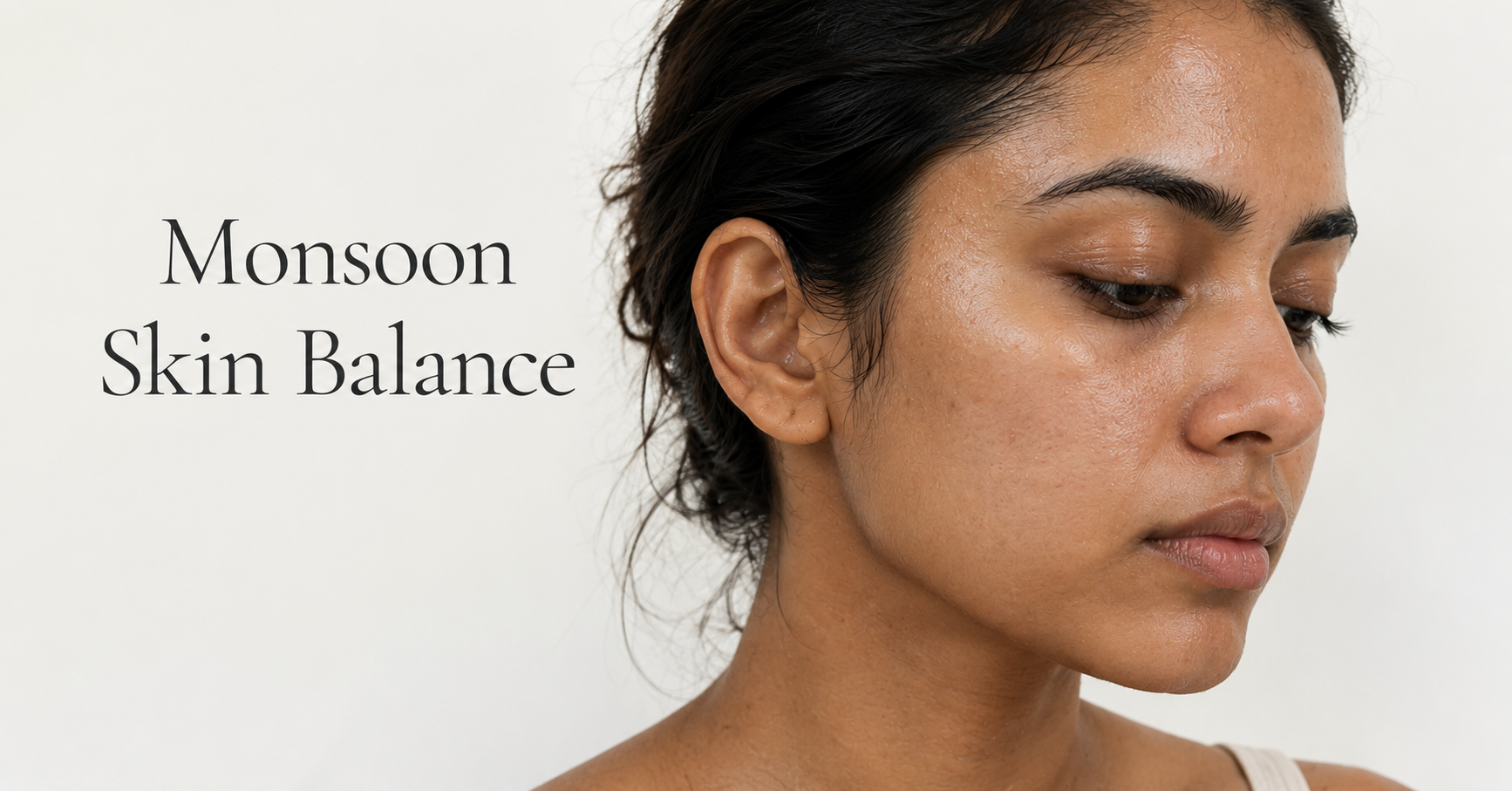
Why Your Skin Feels Oily and Dry at the Same Time During Monsoon
Monsoon weather in India brings high humidity, but that humidity does not automatically translate into balanced, comfortable skin. Many people notice that during the wet season their skin feels simultaneously oilier and more irritated — a combination that makes no obvious sense. Understanding how monsoon conditions actually affect the skin barrier explains why this happens and what to do about it.
The Problem
On the surface, monsoon should be the easiest season for skin. The air carries more moisture. Temperatures drop slightly compared to peak summer. The assumption is that skin should feel hydrated and calm.
The reality most people experience is different.
During monsoon, common skin complaints include:
- Skin that feels greasy within an hour of washing
- Unexpected breakouts or congestion, even on skin types that do not usually experience this
- Dullness or uneven texture despite the humid air
- Tightness or flaking in certain areas, particularly around the nose and chin
- Increased sensitivity or stinging when applying products
These are not isolated symptoms. They are signs that monsoon weather is disrupting the skin’s moisture regulation system at a structural level. Surface humidity and skin hydration are not the same thing.
The Science
What High Humidity Actually Does to the Skin Surface
The skin barrier controls two processes simultaneously. It keeps moisture inside the skin, and it keeps environmental substances outside. These two functions depend on the lipid matrix — a structured network of fats that sits between the outer skin cells.
High ambient humidity does affect the skin surface. Water vapour from the air can temporarily increase the moisture content of the outermost skin layer, known as the stratum corneum. This sounds like a benefit. But it is not uniformly positive.
When external humidity is high, the skin’s own moisture regulation mechanisms slow down. The rate of transepidermal water loss — the natural process by which water moves from inside the skin outward — decreases. This is because the humidity gradient between the skin and the environment narrows. Less moisture pressure differential means less moisture movement.
Why the Skin Produces More Oil in Humidity
Sebaceous glands regulate oil production based on multiple signals, including temperature, hormonal activity, and environmental conditions. In high humidity, the skin surface becomes warmer and more occluded. This increases sebum production.
Excess sebum mixes with sweat, residual skincare product, and environmental particles. This mixture sits on the skin surface and can interfere with the barrier’s normal function if not removed properly.
The Dehydration Paradox
Here is what most skincare content does not explain clearly.
While the outer surface of the skin may feel more moist during monsoon, the deeper layers of the stratum corneum are not necessarily well-hydrated. If the lipid barrier has been disrupted — by over-cleansing, by harsh products used during summer, or by cumulative sun exposure — the skin cannot hold water effectively regardless of external humidity levels.
The result is skin that feels slick or greasy on the surface while still being functionally dehydrated underneath. This is why monsoon skin often looks dull rather than plump, and why the tightness that occurs after washing does not resolve with summer-style heavy moisturisers.
How Pollution Compounds the Problem
Indian monsoon air carries a distinct combination of moisture and particulate matter. Rain dislodges pollutants from surfaces and the atmosphere, increasing the concentration of particles in air and water runoff. These particles can settle on the skin surface, interact with sebum, and generate oxidative stress on the barrier cells. Over time, this contributes to dullness and uneven texture.
Formulation Logic
Monsoon skin needs a different formulation approach than either summer or winter skin.
In summer, the priority is lightweight hydration with minimal lipid load. In winter, the priority shifts toward barrier repair with structured lipids. Monsoon sits between these two states — and this is where most people’s routines fall short. They either stay on their summer routine, which does not address the dehydration paradox, or they switch to heavier products that feel occlusive in high humidity.
The correct approach involves three formulation layers working together.
The first is a mild cleansing system that removes excess sebum and surface particles without stripping the lipid matrix. Over-cleansing during monsoon is a common mistake. Removing too much oil triggers compensatory sebum production and weakens the barrier’s moisture retention function. A surfactant blend that balances cleansing power with mildness is essential here.
The second layer is a lightweight humectant system. Humectants draw water into the skin from the environment and from deeper skin layers. In monsoon conditions, the environment offers more moisture for humectants to work with. Ingredients like glycerin, sodium PCA, and low-molecule sodium hyaluronate are effective without creating heaviness.
The third layer is a minimal but targeted lipid component. This is the nuanced point most monsoon skincare advice misses entirely. The instinct during monsoon is to reduce all oils and heavy textures. But if the barrier has been compromised, removing lipid support entirely allows dehydration to continue beneath the surface. A small amount of lightweight, non-comedogenic lipid — squalane is the clearest example — supports barrier integrity without contributing to surface congestion.
Preservative and formula stability are also relevant during monsoon. High humidity and temperature fluctuations can affect product stability. Formulas designed for Indian conditions account for this at the preservation stage.
Practical Advice
1. Cleanse twice daily but never more. More frequent cleansing removes protective lipids and triggers sebum rebound. A mild surfactant system is more effective than frequency.
2. Apply your moisturiser to slightly damp skin. Humectants pull water into the skin more effectively when there is already surface moisture present. In high humidity, this is easy to achieve.
3. Do not remove all oil-based products from your routine. A lightweight lipid like squalane or jojoba oil at a low concentration helps maintain barrier function without sitting heavily on humid skin.
4. Adjust your cleansing routine if you are in and out of air conditioning. AC environments drop humidity sharply. Moving between humid outdoor air and dry indoor air multiple times a day creates rapid moisture fluctuation at the skin surface. Cleansing only when necessary reduces this stress.
5. Add an antioxidant step in the morning. Monsoon pollution exposure is real. A formula containing green tea extract, vitamin E, or ferulic acid helps address oxidative stress from particulate matter settling on the skin.
Morning routine: gentle cleanse, lightweight humectant moisturiser, antioxidant layer, sun protection.
Evening routine: thorough cleanse to remove accumulated particles and sebum, humectant moisturiser, minimal lipid support.
Climate Relevance
Humidity fluctuations between outdoor and indoor environments
Monsoon outdoor air typically carries 70 to 90 percent relative humidity in most Indian cities. Air-conditioned indoor environments can drop this below 40 percent. The skin adjusts slowly to these transitions. Rapid shifts in environmental humidity increase transepidermal water loss in the short term and make the barrier’s moisture regulation function work harder. This is why skin can feel tight inside an office building even during the wettest part of the season.
Heat and sweat cycles
Temperature during Indian monsoon remains high — often 28 to 35°C in most regions. Sweat production continues at similar levels to summer. Sweat mixed with sebum creates a film on the skin surface that can block the outer layer and contribute to congestion if not cleared with a mild cleanser. The mistake is assuming monsoon means less sweating and therefore less need to cleanse.
Urban pollution exposure
Monsoon rain does not clean the air as completely as it might appear. In dense urban environments, rain carries down particulate matter and surface pollutants, and humid air keeps suspended particles closer to the ground longer. Indian cities, particularly during intermittent rain days when the air is humid but not actively raining, often show high levels of skin-relevant airborne particles. These interact with sebum on the skin surface and can be mildly pro-inflammatory over time.
Hard water
Municipal water in many Indian cities carries higher mineral content. During monsoon, water supply sources sometimes shift, which can change the mineral profile of tap water used for face washing. Hard water can leave a mineral film on the skin surface that interacts with cleanser residue and affects how moisturisers absorb. This is a less-discussed factor in monsoon skin complaints but a real one.
Product Context
Skincare formulated for Indian climate conditions approaches monsoon weather as a distinct functional state, not simply a variation of summer. Nature Theory products are built around the understanding that Indian skin faces simultaneous environmental pressures — humidity, heat, pollution, and indoor AC — that rarely exist in isolation. The face wash system uses a mild surfactant blend designed to clean without stripping, paired with humectants that maintain barrier comfort during the cleansing step itself. The moisturiser formulations are built on humectant and lightweight lipid systems that perform in both high-humidity outdoor conditions and dry indoor environments. The approach throughout is formulation for real conditions, not for idealised climate assumptions borrowed from European or Korean product briefs.
Summary
Monsoon weather creates a specific imbalance in how the skin manages moisture. High ambient humidity increases surface moisture and slows transepidermal water loss, but it also increases sebum production and pollution exposure. If the barrier is already compromised, surface humidity does not resolve underlying dehydration. The practical response is a routine built on mild cleansing, effective humectants, and minimal but targeted lipid support — rather than either a heavy winter approach or a stripped-back summer one. The core principle: skin balance in monsoon comes from barrier maintenance, not barrier removal.
FAQ
Why does my skin feel oily during monsoon but still look dull? Surface oiliness and skin hydration are separate things. High humidity increases sebum production and slows moisture loss from the outer skin layer, but this does not mean the deeper layers of the barrier are well-hydrated. If the barrier has been weakened, dullness and uneven texture persist regardless of ambient humidity. The skin looks dull, not plump, because moisture is not being retained effectively inside the skin.
Should I stop using moisturiser during monsoon because my skin already feels wet? Skipping moisturiser during monsoon is one of the more common mistakes in Indian skincare routines. The feeling of moisture on the skin surface is not the same as skin hydration. Without a humectant to draw water into the skin and a light lipid to prevent it from escaping, the barrier continues to lose moisture — particularly in air-conditioned environments. A lightweight, non-occlusive moisturiser remains necessary.
Why do I break out more during monsoon even though I am not eating differently? Breakouts during monsoon are usually driven by a combination of increased sebum production, sweat accumulation on the skin surface, and the presence of pollution particles that interact with that sebum layer. This combination can block the outer skin layer and trigger congestion. Adjusting your cleanser — rather than using more aggressive products — is usually more effective than eliminating moisturisers or increasing the number of times you wash your face.
Is the high humidity during Indian monsoon actually good for my skin? Partially. High humidity reduces the rate of moisture loss from the skin, which offers some passive benefit. However, the same humidity increases sebum production, encourages surface congestion, and accompanies high temperatures and pollution exposure. In Indian conditions specifically, monsoon humidity is rarely clean or stable — the combination of heat, pollution, and rapid transitions into air-conditioned spaces means the skin faces more stress, not less, despite the surface moisture.
Why does my skin feel tight after washing during monsoon? Tightness after cleansing during monsoon usually means the cleansing step is removing more than surface debris. If the surfactant system is too stripping, it removes protective lipids from the barrier along with sebum and particles. This triggers the tight, slightly uncomfortable feeling that many people associate with a “thorough clean” but which is actually a sign of mild barrier disruption. Switching to a milder surfactant system typically resolves this without reducing cleansing effectiveness.
How should I change my skincare routine for the transition from summer to monsoon? The key adjustment is reducing lipid weight while maintaining barrier support. In summer, many people use minimal product to manage heat and sweat. At the start of monsoon, the instinct is to continue minimising. The more useful change is to introduce a lightweight humectant moisturiser if you are not already using one, and to add an antioxidant step to address the combination of pollution and oxidative stress that monsoon air carries. Cleansing frequency and method typically need no increase — and sometimes benefit from being reduced.
Latest Posts
Continue learning how skincare works.
We explain ingredients, formulation systems, and climate-based skincare in a structured way.
1 thought on “Monsoon Weather and Skin Balance”
Comments are closed.