
What Actually Happens When You Apply Skincare in the Wrong Order
Most people follow their skincare routine without knowing that the sequence in which products are applied determines whether active ingredients actually reach the face skin at all. Knowing how to layer skincare products correctly is not a styling tip — it is applied formulation science. Apply in the wrong order and the products work against each other.
The Problem
Many people use well-chosen skincare products and still find their face feels dry an hour after application, or that active ingredients like niacinamide and vitamin C seem to produce no visible change. When the same person adjusts only the order of application, results often improve without a single product change.
This is not anecdotal. It reflects the physical reality of how formulas interact with each other and with the face skin surface.
Common signs that layering order is wrong:
- Face feels tight or dry within an hour of a complete routine
- Moisturiser sits on the face rather than absorbing
- Serum pills or rolls off instead of sinking in
- Active ingredients appear to do nothing despite being present in the formula
- Face feels temporarily hydrated but dehydrates quickly
These are not product failures. They are sequencing failures. The formulas are working exactly as designed — just not in the intended order.
The Science
How Face Skin Absorbs Products
The outermost surface of facial skin — the stratum corneum — is a semi-permeable barrier. It allows certain molecules to pass through while restricting others, based on molecular size, chemistry, and the condition of the face skin surface at the moment of application.
For an active ingredient to work, it must first penetrate this layer. What is already on the face skin surface when a product is applied directly affects that penetration.
What Happens When You Apply Occlusive Products First
Occlusive and film-forming ingredients — found in moisturisers, creams, and face oils — create a physical layer on the face skin surface. This layer is intentional. It slows moisture loss from the face. But applied before a serum, that same layer becomes a barrier the serum cannot pass through.
The serum sits on top of the film, unable to reach the face skin surface. It may feel temporarily present. Within minutes, it evaporates. The actives it carried never penetrated.
Apply the serum first, to clean face skin, and it absorbs efficiently. Apply the moisturiser over it and the film now seals in what has already been absorbed. This is the mechanism both products are built around.
The core principle: move from the formula with the least occlusive character to the most. Thin to thick. Water-based to oil-based.
pH Timing and Active Ingredients
Some actives require a specific pH window to function. Vitamin C in its ascorbic acid form requires a low pH environment. Applied immediately under a high-pH moisturiser, the surface pH is shifted before the vitamin C has time to absorb and begin working.
Allowing 60 to 90 seconds between a pH-dependent active and the next product gives it time to penetrate before the surface chemistry changes. This is not optional for formulas that depend on pH for efficacy.
Formulation Logic
Cleansers are designed to remove impurities. They leave the face skin surface clean and slightly receptive. A well-formulated cleanser uses a mild surfactant blend to avoid stripping the protective lipid layer — which would leave the face skin barrier weakened before subsequent products are applied.
Serums are typically lightweight, water-based formulas carrying a concentrated active. They contain minimal emulsifiers and no significant lipid phase. This makes them fast-absorbing. They are engineered to deliver an active to the face skin surface as efficiently as possible. Applied to clean, slightly damp face skin, they perform as intended.
Moisturisers are emulsions — combinations of water and oil phases held together by emulsifiers. The lipid content and emulsifiers are what create a film on the face skin surface. This film is functional: it reduces moisture loss from the face. Applied after a serum, it locks in the hydration the serum introduced. Applied before a serum, it locks the serum out.
Face oils, when used, belong last. An oil layer is more occlusive than a standard moisturiser emulsion. Water-based products applied over a face oil cannot penetrate it. Applying oil before moisturiser buries the moisturiser’s water-based components where they cannot function.
The nuanced point most layering guides miss: the sequence is not just about texture. It is about functional role. A hydrating toner applied over a moisturiser is not hydrating the face — it is sitting on a film, evaporating, and accomplishing nothing. The order must respect what each formula is designed to do, not just how it looks or feels.
Practical Advice
1. Cleanse first, every time. Surface impurities — pollution, sebum, sweat — physically block products applied over them. A mild cleanser removes these without disrupting the face skin barrier, setting the correct starting condition.
2. Apply serum to slightly damp face skin. After cleansing, pat the face but leave it faintly damp. Humectants in serums — glycerin, sodium PCA, sodium hyaluronate — attract water. Slightly damp face skin gives them something to bind rather than drawing moisture from within the face.
3. Wait 60 to 90 seconds before applying the next product over pH-dependent actives. This applies to vitamin C, AHA, and BHA formulas. The wait allows the active to begin absorbing before the surface chemistry shifts.
4. Apply moisturiser over serum — not beneath it. The moisturiser’s job is to seal the face. It should seal in what has already been applied, not create a barrier before the serum arrives.
5. Apply face oil last, if using one. Face oils are more occlusive than water-containing moisturisers. Anything applied over a face oil is blocked from reaching the face skin surface.
6. Keep morning and evening routines functionally different. Morning layering should be lighter — hydration and barrier support followed by SPF. Evening routines can carry heavier repair systems because overnight is when the face skin barrier undergoes its natural recovery cycle.
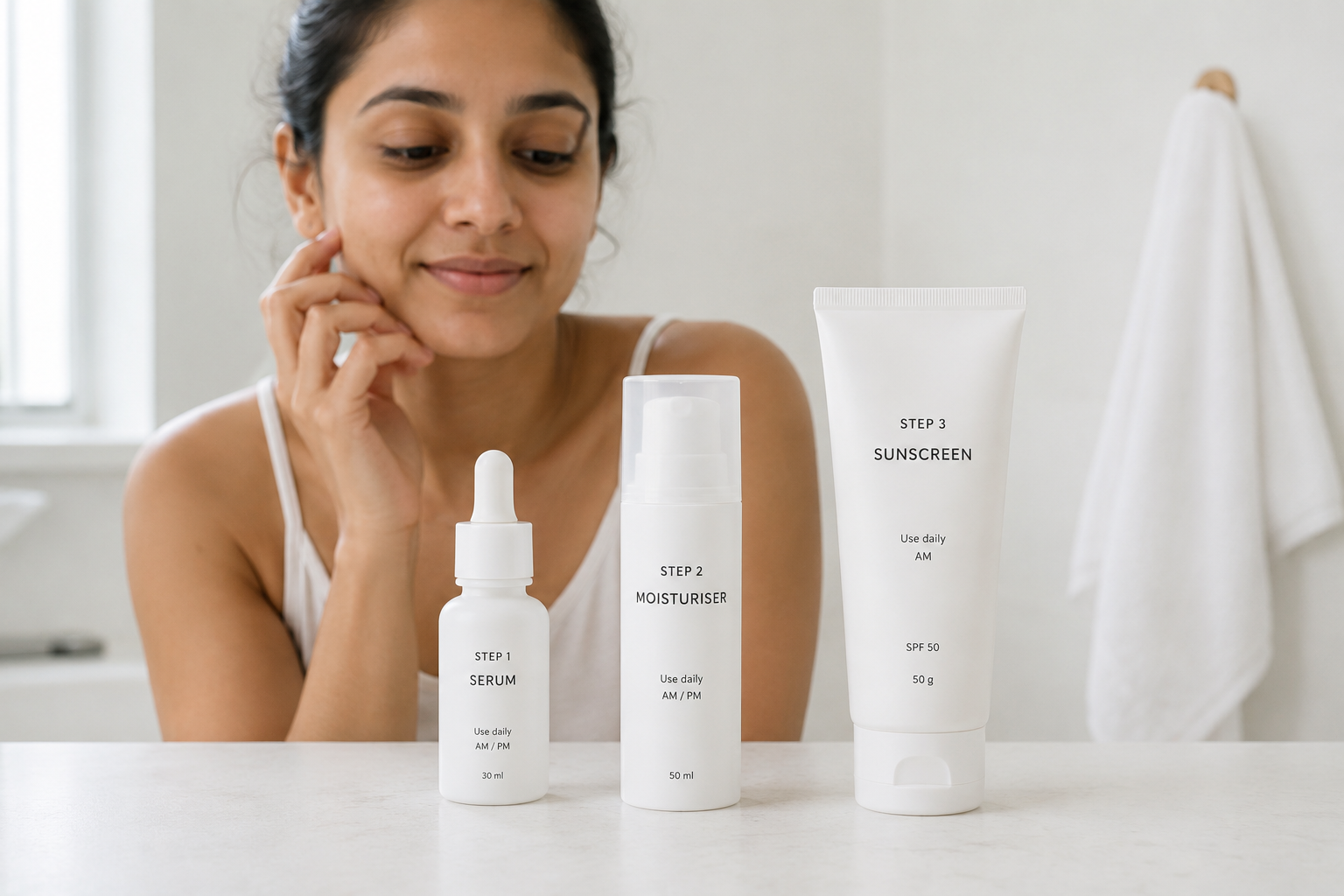
Morning routine: Cleanser → Serum → Moisturiser → SPF
Evening routine: Cleanser → Serum → Night cream
Climate Relevance
AC Environments
Extended time in air-conditioned spaces reduces ambient humidity significantly. The face skin is continuously losing moisture through the day. In this context, correct layering is not a preference — it is the only way the routine can work. Applying a serum first and sealing it with a moisturiser allows the face to retain some hydration despite the low-humidity environment. Incorrect layering in AC means the face stays dehydrated throughout the day regardless of how many products were applied in the morning.
Heat and Multiple Daily Cleanses
In warm Indian weather, most people cleanse their face two or three times daily due to sweat and pollution accumulation. Each cleanse removes surface lipids. If the layering order is wrong after every cleanse, the face skin barrier is repeatedly exposed without effective recovery. Correct sequencing — serum first, moisturiser second — after each cleanse gives the face skin surface its best chance to recover between wash cycles.
Hard Water
Hard water leaves a mineral film on the face skin surface after washing. This film has a slightly alkaline pH. Applying a pH-sensitive active directly onto this mineral residue before the surface pH has normalised reduces how effectively the active can function. In cities across urban India where hard water is common, applying a low-pH mist or toner to the face skin after cleansing and before an active serum helps counteract this interference.
Monsoon and Humidity Shifts
High ambient humidity during monsoon means humectants in serums can draw moisture from the air, which improves their performance. When humidity drops — particularly as AC use increases post-monsoon — the same formula may feel less effective. The product has not changed. The layering environment has. Consistent layering order allows you to isolate the cause of any change in results and adjust product selection accordingly, rather than attributing inconsistent outcomes to product failure.
Formulation Design and Layering Order
In Nature Theory formulations, each product in the range is designed to be part of a sequence rather than used in isolation. The face wash uses a mild surfactant system that cleanses without stripping the face skin surface — leaving it in the right condition for what follows. The serums and actives are lightweight, designed for direct contact with clean face skin. The hydrating face cream and night repair cream are structured lipid systems built to be applied over lighter formulas, sealing in the hydration and actives that preceded them. When used in the intended order, the formulation architecture functions as designed. Correct skincare layering is not a separate step — it is part of how the formulas work.
Summary
The order in which skincare products are applied determines whether their active ingredients reach the face skin surface or remain inactive on top of a prior product’s film. Lighter, water-based formulas absorb first. Heavier, lipid-based formulas seal the face skin surface after. Understanding the reason behind the sequence — rather than simply following a list — allows any routine to be adjusted for changing conditions, products, and climates. Correct layering order is applied formulation science, not skincare convention.
Frequently Asked Questions
Does layering order really change results if I use good products? Yes. A well-formulated serum applied over a moisturiser may remain entirely on the surface and evaporate without reaching the face skin. Product quality does not override the physical barrier created by a prior occlusive layer. The right product in the wrong position will not perform as intended.
Why does my moisturiser pill or roll off my face? Pilling usually happens when a film-forming product is applied before the previous product has absorbed. The most common cause is applying moisturiser too quickly over a serum — the serum’s polymer or gum system has not yet bonded to the face skin surface, so the moisturiser rolls against it rather than spreading smoothly. Waiting 60 to 90 seconds between steps resolves this in most cases.
Where does SPF go in the layering order? SPF belongs as the final step in a morning routine, applied after moisturiser. SPF formulas are designed to form a film at the outermost surface of the face to intercept UV radiation. Applying anything over SPF disrupts that film. Applying SPF under moisturiser buries the UV filters beneath a layer where they cannot function at the surface.
Does this matter specifically for Indian skin conditions? Yes. Indian skin is routinely exposed to conditions that increase moisture loss — heat, urban pollution, AC environments, frequent cleansing due to sweat. Correct layering maximises how much benefit each product delivers, which matters more when the face skin barrier is under consistent environmental pressure. The layering principle is universal, but the consequences of incorrect sequencing are more pronounced in Indian climate conditions.
Can I skip a serum entirely and just use moisturiser? Yes. A routine does not require every product category. Cleanser followed by a well-formulated moisturiser is a complete and effective routine. A serum exists to deliver a concentrated active to the face skin before the moisturiser creates its seal. If a serum is not part of the routine, the moisturiser is applied directly to clean face skin, which is correct and valid.
Is the layering order different for oily face skin? The sequence is identical — thin to thick, water-based before oil-based. The difference for oily face skin is product selection, not order. A lightweight serum and a lighter moisturiser are typically chosen. Face oils are generally avoided. The routine remains: cleanser, then serum, then moisturiser. The sequence does not change based on skin type.
Latest Posts
Continue learning how skincare works.
We explain ingredients, formulation systems, and climate-based skincare in a structured way.