
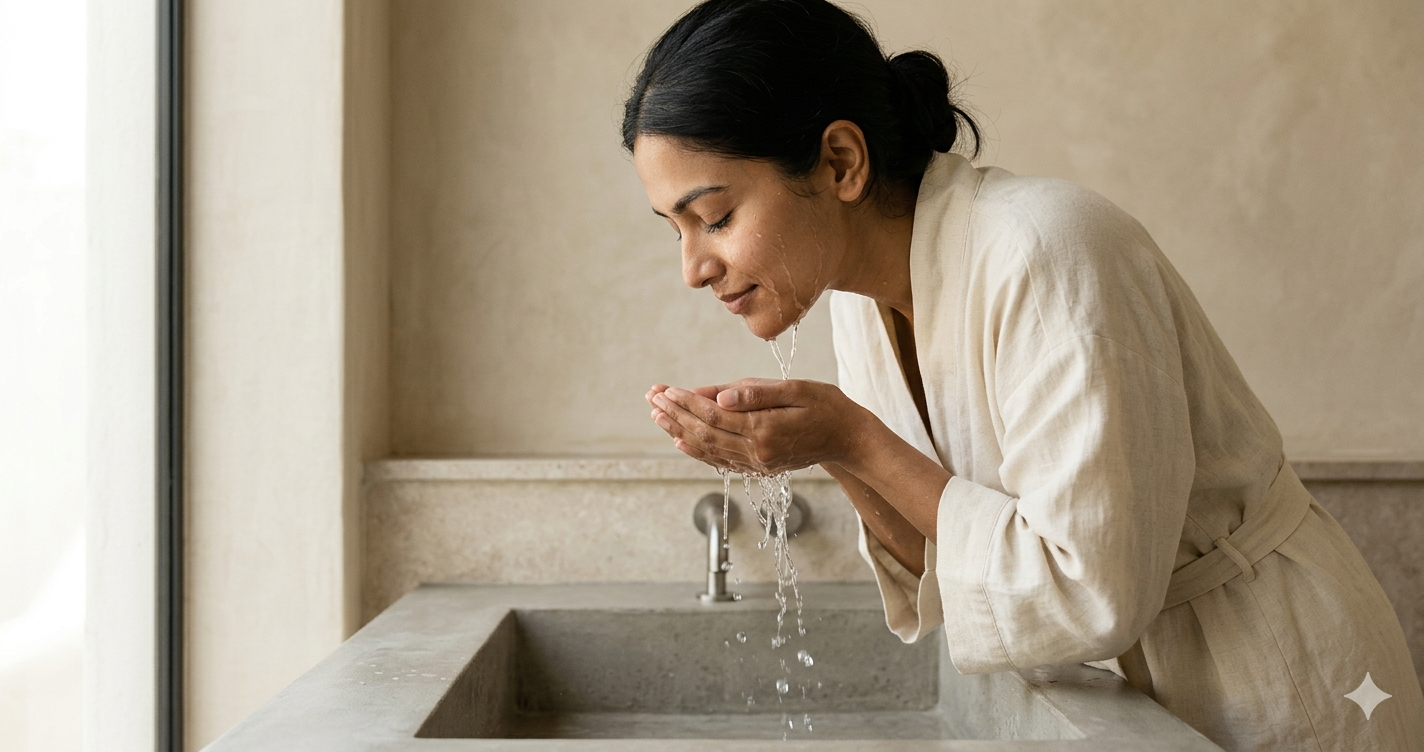
Your Skin Feels Tight After Washing. Cleanser pH Is Why.
Most people blame their moisturiser when their skin feels tight. The problem usually starts earlier — during cleansing. Cleanser pH determines whether your skin barrier leaves the wash stable or slightly disrupted, and that difference shows up in how your skin behaves for the rest of the day.
The Problem: What You Actually Experience
After washing your face, you may notice:
- Skin feels tight or stretched
- Dryness appears within minutes
- You feel the need to apply moisturiser immediately
- Mild redness or sensitivity
- Products sting more than usual
These are not just comfort issues. They reflect how the barrier responds at a structural level.
The Science: Why Cleanser pH Affects Skin Barrier Function
The surface of the skin maintains a slightly acidic environment, typically between pH 4.5 and 5.5. This is known as the acid mantle. It supports enzyme activity and helps maintain the organisation of lipids in the outermost layer of the skin, called the stratum corneum.
When a cleanser with a higher pH is used, this balance shifts. The lipid structure becomes less organised, and the enzymes responsible for maintaining the barrier do not function as efficiently. As a result, the barrier becomes temporarily less stable.
How Cleanser pH Affects Barrier Structure
The stratum corneum is organised like a brick-and-mortar system, where skin cells form the structure, while lipids hold them together.
When cleanser pH rises above the skin’s natural range, the lipid structure becomes less compact. The connections between cells loosen, and permeability increases. The barrier does not collapse, but it becomes less efficient at holding water and resisting external stress.
TEWL and Why Skin Feels Tight
Transepidermal water loss (TEWL) refers to the passive evaporation of water from the skin.
When the barrier is disrupted due to pH imbalance, water escapes more easily. Hydration decreases faster than it is replenished, which creates the feeling of tightness shortly after washing.
Why Repeated Cleansing Matters
The skin can gradually restore its pH, but repeated exposure to unsuitable cleansers slows this process.
If cleansing happens multiple times a day, the barrier does not fully stabilise between washes. Over time, hydration becomes inconsistent and sensitivity increases.
Formulation Logic: How Cleanser pH Works in Skincare
Cleanser performance depends on how multiple systems work together, not just pH alone.
Mild Surfactant System
A mild surfactant system is designed to remove oil, sweat, and impurities while minimising disruption to the lipid layer.
When combined with unsuitable pH, even mild surfactants can contribute to barrier instability.
pH Adjustment System
Modern cleansers include pH adjustment systems to align with the skin’s natural range.
This supports enzyme function and helps maintain lipid organisation. However, pH alone does not define mildness. The behaviour of surfactants at that pH level determines how the barrier responds.
Hydration Support During Cleansing
Some cleansers include humectants such as glycerin, sodium PCA, or panthenol.
These ingredients help attract water and reduce immediate dryness after washing. However, hydration support is effective only when the overall formulation maintains barrier stability.
System-Level Understanding
A balanced cleanser works through:
- mild surfactant selection
- skin-compatible pH
- hydration support
When these systems are aligned, cleansing removes impurities without leaving the barrier in a compromised state.
Practical Advice: What to Do
- Choose a cleanser formulated at skin-compatible pH
pH must work alongside surfactant selection, as surfactant behaviour determines barrier impact. - Avoid unnecessary repeated cleansing
Frequent exposure prevents the skin from restoring its natural pH between washes. - Use lukewarm water instead of hot water
Heat accelerates lipid disruption and increases water loss. - Apply moisturiser immediately after cleansing
This helps reduce TEWL before hydration drops. - Keep your routine consistent
Barrier recovery depends on repeated exposure to stable formulations.
Simple Routine (Why This Works)
Morning:
- Gentle cleanser → removes impurities without destabilising pH
- Moisturiser → restores hydration and supports lipid structure
- Sunscreen → prevents UV-related barrier disruption
Night:
- Gentle cleanser
- Moisturiser → supports overnight recovery when water loss increases
Climate Relevance: Why Cleanser pH Matters in Indian Conditions
Indian climate conditions significantly influence how cleanser pH affects the skin.
Hard Water During Cleansing
Many regions in India have mineral-rich hard water. These minerals interact with cleansers and can increase dryness, especially when combined with higher pH formulations.
AC Exposure and Low Humidity
Air-conditioned environments reduce humidity levels. After cleansing, this accelerates water loss and makes pH imbalance more noticeable.
Heat and Sweat Cycles
Sweating leads to more frequent cleansing. If each wash disrupts pH balance, the barrier does not get time to stabilise.
Pollution Exposure
Pollution increases the need for cleansing. However, frequent cleansing with unsuitable pH can increase long-term barrier stress.
The Nature Theory Approach
At Nature Theory, cleanser pH is addressed through a formulation system designed to align with the skin’s natural acid mantle range. The cleanser uses a combination of decyl glucoside, cocamidopropyl betaine, sodium lauroyl sarcosinate, and coco glucoside to achieve effective cleansing while reducing barrier disruption. The pH is maintained within a controlled range close to the skin’s natural level. Hydration-support components such as panthenol and sodium PCA are included to maintain comfort during cleansing. The formulation is designed so that cleansing supports barrier stability rather than requiring recovery afterward.
Summary
Cleanser pH directly influences how your skin behaves after washing. When it is not aligned with the skin’s natural range, barrier structure becomes less stable and water loss increases.
This leads to tightness, dryness, and sensitivity over time.
Consistent use of a balanced cleansing system helps maintain barrier stability and long-term skin comfort.
FAQ
Why does my skin feel tight immediately after washing?
This usually happens due to increased water loss after cleansing. When pH disrupts barrier structure, hydration escapes faster than it is retained.
Does cleanser pH affect how my moisturiser works?
Yes. If the barrier is disrupted during cleansing, moisturisers cannot retain hydration effectively.
Is a low pH cleanser always better?
Not always. Cleanser performance depends on both pH and surfactant system working together.
How often should I cleanse in Indian weather?
Twice daily is usually sufficient. Frequent cleansing can disrupt barrier stability, especially in hot conditions.
Does hard water affect cleanser performance?
Yes. Minerals in hard water can increase dryness and influence how cleansers interact with the skin.
Can a moisturiser fix tight skin caused by cleansing?
Not completely. If cleansing continues to disrupt the barrier, hydration loss will persist.
Latest Posts
Continue learning how skincare works.
We explain ingredients, formulation systems, and climate-based skincare in a structured way.
2 thoughts on “Your Skin Feels Tight After Washing. Cleanser pH Is Why.”
Comments are closed.