
The Problem
Some moisturizers feel light and absorb quickly.
Others feel richer and stay on the skin longer.
You may describe them as gel-like or creamy.
But this difference is not just about how much oil is in the product.
It comes from how water and oil are structured inside the formulation.
A Quick Recap: What an Emulsion Does
An emulsion is a system that combines water and oil into a stable form so both hydration and barrier support can be delivered together.
But the way this system is structured changes how the product behaves on your skin.
The Two Types of Emulsions
There are two main ways to structure an emulsion: oil-in-water and water-in-oil.
The difference depends on which component forms the outer phase of the system.
Oil-in-Water Emulsions (O/W)
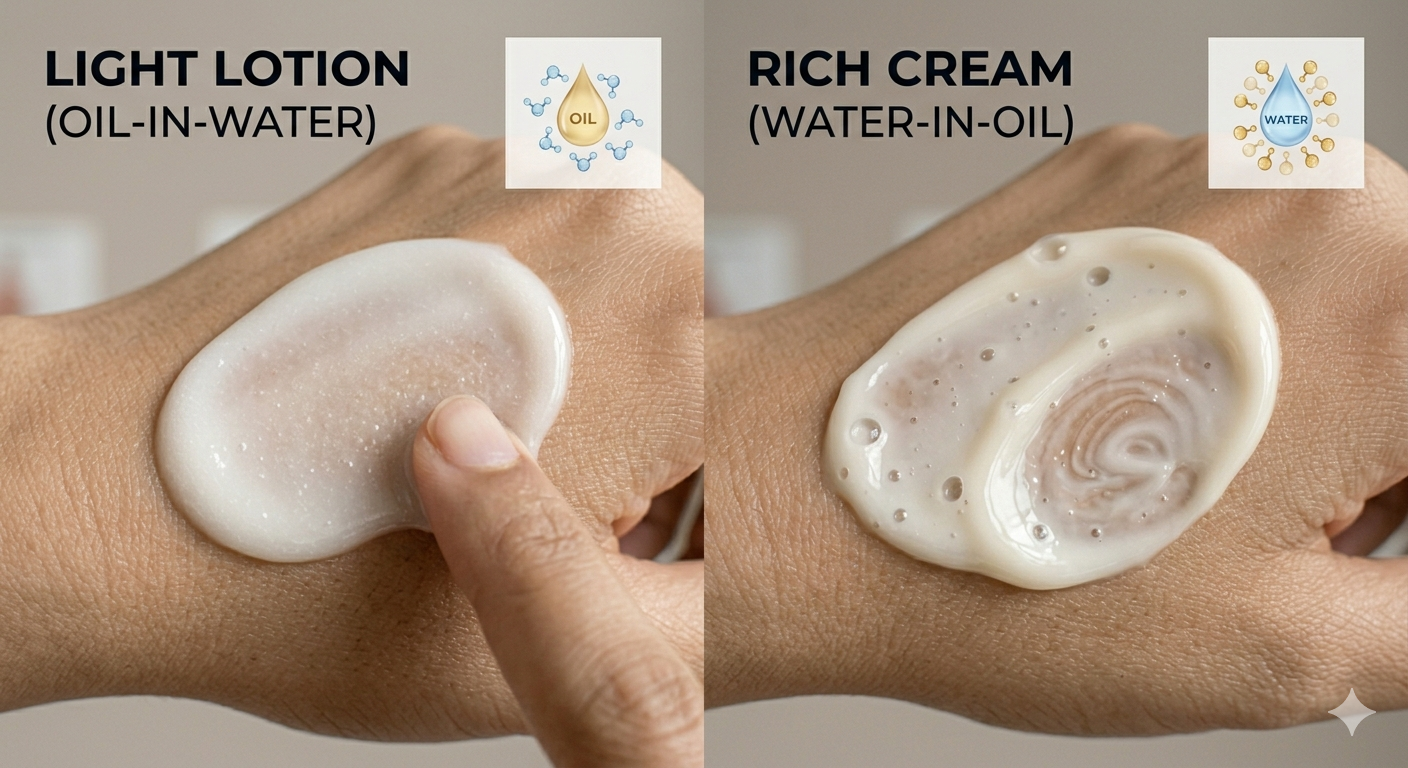
In an oil-in-water emulsion, water forms the outer phase while oil is dispersed within it in small droplets.
Because water is the dominant phase, these emulsions spread easily, absorb quickly, and feel lighter on the skin.
This is why most lotions and lightweight moisturizers are oil-in-water systems.
Water-in-Oil Emulsions (W/O)
In a water-in-oil emulsion, oil forms the outer phase while water is dispersed within it.
Because oil surrounds the system, these emulsions feel richer, stay longer on the skin, and provide stronger support in reducing water loss.
This is why thicker creams and more protective moisturizers are often water-in-oil systems.
Why This Difference Matters for Your Skin
The structure of the emulsion changes how your skin experiences the product.
Oil-in-water systems often feel more comfortable in humid conditions where the skin already has surface moisture.
Water-in-oil systems provide more support in dry environments where reducing water loss becomes more important.
This is not about one being better than the other.
It is about choosing what suits your skin and environment.
How Climate Changes What Feels Right
In Indian conditions, your skin moves between outdoor heat and humidity and dry air-conditioned interiors throughout the day.
This constant shift changes how products feel and perform.
A lighter emulsion may feel comfortable outdoors, while a richer system may feel more supportive indoors.
Why Formulation Still Matters Beyond Type
Even within the same emulsion type, products can behave differently.
Two oil-in-water emulsions can feel different on the skin, and two water-in-oil systems can vary in how long they remain effective.
This depends on how the formulation is balanced and stabilised.
The emulsion type defines the structure, but the full formulation determines performance.
A More Practical Way to Choose
Instead of focusing only on whether a product feels light or heavy, observe how your skin feels over time.
If your skin stays comfortable for longer, the system is working.
If the effect fades quickly, the structure may not be suited to your conditions.
Understanding emulsion types helps you make more informed choices.
Conclusion
Oil-in-water and water-in-oil emulsions are two ways of structuring water and oil in skincare.
They create different textures, different skin feel, and different levels of support.
Neither is better on its own.
The right choice depends on your skin, your environment, and how your skin responds over time.
At Nature Theory, emulsions are selected and designed based on how they perform in real conditions, not just how they feel at the moment of application.
Frequently Asked Questions
What is the actual difference between oil-in-water and water-in-oil emulsions? It comes down to which one is on the outside. In an oil-in-water emulsion, water is the main phase and oil droplets are floating inside it — that’s why it feels light and absorbs fast. In a water-in-oil emulsion, oil is on the outside with water trapped inside — that’s why it feels richer and stays on your skin longer. Same two ingredients, completely different experience.
Why does my moisturiser feel so light on some days and not enough on others? Your skin’s needs change with the environment. On a humid day outdoors, a light oil-in-water moisturiser feels perfect because your skin already has surface moisture. But in a dry air-conditioned room, that same product might not be enough — your skin needs something richer, like a water-in-oil formula, to slow down moisture loss. It’s not the product failing — it’s a mismatch with conditions.
Is a lotion the same as a cream? What’s really different? Not exactly. Most lotions are oil-in-water emulsions — lighter, more fluid, absorb quickly. Most creams are water-in-oil emulsions — thicker, richer, sit on the skin longer. The difference in texture isn’t random. It comes directly from how the water and oil are structured inside the product.
Which is better for oily or acne-prone skin — oil-in-water or water-in-oil? Oil-in-water emulsions are generally more comfortable for oily or acne-prone skin. They’re lighter, don’t leave a heavy film, and feel less greasy. Water-in-oil formulas tend to feel occlusive, which can feel too heavy for people whose skin already produces a lot of oil.
Which one is better for dry skin? Water-in-oil emulsions are usually the better fit for dry skin. The oil forms an outer layer that slows down moisture loss, which is exactly what dry skin needs. If your skin feels dry again within an hour of moisturising, a water-in-oil formula may hold hydration for longer.
Does the emulsion type affect how well active ingredients work? Yes, it can. The outer phase of the emulsion affects how quickly ingredients reach the skin. Water-soluble ingredients are delivered differently in an oil-in-water system compared to a water-in-oil one. This is part of why two products with the same ingredient can feel and perform very differently on your skin.
Why do some moisturisers stop working in Indian summers? In hot and humid Indian summers, heavier water-in-oil formulas can feel suffocating. The oil-heavy outer layer traps heat and sits on top of already sweaty skin. A lighter oil-in-water emulsion performs better outdoors in Indian summers — it spreads easily, absorbs without leaving residue, and doesn’t add to the heaviness your skin is already feeling.
Can you use both types of emulsions in the same routine? Yes, and many people do without realising it. A lighter oil-in-water moisturiser during the day and a richer water-in-oil cream at night is actually a practical way to match product texture to what your skin needs at different times. The key is noticing how your skin feels and choosing accordingly.
How do I know which emulsion type is in a product I already own? Look at the texture and how it absorbs. If it’s fluid, spreads easily, and absorbs in under a minute — it’s likely oil-in-water. If it’s thick, takes longer to absorb, and leaves a slight film — it’s likely water-in-oil. You can also check the ingredient list: if water is listed first, it’s usually oil-in-water. If an oil or wax is near the top, it may be water-in-oil.
Does a more expensive moisturiser just mean a better emulsion? Not necessarily. Price doesn’t determine emulsion type or quality. What matters is how well the formulation is balanced for your skin type and environment. A well-made oil-in-water emulsion suited to your conditions will outperform an expensive but mismatched water-in-oil cream every time.
Latest Posts
Continue learning how skincare works.
We explain ingredients, formulation systems, and climate-based skincare in a structured way.
1 thought on “Difference Between Oil-in-Water and Water-in-Oil Emulsions”
Comments are closed.