
The Problem
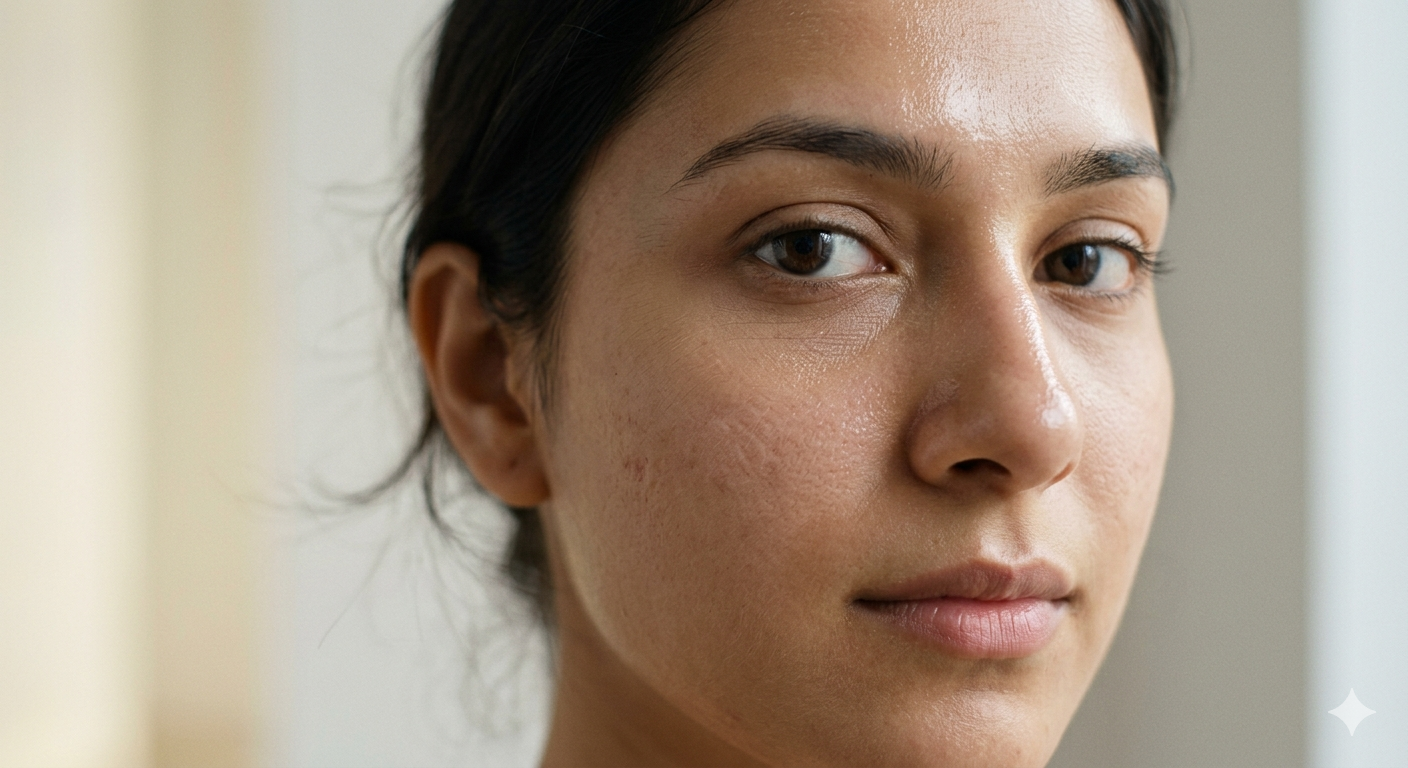
Your skin looks oily.
There is shine on the surface. Sometimes even breakouts.
But at the same time, it feels tight.
Sometimes uncomfortable after washing. Sometimes dull by the end of the day.
So you avoid moisturizers or switch to lighter products.
But nothing really improves.
This is where things get confusing.
Because your skin is not just oily.
It is dehydrated.
How Skin Can Be Oily and Dehydrated at the Same Time
Oil and hydration are not the same.
Oil sits on the surface of your skin.
Hydration refers to water inside the skin.
When your skin loses water, it becomes dehydrated.
To compensate, it may produce more oil.
This creates a surface that looks oily, but underneath, the skin is still lacking water.
This is why your skin can feel both greasy and tight at the same time.
Why This Is Common in Indian Conditions
In many Indian cities, your skin moves through different environments every day.
Outdoor heat and humidity increase sweat and oil production.
Then you step into air-conditioned spaces, where the air is dry.
This increases water loss from the skin.
So your skin responds by producing more oil, while still losing hydration.
Over time, this creates a cycle:
- more oil on the surface
- less water inside
- increasing imbalance
Why Typical Moisturizers Don’t Work in This Case
If your skin feels oily, you may choose very light or gel-based products.
These can feel comfortable at first.
But many of them focus only on adding water, without helping the skin retain it.
So hydration fades quickly.
On the other hand, heavier products may feel uncomfortable or greasy.
This leads to a common pattern:
- light products don’t last
- heavy products feel too much
The issue is not the category.
It is the formulation balance.
What Your Skin Actually Needs
For oily but dehydrated skin, the goal is not to reduce oil completely.
It is to support hydration without overloading the skin.
This requires a balanced system.
Water needs to be drawn into the skin.
The surface needs to feel comfortable, not heavy.
And water loss needs to be controlled so hydration stays longer.
If any of these are missing, the skin goes back to feeling tight again.
Why Formulation Quality Matters Here
Two moisturizers can both be labeled “lightweight,” but behave very differently.
For example, a product may contain ingredients that attract water into the skin.
But if it does not include enough support to retain that water, hydration disappears quickly—especially in air-conditioned environments.
This is why some products feel hydrating for a short time but do not last.
A well-balanced formulation works differently.
It allows hydration to stay within the skin instead of evaporating quickly.
This is what improves how your skin feels throughout the day, not just immediately after application.
How to Choose the Right Moisturizer in Practice
Instead of focusing only on whether a product is “light” or “oil-free,” observe how your skin behaves after using it.
If your skin becomes oily but still feels tight later, hydration is not being retained.
If a product feels heavy and uncomfortable, the balance is not right for your skin.
If your skin feels stable and comfortable for longer, the formulation is working.
The goal is not to remove oil completely.
It is to bring your skin back to balance.
A More Useful Way to Understand Your Skin
If your skin looks oily but feels uncomfortable, it is giving you useful information.
It is not asking for stronger cleansing.
It is asking for better hydration support.
Once this is understood, product choices become clearer.
Conclusion
Oily skin does not always mean well-hydrated skin.
In many cases, it is the opposite.
Choosing the right moisturizer for oily but dehydrated skin is not about avoiding moisture.
It is about using formulations that help your skin hold hydration without feeling heavy.
When hydration is properly supported, the skin becomes more stable.
Oil production often feels more balanced.
And your skin feels comfortable for longer.
This is how we approach moisturizer formulation at Nature Theory.
Not by choosing between light or heavy, but by building balanced systems that support hydration in real conditions.
Frequently Asked Questions
My skin is oily — so why does it still feel tight and uncomfortable? Because oily and hydrated are two completely different things. Oil is produced by your skin’s sebaceous glands and sits on the surface. Hydration is water inside the skin. Your skin can be producing too much oil on top while being dehydrated underneath at the same time. The tightness you feel is your skin telling you it needs water — not that it needs to be dried out more.
Can oily skin actually be dehydrated — isn’t that a contradiction? It sounds like one, but it’s not. In fact, dehydration is one of the reasons oily skin gets oilier. When your skin loses water, it tries to compensate by producing more oil to protect itself. So the more dehydrated your skin is, the more oil it may produce. The shine on the surface is often your skin’s response to a lack of water, not the cause of it.
Should people with oily skin skip moisturiser altogether? No — and this is one of the most common mistakes. Skipping moisturiser makes dehydration worse, which makes oil production worse. Your skin needs water-based hydration even if it’s already producing oil. The goal is to find a formulation that adds hydration without adding heaviness. Avoiding moisturiser entirely keeps the problem going in circles.
Why does my moisturiser make my skin feel greasy but still dry by afternoon? Two possible reasons. First, the product might be too oil-heavy for your skin — so it sits on top instead of absorbing, creating greasiness. Second, even if it absorbs, if it doesn’t contain ingredients that help retain moisture, the hydration evaporates quickly — especially in dry air-conditioned spaces. The product you need is one that draws water into the skin and keeps it there, without feeling heavy on the surface.
What kind of moisturiser actually works for oily but dehydrated skin? You need a lightweight, water-based formula — typically an oil-in-water emulsion — that contains humectants like hyaluronic acid to draw moisture in, and a small amount of barrier-supporting ingredients to keep that moisture from escaping. Not too much oil, but not zero either. The balance between hydration and retention is what makes the difference — not whether the label says “oil-free” or “gel.”
Why does oily dehydrated skin happen so much in Indian cities? Because of how Indian environments work throughout the day. You’re outdoors in heat and humidity, which pushes your skin to produce sweat and oil. Then you step into an air-conditioned office or home, where the air is very dry and pulls moisture out of your skin rapidly. Your skin is constantly switching between two extremes. Over time, this creates a pattern of excess oil on the surface and low water levels underneath — which is exactly what oily dehydrated skin is.
Is gel moisturiser the best option for oily skin? Not always. Gel moisturisers feel light, which is why they’re popular for oily skin. But many gels add water without helping the skin retain it. In dry indoor air, that moisture evaporates fast. A gel that contains proper humectants and some barrier support will outperform a basic gel that’s just mostly water and a thickener. Look at how your skin feels two to three hours after applying, not just how the product feels going on.
Does over-cleansing make oily dehydrated skin worse? Yes, significantly. Cleansing too often or using harsh face washes strips the skin’s natural barrier. When the barrier is damaged, the skin loses water faster. To cope, it produces more oil. So what looks like an oily skin problem is often a barrier damage problem at the root. Switching to a gentler cleanser used twice a day — not more — is often the first step to breaking the cycle.
Will using a moisturiser make my skin break out more? A well-matched moisturiser for oily skin should not cause breakouts. Breakouts from moisturisers usually happen when the formula is too heavy, too occlusive, or contains ingredients that don’t agree with your skin. A lightweight, balanced formula designed for oily skin actually helps reduce breakouts over time by keeping the skin hydrated and the barrier intact — which means the skin is less reactive and inflamed.
How do I know if my skin is oily, dehydrated, or both? A simple way to check — wash your face with a gentle cleanser and don’t apply anything. Wait 30 to 60 minutes. If your skin feels tight or uncomfortable but also starts to look shiny, you likely have oily dehydrated skin. The shine is oil production restarting, the tightness is the water loss. If your skin feels comfortable and balanced without any product, it’s neither. Most people living in Indian cities who feel this daily shift between greasy and tight fall into the oily dehydrated category.
Latest Posts
Continue learning how skincare works.
We explain ingredients, formulation systems, and climate-based skincare in a structured way.
3 thoughts on “Oily Skin but Still Dehydrated: How to Choose the Right Moisturizer”
Comments are closed.