
Difference Between Humectants, Emollients, and Occlusives
The Problem
You apply a moisturizer. Your skin feels good for a while. Then a few hours later, the dryness comes back.
This is a common experience, and it usually has less to do with your skin type and more to do with how the product is built.
Most moisturizers are described using words like “hydrating” or “nourishing.” These describe how a product feels, but not how it actually works.
To understand why some products work only for a short time while others keep skin comfortable throughout the day, you need to understand the difference between humectants, emollients, and occlusives.
How Skin Actually Holds Moisture
Your skin is designed to hold water in a structured way.
The outer layer contains cells that store moisture, surrounded by lipids that act like a seal. When this structure is balanced, skin feels soft, flexible, and stable.
But water is constantly escaping through transepidermal water loss. This is normal, but when water is lost faster than it is replaced, dryness starts to appear.
This is where moisturizers come in. But they do not all work in the same way.
Understanding the Difference Between Humectants, Emollients, and Occlusives
A moisturizer is not just one thing. It is a combination of functions working together.
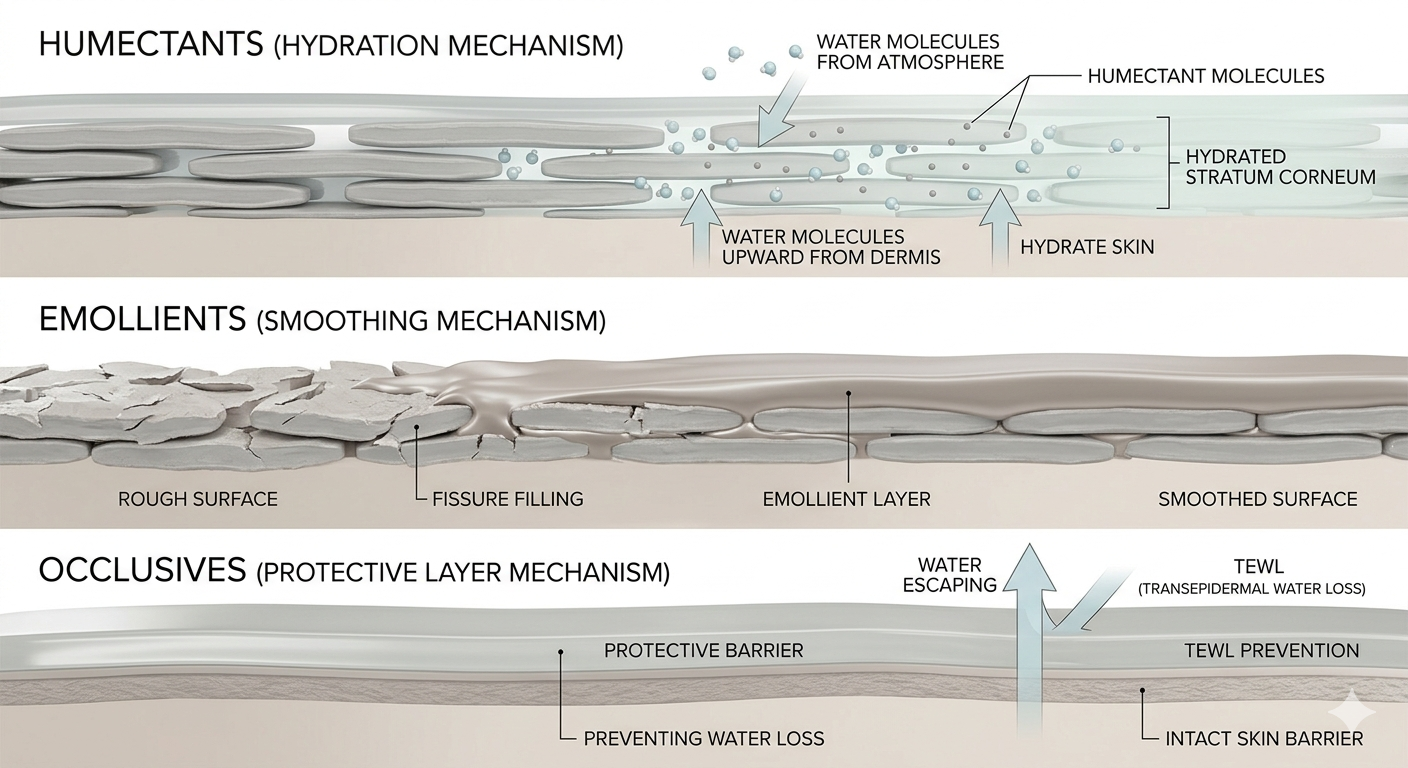
Humectants are responsible for bringing water into the skin. Ingredients like glycerin, sodium PCA, and hyaluronic acid attract water and increase hydration in the outer layer.
Emollients work on the surface. They smooth out the skin by filling small gaps between cells, improving texture and reducing roughness. Squalane and plant oils are common examples.
Occlusives form a light protective layer that slows down water loss. This helps the hydration stay in the skin for longer. Butters and waxes are typically used for this role.
Each of these plays a different part in how the skin stays hydrated. None of them can fully replace the others.
Why Moisturizers Need All Three
When one part of the system is missing, hydration becomes unstable.
A product built mostly on humectants can feel hydrating at first, but the effect fades because water is not being held in place.
A product that relies heavily on occlusives may feel thick or coated, but if there is not enough water being introduced, the skin may still feel dry underneath.
Emollients improve how the skin feels, but on their own they do not significantly change hydration levels.
Long-lasting comfort comes from balance. Water needs to be added, supported, and retained at the same time.
Why Your Environment Changes Everything
Where you spend your day changes how your skin behaves.
In hot and humid conditions, there is moisture in the air, which helps humectants perform better. Heavy layers can start to feel uncomfortable on the skin.
In air-conditioned environments, the air becomes dry. Water escapes more quickly, and the skin starts to feel tight again.
Most people in India move between these two environments throughout the day. You step out into humidity, then into cooled indoor spaces, and back again.
This constant shift puts pressure on the skin’s ability to hold hydration. A moisturizer that works in this context needs to be balanced enough to handle both conditions.
A More Practical Way to Choose a Moisturizer
Instead of focusing on what a product claims, it helps to pay attention to how your skin behaves over time.
If your skin feels hydrated immediately but dry after a few hours, the formula may not be holding water effectively.
If it feels heavy but not truly comfortable, it may not be adding enough hydration.
If it feels smooth but still tight, the system may not be balanced.
The goal is not just how your skin feels right after application, but how it feels several hours later.
That is where formulation shows its quality.
Conclusion
Moisturizing is not a single step. It is an ongoing process of bringing water into the skin, supporting its surface, and slowing down water loss.
The difference between humectants, emollients, and occlusives explains why some products work for a short time while others provide lasting comfort.
When these three elements are balanced, skin does not just feel better immediately. It stays more stable across different environments and throughout the day.
This is also the principle behind how we approach formulation at Nature Theory. Instead of focusing on individual ingredients, the focus is on building systems where hydration, lipid support, and water retention work together in a balanced way.
Frequently Asked Questions
Why does your moisturiser stop working by noon — even though you apply it every morning? Because most moisturisers only do one or two things well, not all three things your skin actually needs. Keeping skin hydrated throughout the day requires three jobs to happen at the same time — pulling water in, smoothing the surface, and slowing water from escaping. If any one of these is missing or weak in your moisturiser’s formula, hydration fades within a few hours. That midday dryness is not your skin failing — it’s your moisturiser running out of road.
What are humectants, emollients, and occlusives — explained in plain English? Think of it as a three-person team, each doing a different job. Humectants are the water magnets — they pull moisture from the environment and from deeper skin layers into the outer surface. Common ones are glycerin and hyaluronic acid. Emollients are the smoothers — they fill in the tiny gaps between skin cells and make the surface feel soft and comfortable. Squalane and plant oils are examples. Occlusives are the sealers — they form a thin protective layer on top that slows water from evaporating off your skin. Butters and waxes do this job. Your skin needs all three working together, not just one of them.
Do you actually need all three — or can one ingredient do everything? No single ingredient does all three jobs well. Some ingredients do overlap slightly — certain oils have both emollient and mild occlusive properties, for example. But there’s no one ingredient that pulls water in, smooths the surface, and seals it all equally well. This is why single-ingredient skincare — like pure glycerin or pure coconut oil — often feels incomplete. Glycerin without an occlusive leaves water nowhere to stay. An oil without a humectant may seal without actually adding moisture. Balance across all three is what makes the difference.
Is glycerin a humectant — and why do so many products use it? Yes, glycerin is one of the most effective and well-researched humectants in skincare. It pulls water into the skin, improves surface hydration quickly, is generally well tolerated by almost all skin types, and is cost-effective. This is why it shows up near the top of so many ingredient lists across all price ranges. A product containing glycerin near the top is actively pulling moisture into your skin — that’s a good sign. The question is whether the formula also has emollients and occlusives to support and retain that hydration.
Why does hyaluronic acid sometimes make skin feel drier — isn’t it supposed to hydrate? This happens when hyaluronic acid is used without an occlusive to seal it in. Hyaluronic acid is a humectant — it draws water. But in dry conditions, like an air-conditioned room, if there’s no moisture in the surrounding air to draw from, it can pull water from deeper skin layers upward and then lose it to the dry air. The result is skin that feels more dehydrated than before. The fix is always to follow a hyaluronic acid product with a moisturiser that contains occlusive ingredients. The humectant draws the water in — the occlusive keeps it there.
What’s the difference between a humectant moisturiser and an occlusive one — which does your skin need? A humectant-heavy moisturiser — usually a lightweight gel or fluid — works best in humid conditions where there’s moisture in the air to draw from. It adds hydration effectively but may not lock it in for long. An occlusive-heavy moisturiser — usually a thick cream or balm — creates a stronger seal and is better for dry or cold environments, or for skin that loses water rapidly. Most people in India need something balanced between the two — enough humectant to add hydration and enough occlusive to keep it from escaping as you move between outdoor humidity and indoor AC air.
Why does a thick, rich cream sometimes leave skin feeling dry underneath? Because it’s heavy on occlusives but light on humectants. A thick cream can create a strong surface seal — you can feel that heaviness and coating. But if the formula doesn’t also contain enough ingredients that actively pull water into the skin, all you’ve done is seal in whatever small amount of moisture was already there. The skin may feel coated on top but still dehydrated underneath. This is why heavy doesn’t automatically mean hydrating — the formula needs to be doing both jobs, not just one.
Do emollients actually do anything important — or are they just for texture? Emollients do something important that often goes unnoticed. They fill in the microscopic gaps between skin cells in the outer layer — those gaps are where the surface feels rough, where fine lines look more pronounced when skin is dry, and where the barrier is least effective. By filling those gaps, emollients improve texture, reduce roughness, and make the overall barrier more intact and functional. They also affect how comfortable a product feels on the skin and how well it spreads. They don’t add hydration directly, but they make the surface environment better for everything else to work in.
Should people with oily skin avoid occlusives completely? Not completely, but the type and amount matters. Very heavy occlusives — like thick balms or petroleum-based products — can feel too occlusive on oily skin and may contribute to clogged pores. But lighter occlusives in a well-balanced formula are important even for oily skin, because oily skin can still be dehydrated. Skipping all occlusive ingredients means water escapes freely, which can actually worsen oiliness as the skin compensates. The goal is to use a formula with light occlusives in the right balance — enough to slow water loss without creating a heavy, pore-clogging layer.
How do you tell if your moisturiser has a good balance of all three — humectants, emollients, and occlusives? Check how your skin feels at two different moments. Right after applying — if it feels smooth, comfortable, and not greasy, the emollients are working. Then check again two to three hours later, especially after time in air conditioning. If your skin still feels comfortable and not tight, the humectants and occlusives are doing their job. If the comfort disappears within an hour, the formula is likely low on occlusives. If the product felt heavy but your skin still felt dry underneath after a few hours, it’s likely heavy on occlusives but low on humectants. Your skin tells you which part of the balance is missing — you just have to check at the right time.
Latest Posts
Continue learning how skincare works.
We explain ingredients, formulation systems, and climate-based skincare in a structured way.
1 thought on “Difference Between Humectants, Emollients, and Occlusives”
Comments are closed.