
The Problem
Many skincare routines have become unnecessarily complex.
Multiple steps, overlapping products, and constant changes often lead to:
- confusion
- inconsistent results
- skin that feels unstable
👉 The issue is not the lack of products.
It is the lack of structure.
A daily skincare routine does not need to be extensive.
It needs to be functionally complete and consistent.
What a Skincare Routine Should Do
A routine is not just a sequence of steps.
It is a system designed to support how the skin functions daily.
At a basic level, skin needs:
- gentle cleansing
- hydration
- barrier support
These three functions form the foundation of an effective routine.
The Science Behind a Simple Routine
The skin is constantly exposed to:
- pollution and environmental particles
- UV exposure
- water loss throughout the day
- air-conditioned environments that increase dryness
At the same time, it tries to maintain:
- hydration levels
- barrier stability
- overall balance
👉 A routine works when it supports these natural processes instead of disrupting them.
The Three Essential Steps
A simple daily skincare routine can be built around three core steps.
1. Gentle Cleansing
Cleansing removes:
- dirt
- sweat
- excess oil
- environmental residue
But over-cleansing or using harsh surfactants can:
- remove essential lipids
- increase transepidermal water loss (TEWL)
- lead to tightness and dryness
👉 The goal is to cleanse without disrupting the skin barrier.
2. Hydration
Hydration helps maintain water content within the skin.
This is supported by humectants such as:
- glycerin
- sodium PCA
- hyaluronic acid
However, hydration must also be retained to be effective.
To understand why hydration often doesn’t last—especially in hot conditions—see Why Skin Gets Dehydrated in Indian Summers (Even When It Feels Oily).
3. Barrier Support
The skin barrier relies on lipids to retain moisture and maintain stability.
Barrier-supporting components help:
- reduce water loss
- improve skin comfort
- protect against environmental stress
These include:
- ceramides
- fatty acids
- cholesterol
- certain botanical oils and extracts that support skin balance
These lipids function like a structural layer that helps the skin hold on to water and remain resilient.
Barrier support is closely linked to how moisturizers work in maintaining hydration and reducing water loss, explained in Why Moisturizers Work: The Science Explained.
What This Looks Like in Practice
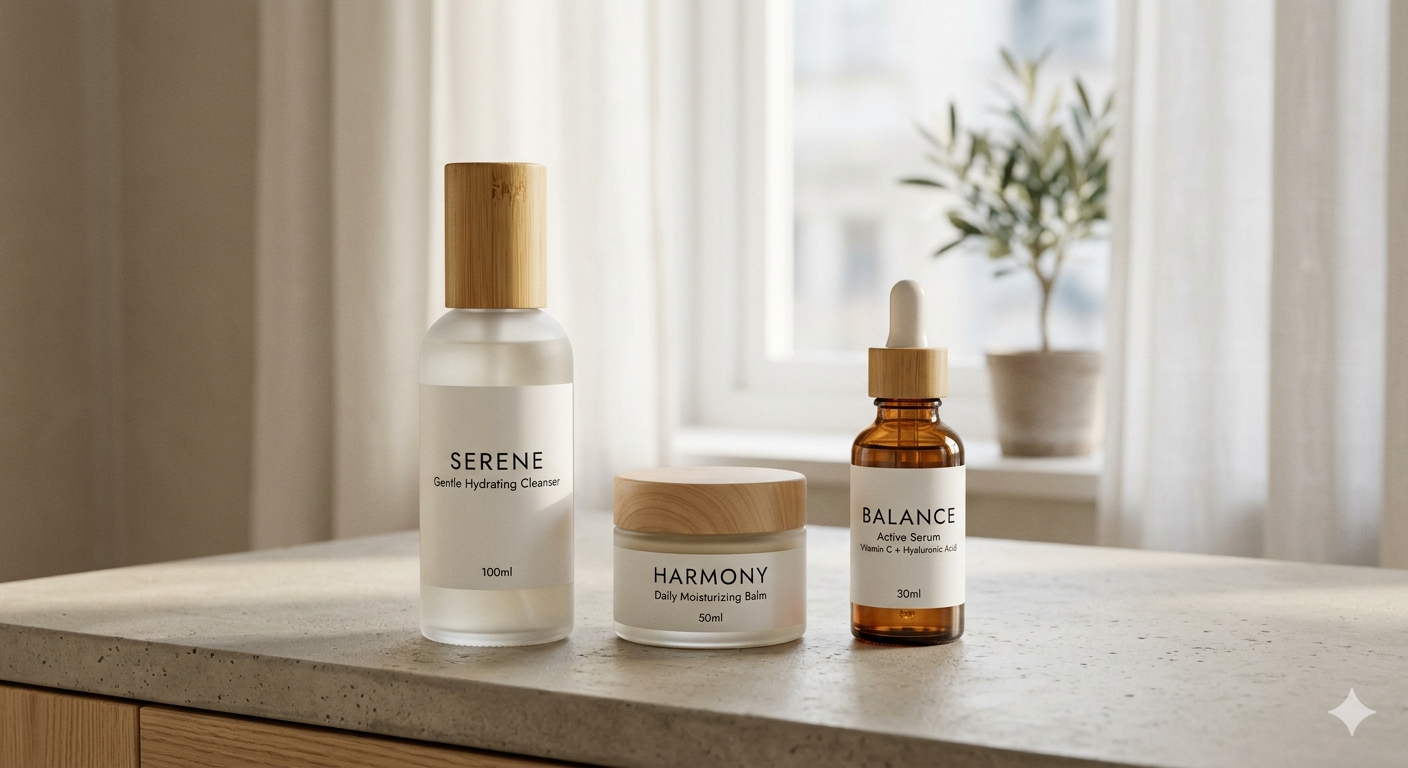
For many people, a simple routine can look like:
- a gentle cleanser
- a hydrating product with humectants
- a barrier-supportive moisturizer
In the morning, this is followed by sunscreen as the final step.
👉 This structure supports the skin without unnecessary complexity.
Why More Steps Are Not Always Better
Adding more products can:
- increase the risk of irritation
- disrupt skin balance
- create conflicting interactions
Example
Layering multiple exfoliating acids, retinoids, and strong actives in the same routine can increase sensitivity and weaken barrier stability.
In contrast:
👉 A simple, well-structured routine often delivers more consistent results.
Climate Matters (Indian Conditions)
In Indian cities, skin is often exposed to:
- heat and UV radiation
- traffic pollution
- humidity changes
- long hours in air-conditioned environments
This constant shift affects hydration and barrier stability.
In hot and humid conditions
Lightweight formulations are generally more comfortable.
In dry or air-conditioned environments
Additional barrier support is needed to prevent water loss.
👉 A routine should adapt to environment—not follow a fixed template.
Morning vs Evening Routine
The core structure remains the same, but the purpose shifts slightly.
Morning
- cleanse lightly (or rinse if appropriate)
- hydrate
- support barrier
- protect with sunscreen as the final step
👉 Focus: maintaining balance and protecting the skin during daily exposure.
Evening
- cleanse more thoroughly
- restore hydration
- support barrier recovery
👉 Focus: repair and stabilization.
A System-Level Approach
A skincare routine is not about steps—it is about function.
When each step supports:
- hydration
- barrier stability
- gentle cleansing
👉 the system becomes consistent and predictable.
At Nature Theory, skincare is approached as a structured system—where each step supports how the skin functions, rather than following trends or complex routines.
Conclusion
A simple daily skincare routine is not minimal—it is structured.
It focuses on:
- cleansing without disruption
- maintaining hydration
- supporting the skin barrier
Healthy skin is not built through more steps, but through consistent, well-structured care that supports these functions every day.
To understand how each step in a routine works at a deeper level, see Why Skincare Formulation Matters More Than Ingredients.
Frequently Asked Questions
How many products do you actually need in a daily skincare routine — is 10 steps really necessary? No. Most people need three products to cover everything their skin requires daily — a cleanser, a moisturiser, and sunscreen in the morning. That’s it. Three products, used consistently, will outperform a 10-step routine used inconsistently or built without logic. The skincare industry benefits from selling more products, not from telling you that less can work better. A routine is not measured by how many steps it has — it’s measured by whether each step has a clear, necessary function and whether it’s being done consistently.
What are the only three things your skin actually needs every day — and why? Gentle cleansing, hydration, and barrier support. Cleansing removes sweat, oil, pollution, and sunscreen that have built up on the skin surface. Hydration replenishes water content in the skin so it stays flexible and comfortable. Barrier support — through a moisturiser with lipid-based ingredients — slows water from evaporating and keeps the skin stable through the day. When these three things are done well, your skin has everything it needs to function. Everything else — serums, toners, essences, eye creams — is optional and should only be added if there’s a specific, clear purpose.
Is a morning skincare routine different from an evening one — or can you do the same thing both times? The core steps are the same but the purpose shifts. In the morning, the focus is protection — cleansing to remove overnight buildup, moisturising to support the barrier, and applying sunscreen as the final step before UV and pollution exposure. In the evening, the focus is recovery — a more thorough cleanse to remove the day’s sunscreen, sweat, and pollution, followed by moisturising to give the skin the best conditions to repair itself overnight. You don’t need completely different products for morning and evening. The same cleanser and moisturiser can work for both — just with sunscreen added in the morning.
Why does a simple 3-step routine sometimes work better than a complex 8-step one? Because skin needs consistency and stability, not constant input. Every product you layer changes something — the pH, the oil balance, the surface structure. When too many products are used together, the interactions between them can cause irritation, sensitivity, or unpredictable results. A simple routine removes all these variables. Your skin responds to the same inputs every day, settles into a stable state, and gradually improves. With a complex routine, it’s also impossible to know which product is helping and which is causing problems. Simplicity gives you control and clarity that complexity never can.
When should you do your skincare routine — morning, night, or both? Both, ideally — but if you had to choose one, the evening routine is more important. During the day, sunscreen and moisturiser protect your skin from UV, pollution, and water loss — that’s the morning routine’s job. At night, your skin does most of its natural repair and recovery work. Cleansing off the day’s buildup and applying moisturiser gives your skin clean conditions to work in and the lipid support it needs to recover effectively. Many people skip the evening routine out of tiredness, but it’s the most impactful skincare time of day.
Is sunscreen part of a basic skincare routine — or is it optional? It’s non-negotiable in any complete daily routine, especially in India. UV exposure in India is high for most of the year — not just in peak summer. UV radiation causes cumulative damage to the skin barrier, accelerates uneven pigmentation, and breaks down the skin’s structural proteins over time. This damage builds invisibly, year after year, and shows up later as texture changes, dark spots, and loss of skin resilience. A cleanser and moisturiser without sunscreen is an incomplete system. SPF is the step that protects everything else you’re doing from being undone by daily sun exposure.
Can a simple daily routine actually fix skin problems — or do you need targeted treatments? For most common skin concerns — dryness, mild sensitivity, oiliness, dullness, minor dehydration — a consistent, well-structured simple routine fixes more than people expect. Many skin problems that seem complex are actually caused by a disrupted barrier from harsh cleansers, inconsistent moisturising, or no sun protection. Correcting these basics often resolves the issues without any targeted treatment at all. Targeted treatments — for acne, hyperpigmentation, or specific concerns — should be layered on top of a solid simple routine as a foundation. Adding treatments to a broken baseline routine rarely works and often makes things worse.
Does the order of products in a skincare routine actually matter — or is it just a preference? Order genuinely matters because it affects how well each product absorbs and functions. The general rule is thinnest to thickest — lighter textures go on first because they need direct contact with the skin to absorb, while heavier textures go on top to seal and support. So cleanser first, then any lightweight hydrating serum if you use one, then moisturiser, then sunscreen in the morning as the last step. Applying sunscreen before moisturiser, for example, reduces its effectiveness because the moisturiser on top can dilute or disrupt the sunscreen film. The correct order makes each product work as intended.
How long should you stick to a simple routine before deciding it’s not working? At minimum four to six weeks before making any judgment. In the first two weeks, your skin is simply adjusting — it may feel different, slightly purge, or just not show clear improvement yet. This is normal and not a signal to switch. By weeks three and four, the skin starts settling into a stable pattern and improvements in hydration, comfort, and balance become more noticeable. Visible changes in texture and skin tone take longer — typically six to twelve weeks of consistent use. The biggest mistake is abandoning a routine after two weeks and assuming it failed, when the skin simply hadn’t had enough time to respond.
How do you adapt a simple daily routine for Indian conditions — heat, humidity, pollution, and AC? The structure stays the same but the product textures shift with the environment. In hot, humid outdoor conditions — like Indian summers — a lightweight gel cleanser and a gel-cream moisturiser work better than heavier creams. In dry air-conditioned environments, you may need slightly more barrier support — a richer moisturiser at night, or a small amount of an extra emollient product. The key is to keep the three-step structure constant and adjust the weight and texture of your products to match what your skin is actually dealing with. A routine that works outdoors in Mumbai monsoon and indoors in Delhi AC is not a different routine — it’s the same structure with climate-adjusted products.
Latest Posts
Continue learning how skincare works.
We explain ingredients, formulation systems, and climate-based skincare in a structured way.
6 thoughts on “How to Build a Simple Daily Skincare Routine”
Comments are closed.