
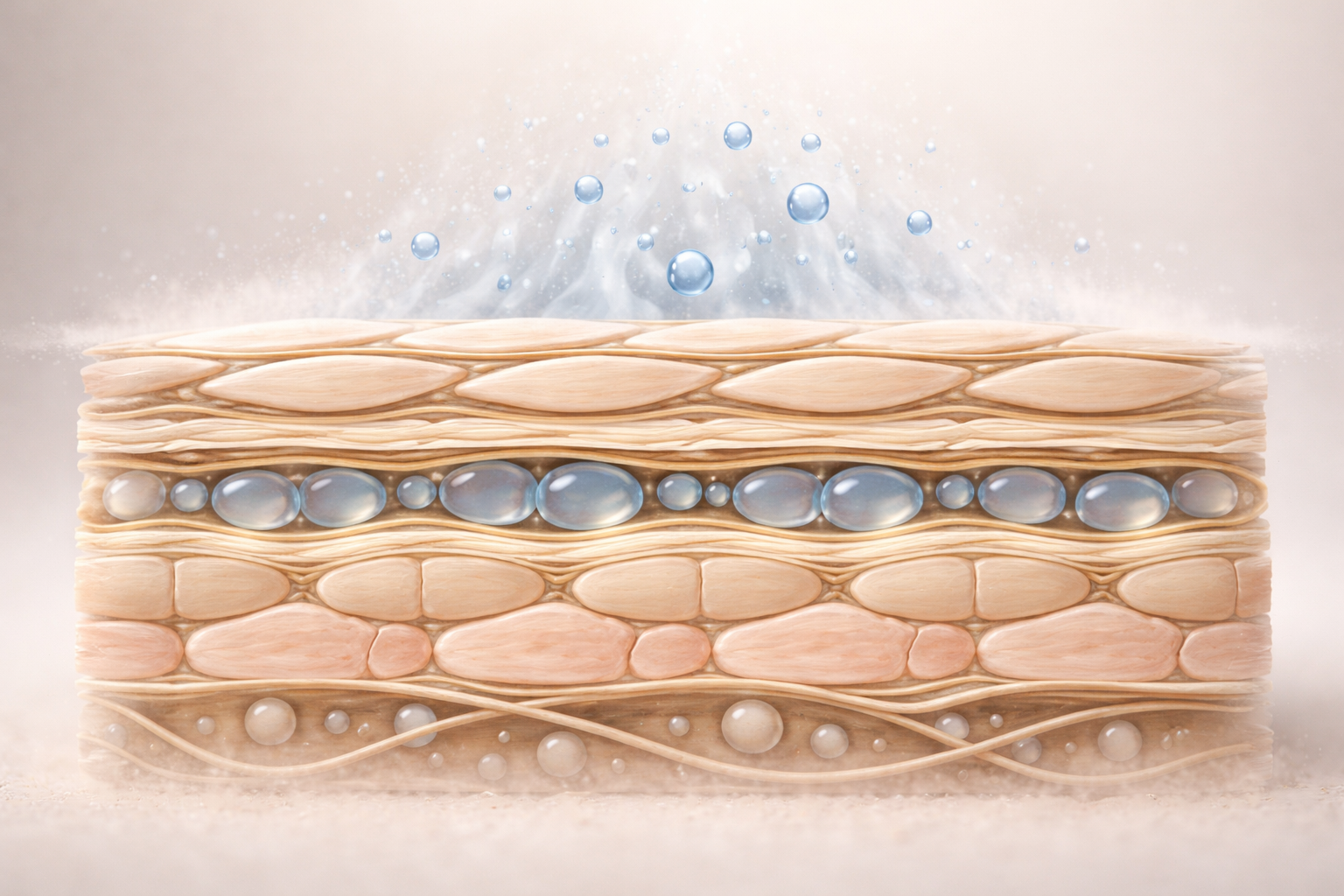
Your skin barrier controls hydration, protection, and comfort.
When it is disrupted, skin becomes dry, reactive, and inconsistent.
The Problem
Dryness after cleansing.
Tightness that does not go away.
Skin reacting unpredictably to products.
Even with regular skincare, skin may feel uncomfortable.
This often leads to:
- trying stronger products
- layering multiple actives
- frequently changing routines
In many cases, the underlying issue is not lack of products.
It is barrier instability.
The Science
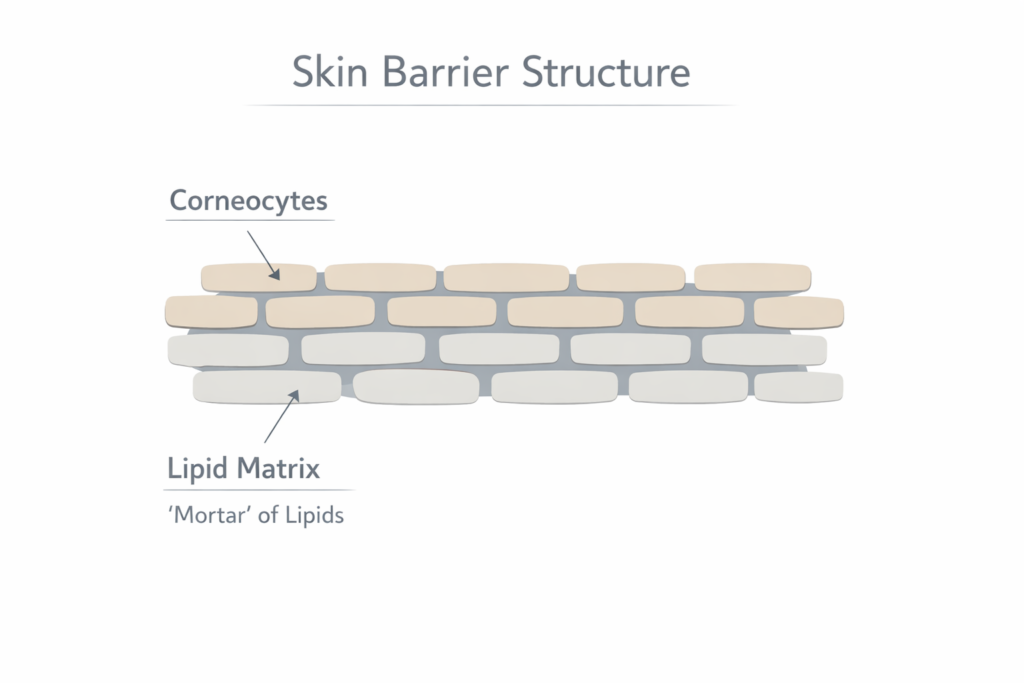
Your skin barrier is the outermost layer of the skin.
It is made of:
- skin cells (corneocytes)
- lipids (fats that hold these cells together)
Think of it as a structured layer.
Cells form the structure.
Lipids form the seal.
This seal controls:
- water retention
- protection from external stress
- overall skin stability
When this structure is disrupted:
- sensitivity increases
- water escapes more easily
- skin becomes dry and tight
What the Skin Barrier Does
Prevents Water Loss
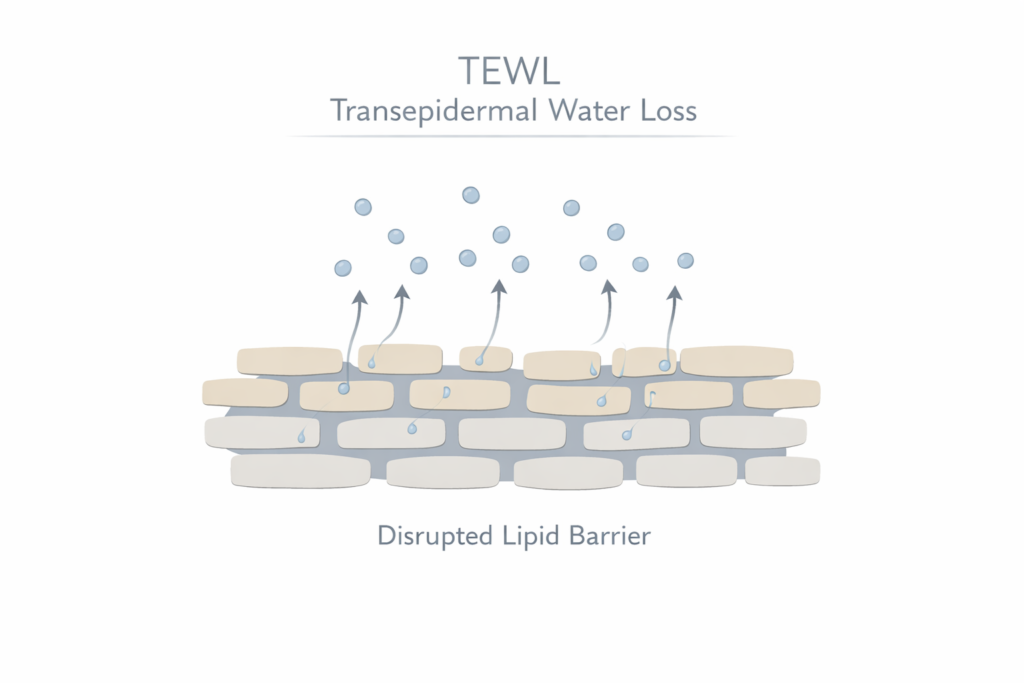
The barrier reduces transepidermal water loss (TEWL). Without it, water escapes from the skin surface faster. This leads to dehydration, tightness, and rough texture.
Protects Against External Stress
The barrier helps defend against pollution, environmental exposure, and irritants. When weakened, skin becomes more reactive.
Maintains Skin Balance
Healthy barrier function supports consistent hydration, smoother texture, and better tolerance to skincare.
What Disrupts the Skin Barrier
Harsh Cleansing
Strong surfactants can remove not only dirt but also essential lipids. This weakens the barrier structure.
Overuse of Actives
Frequent use of exfoliating acids or strong treatments can reduce barrier integrity.
Environmental Stress
In Indian conditions, skin is exposed to heat, humidity variation, pollution, and hard water. These factors increase barrier stress over time.
Low Humidity and Air Conditioning
Indoor environments can accelerate water loss from skin.
What Actually Happens
Barrier disruption increases transepidermal water loss (TEWL).
This means:
Water leaves the skin faster than it is replenished.
Result:
- inconsistent skin behavior
- dehydration
- reduced comfort
Ingredient and System Logic
Effective skincare does not rely on single ingredients.
It uses systems.
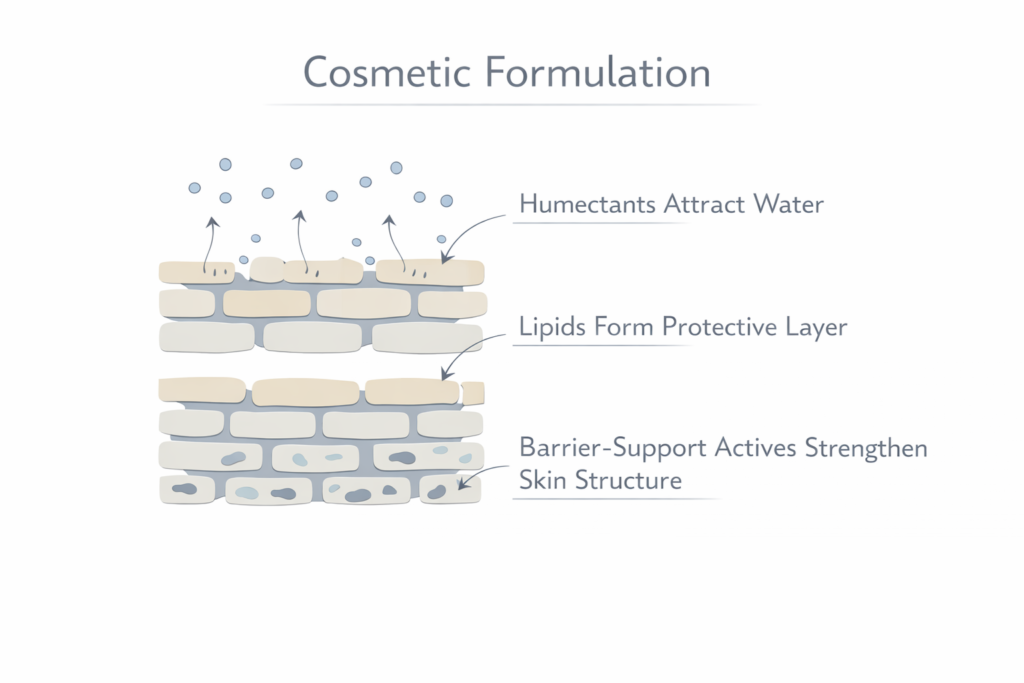
- Humectant Network
Ingredients like:
- Glycerin
- Sodium PCA
Function:
Attract and retain water inside the skin
- Lipid Support System
Ingredients like:
- Squalane
- Plant oils and butters
Function:
Reduce water loss and improve barrier stability
- Barrier-Support Actives
Ingredients like:
- Niacinamide
- Panthenol
Function:
Improve skin resilience and reduce irritation potential
Why this matters in Indian Conditions
Skin is constantly exposed to:
- heat and UV
- humidity fluctuations
- pollution
- air-conditioning dryness
- hard water
These factors can weaken barrier stability over time.
This is why skin may feel:
- dry in AC environments
- sticky but dehydrated in humidity
- reactive in polluted conditions
Barrier-support skincare must be designed for these realities.
What to look for
Choose products that:
- use mild cleansing systems
- include hydration-support ingredients
- contain balanced lipid systems
- are designed for daily use
Avoid relying only on strong actives.
Consistency matters more than intensity.
A Formulation Approach
Formulation-focused skincare builds systems, not shortcuts.
It combines:
- mild surfactants
- structured lipid systems
- hydration networks
to support long-term skin comfort.
This approach prioritizes repeat use and barrier stability.
Conclusion
The skin barrier controls hydration, protection, and comfort.
When disrupted, skin loses water and becomes unstable.
Effective skincare supports the barrier through:
- hydration systems
- lipid balance
- gentle formulation design
Long-term skin health depends on consistency and structure.
Latest Posts
Continue learning how skincare works.
We explain ingredients, formulation systems, and climate-based skincare in a structured way.
19 thoughts on “What Is the Skin Barrier and Why It Matters”
Comments are closed.