
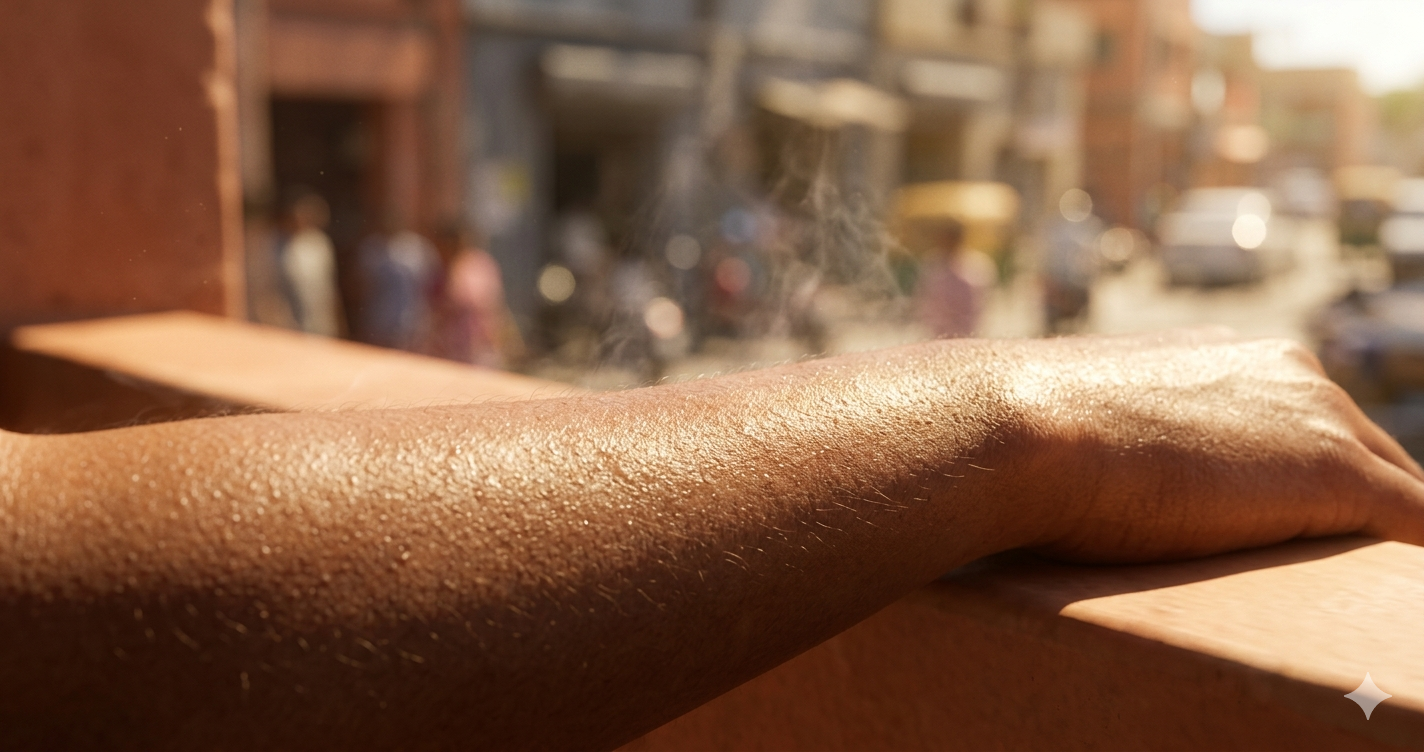
Skincare recommendations rarely account for where you actually live.
Most published skincare advice originates in temperate climates — environments with moderate temperatures, relatively consistent humidity, and water quality that is reasonably predictable. The recommendations built for those conditions are then applied globally, including in India, where the climate is fundamentally different and changes dramatically across seasons, cities, and even times of day.
Understanding how climate affects the skin is not about finding exotic Indian ingredients. It is about understanding the specific stresses that Indian environmental conditions place on the skin barrier, and designing care accordingly.
Heat is the most obvious variable. High ambient temperatures accelerate water evaporation from the skin surface, increasing TEWL and making hydration harder to sustain. They also increase sebum production, which creates a different kind of surface environment — one where certain product textures become uncomfortable or counterproductive. A rich cream designed for cold, dry climates can feel occlusive and congesting in 38°C heat and 80% humidity. The same skin in the same city in January may need that richness.
Humidity adds complexity. High outdoor humidity reduces the rate at which water evaporates from the skin, which can reduce TEWL temporarily. But this benefit disappears immediately upon entering an air-conditioned room. Air conditioning reduces ambient humidity significantly, and the skin shifts from a high-humidity external environment to a low-humidity indoor one multiple times per day. This cycle of hydration shift — humid outdoors, dry indoors, humid again — creates unpredictable barrier stress that persists even when the skin “looks” fine.
Pollution is a growing factor across Indian cities. Particulate matter, nitrogen dioxide, and ozone exposure create oxidative stress on the skin surface. This weakens the skin barrier, increases inflammatory signals, and accelerates pigmentation irregularities. The effect is not always visible in the short term, but it accumulates. Skincare for polluted urban environments is not just about antioxidants — it is about maintaining a barrier strong enough to resist the daily chemical stress that pollution represents.
Hard water is present across much of India, particularly in cities drawing from groundwater sources. Minerals — primarily calcium and magnesium — react with cleansing agents and leave residue on the skin after washing. This residue shifts the skin surface toward a more alkaline pH, which disrupts barrier function. The same product that feels gentle in soft water can leave skin dry and reactive in hard water. This is a formulation variable, not just a water quality problem — cleansing systems can be designed to minimise residue formation and buffer against pH disruption.
This section addresses climate as a formulation variable and explains how Indian environmental conditions affect skin differently than temperate-climate advice assumes.
Articles in this section:
- Why Skin Gets Dehydrated in Indian Summers (Even When It Feels Oily)
- Why Your Skin Still Feels Dehydrated in Humidity: A Lightweight Hydration Routine for Indian Summers
- Pollution and Skin Barrier Stress Explained
- Hard Water and Skin Health: Why Minerals Affect Skin Comfort
- Monsoon Weather and Skin Balance
- Why Climate-Compatible Skincare Matters More Than You Think
- Why Indian Weather Demands Different Day and Night Creams
Continue learning how skincare works.
We explain ingredients, formulation systems, and climate-based skincare in a structured way.