
Most skincare conversations start with products. This one starts with skin.
Before any ingredient can be evaluated, and before any routine can be designed, there is one question worth understanding: how does skin actually function? What is it doing all the time, independent of what you apply to it?
Skin is not a passive surface. It is a living barrier system that regulates water, responds to environmental input, and continuously works to maintain its own balance. This balance is not static — it shifts with temperature, humidity, cleansing, stress, and the products applied to it. Understanding this process changes how you think about skincare entirely.
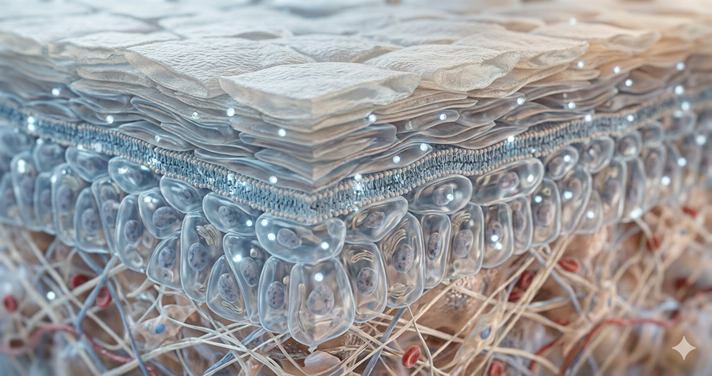
At the centre of skin health is the stratum corneum — the outermost layer of the skin. It is made up of flattened, protein-filled cells arranged in a tightly organised structure, held together by a complex mixture of lipids. These lipids include ceramides, fatty acids, and cholesterol, and they serve a precise mechanical function: they fill the spaces between skin cells, forming a seal that slows the movement of water out of the skin.
This water loss — called transepidermal water loss, or TEWL — is the most important variable in skin comfort. When the skin barrier is intact, TEWL stays within a normal range. Skin feels soft, stable, and comfortable. When the barrier is disrupted, water escapes faster. Skin becomes dry, tight, and more reactive. Everything else in skincare is, in one way or another, an attempt to manage this balance.
The skin barrier can be disrupted by many things: aggressive cleansing, alkaline water, environmental pollution, low humidity, and even over-applying actives. In Indian conditions specifically, the skin is exposed to high heat that accelerates surface water loss, humidity fluctuations that create inconsistent barrier stress, and hard water during washing that leaves mineral residue on the skin surface and shifts its pH.
Understanding these mechanisms does not make skincare more complicated. It makes it more precise. Once you know what the skin barrier is, what damages it, and what supports it, choosing products becomes a question of function rather than marketing.
This section covers the biological foundation of skin health. The articles here explain skin barrier structure, how TEWL works, why moisture is lost during the day, and what all of this means for how you care for your skin.
Articles in this section:
- What Is the Skin Barrier and Why It Matters
- What Is TEWL and How It Affects Skin Hydration
- Why Skin Needs Both Water and Lipids to Stay Healthy
- Why Skin Loses Moisture During the Day
- Damaged Skin Barrier: What It Means, Why It Happens, and How Skin Recovers
- Natural Moisturizing Factor: Why Your Skin Stays Dry
Continue learning how skincare works.
We explain ingredients, formulation systems, and climate-based skincare in a structured way.