
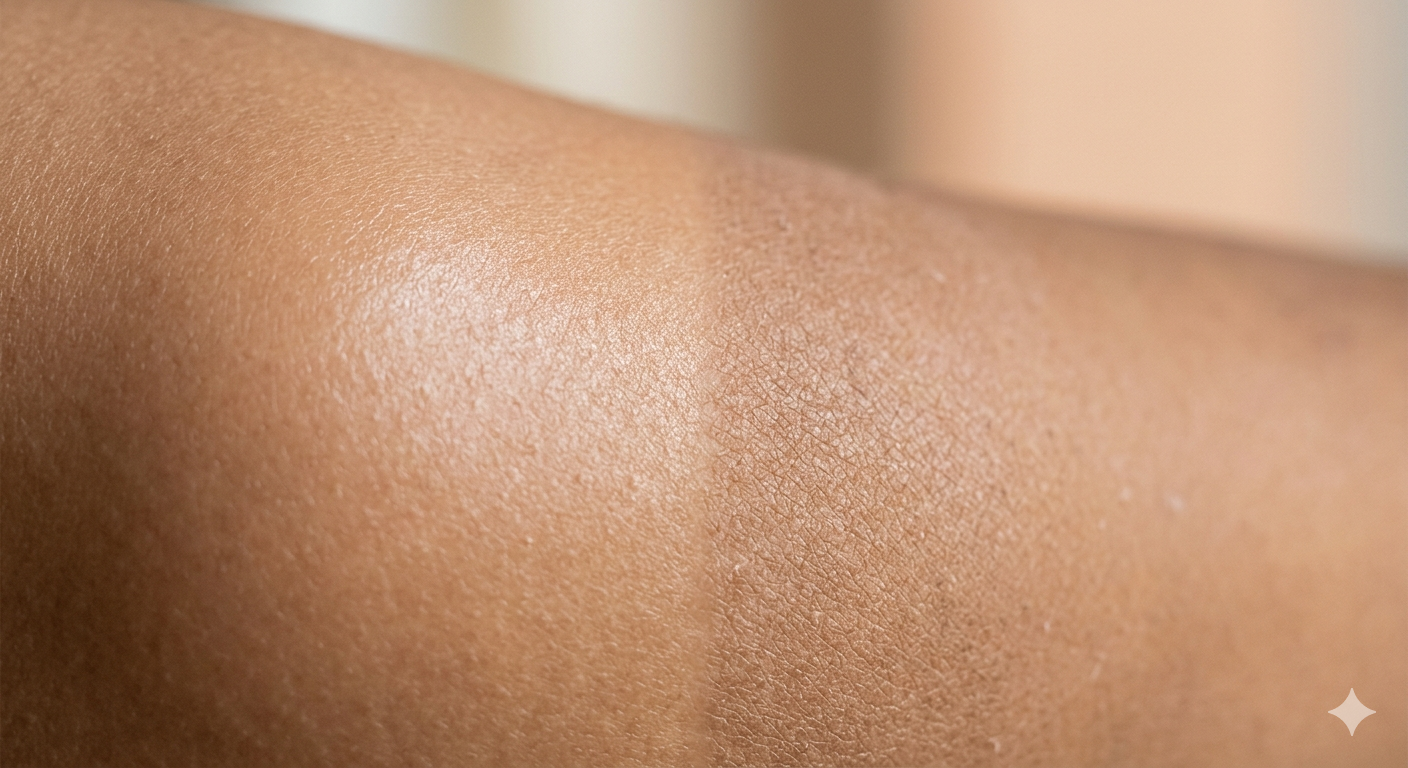
The Problem
You apply a moisturizer in the morning.
Your skin feels fine at first. But by the end of the day, it feels dry again. Sometimes tight. Sometimes dull.
So you try applying more. Or switching products.
But the pattern stays the same.
This is often not dry skin.
It is dehydrated skin.
What Dehydrated Skin Actually Means
Dehydrated skin is about water, not oil.
Your skin is losing water during the day and not holding enough of it.
This is why hydration fades quickly, even if you use a moisturizer.
And this is also why dehydrated skin can sometimes feel oily.
Your skin may produce more oil to compensate, while still lacking water underneath.
So you may see shine on the surface, but still feel tight or uncomfortable.
This is common in hot, humid Indian conditions, where skin can look oily but still be dehydrated.
Why Moisturizers Often Don’t Work for Dehydrated Skin
A moisturizer can feel good when you apply it, but that feeling depends on what the formula is actually doing.
Some products focus mostly on adding water.
Some focus on creating a soft surface feel.
Some are very light and absorb quickly, but do not help the skin hold hydration for long.
This is why two moisturizers can feel similar at first, but behave very differently after a few hours.
The difference is not just ingredients. It is how the formulation is built.
What Actually Helps Hydration Last
For hydration to stay stable, your skin needs three things working together.
Water needs to be added into the skin.
The surface needs to be supported so it feels smooth and comfortable.
And water loss needs to be reduced so hydration does not disappear quickly.
In formulation terms, this usually means a balance of humectants, emollients, and occlusives.
Humectants attract water into the skin.
Emollients support the surface and improve skin comfort.
Occlusives slow down water loss.
When these are balanced properly, hydration lasts longer instead of fading within hours.
How to Choose a Moisturizer for Dehydrated Skin in Practice
Instead of focusing only on labels, look at how a product behaves on your skin.
If hydration disappears quickly, the product may not be holding water effectively.
If it feels light but does not last in air-conditioned spaces, it may need more support.
If it feels heavy but still does not improve comfort, the balance may not be right.
In humid environments, very heavy products can feel uncomfortable, while in dry indoor environments, very light products may not be enough.
This is why a balanced formulation works better than extremes.
Why Environment Makes Dehydration Worse
Your skin does not stay in one condition.
In many Indian cities, you move between heat, humidity, pollution, and air-conditioned spaces in a single day.
Outside, heat increases sweat and surface buildup.
Inside, air-conditioning reduces moisture in the air, making your skin lose water faster.
This constant shift makes it harder for your skin to hold hydration.
If your moisturizer is not built to handle both conditions, dehydration becomes more noticeable.
A More Useful Way to Understand Your Skin
Instead of asking whether a moisturizer is “hydrating,” observe how your skin behaves.
If your skin feels more tight or uncomfortable by evening than in the morning, it is likely losing water faster than it should.
If hydration does not last through indoor environments, your skin may not be retaining moisture effectively.
These patterns are more useful than focusing on ingredient lists.
Conclusion
Dehydrated skin is not solved by using more product.
It is solved by using the right kind of support.
A good moisturizer helps your skin take in water, hold it, and stay stable across different environments.
This is also how we approach formulation at Nature Theory.
Instead of focusing on single ingredients, the focus is on building balanced systems where hydration, surface support, and water retention work together to support the skin throughout the day.
Frequently Asked Questions
You moisturise every day — so why is your skin still dry by evening? Because moisturising and hydration staying are two different things. Applying a moisturiser adds water to your skin, but if the formula isn’t built to hold that water in, it evaporates during the day — especially in air-conditioned spaces. Your skin isn’t failing to absorb the product. The product is failing to keep the hydration locked in long enough. That’s a formulation problem, not a skin problem.
What is dehydrated skin and how is it different from dry skin? Dry skin is a skin type — it means your skin naturally produces less oil. Dehydrated skin is a condition — it means your skin is lacking water, regardless of how much oil it produces. Anyone can have dehydrated skin, including people with oily skin. The key signs of dehydration are tightness that comes and goes during the day, dullness, and hydration that fades within a few hours of moisturising. Dry skin tends to feel consistently rough and flaky all the time.
Why does my skin look oily but still feel tight and uncomfortable? This is one of the most misunderstood skin situations, and it’s very common in India. When your skin loses water, it sometimes compensates by producing more oil. So the surface looks shiny, but underneath, the skin is still dehydrated. The tightness is water loss. The shine is your skin’s defence response. Treating it as just an oiliness problem — and skipping or reducing moisturiser — makes the dehydration worse, which makes the oiliness worse.
What should a good moisturiser for dehydrated skin actually do? Three things, working together. First, it needs humectants — ingredients like hyaluronic acid — that draw water into the skin. Second, it needs emollients that smooth and support the skin surface so it feels comfortable. Third, it needs something that slows down water loss so the hydration doesn’t just evaporate after an hour. A moisturiser that does only one or two of these will feel good briefly but won’t last. All three together is what makes hydration actually stick.
What are humectants, emollients, and occlusives — and do I need all three? In simple terms: humectants pull water in, emollients make the surface feel smooth and comfortable, and occlusives create a layer that slows water from escaping. For dehydrated skin, you need all three working together in the right balance. Most good moisturisers contain all three — the question is whether they’re balanced well enough for your skin type and environment. A formula that’s too occlusive feels heavy and greasy. Too little occlusive and hydration disappears fast.
Why does my moisturiser work fine outdoors but my skin feels dry again the moment I go inside? Air conditioning is the main reason. AC pulls moisture out of the air, which makes your skin lose water faster — this is called increased transepidermal water loss. If your moisturiser doesn’t have enough ingredients to slow that water loss, the dry indoor air draws the hydration right out of your skin. This is especially noticeable in Indian cities where you go from hot, humid outdoors to very dry air-conditioned offices or malls multiple times a day.
Is applying more moisturiser the solution for dehydrated skin? Usually not. Applying a second layer of a product that isn’t working well just gives you more of something that isn’t solving the problem. The better move is to find a product that actually retains hydration — then you won’t need to reapply constantly. Using more of the wrong formula will either feel heavy on the skin or give you maybe an extra hour of comfort before the dehydration returns. More quantity is not the same as better formulation.
Should I use a serum before my moisturiser if my skin is dehydrated? A hydrating serum with humectants — like hyaluronic acid — applied before your moisturiser can help, because it adds a layer of water-attracting ingredients before you seal with the moisturiser. But this only works well if your moisturiser is also properly formulated. A serum under a weak moisturiser is like filling a leaky bucket. The moisturiser is what determines how long the hydration lasts, so that’s the more important product to get right.
Does drinking more water fix dehydrated skin? Drinking enough water is important for overall health, but it doesn’t directly fix skin dehydration the way most people think. Skin dehydration is mainly caused by water escaping from the surface faster than the skin can retain it — not by a lack of water consumption. What fixes skin dehydration is using the right topical products that help the skin hold onto moisture. Staying hydrated internally is a good baseline, but it won’t compensate for a barrier that’s losing water rapidly.
How do I know if a moisturiser is actually right for my dehydrated skin before buying it? The honest answer is that you can’t know for certain from the label alone. But there are useful signals. Look for humectants near the top of the ingredient list — hyaluronic acid, glycerin, or similar. Check that the formula isn’t purely water-based with no barrier support. Then test it properly — apply it in the morning and check how your skin feels three to four hours later, especially after spending time in AC. If it still feels comfortable and not tight, the formula is working. If your skin is already back to feeling dry within two hours, that product isn’t retaining hydration well enough for your conditions.
Latest Posts
Continue learning how skincare works.
We explain ingredients, formulation systems, and climate-based skincare in a structured way.
2 thoughts on “How to Choose a Moisturizer for Dehydrated Skin”
Comments are closed.